
Everything on TikTok hinges on one make-or-break moment: the first three seconds. If you can nail this, you’re already halfway there. It’s a simple but powerful formula: combine an irresistible hook that makes people stop scrolling, tap into a trending sound to tell the algorithm you're relevant, and post when your audience is actually online. Get these three things right, and you’ll build a solid foundation for real growth.
Why Your First Three Seconds Determine Everything
Your quest for more views begins and ends with your hook. On the For You Page, you're competing in a high-speed attention economy. You have a tiny window—less than three seconds—to convince a total stranger that your video is worth their time. This isn't just friendly advice; it's the unwritten law of the platform.
The algorithm is brutally efficient and cares about one thing above all else: viewer retention. If someone swipes away from your video instantly, TikTok gets the message loud and clear: this content isn't engaging. It'll stop pushing it to new people. But if you can hook them, your average watch time skyrockets. That’s the signal the algorithm needs to know your video is a winner and deserves to be seen by more people.
Shifting Your Mindset to Be Hook-First
Here’s where a lot of creators go wrong. They pour their energy into making a fantastic video, then try to slap a hook on at the end. To really win, you need to flip that process on its head.
Your entire creative process should start and end with the hook. Think of it like a movie trailer or a news headline—if it doesn't immediately grab someone, the rest of your amazing content might as well not exist.
This "hook-first" mentality means you're brainstorming opening lines and visuals before you even think about hitting record. Here are a few battle-tested blueprints for crafting hooks that stop scrollers in their tracks:
- Spark a Debate: Lead with a controversial take that challenges a common belief. For a food creator, something like, "You've been cooking pasta all wrong" is an instant attention-grabber. People need to know why.
- Show, Don't Tell (Immediately): Forget the slow buildup. Start your video with the most visually arresting shot. A DIY creator could open with the jaw-dropping "after" of a room makeover before walking through the steps.
- Promise a Clear Payoff: Tell viewers exactly what they’ll get out of watching. A tech influencer could say, "This one iPhone setting is secretly killing your battery." It offers a specific, valuable solution.
- Open a Curiosity Loop: Tease a story but don't give away the ending. For instance, "I tried that viral marketing hack everyone's talking about, and the results were… not what I expected."
The Data Behind Snappy Content
This isn't just theory; it's backed by cold, hard data. While the average TikTok user spends over 58 minutes on the app daily, the average session is just a little over 10 minutes. This means people are dipping in and out for quick hits of entertainment all day long.
This kind of behavior massively rewards content that gets straight to the point. Short, punchy videos under 15 seconds that are front-loaded with a killer hook consistently perform better because they perfectly match these short attention spans.
A powerful hook doesn't just get you a view; it earns you watch time. And on TikTok, watch time is the currency that buys you reach on the For You Page.
Perfecting your opening is more about psychology than just fancy editing. You're creating an itch in the viewer's brain that they have to scratch. By combining the right visuals, on-screen text, and audio in those first few seconds, you're giving yourself the best possible shot at going viral. Using one of the best video editing apps for TikTok will give you the creative control to make those initial moments pop.
How to Ride TikTok Trends and Sounds to the Top
Jumping on trends is probably the fastest way to tell the TikTok algorithm that your content is relevant right now. Think of trending sounds and popular video formats as a shared language. When you use them, you're plugging your video directly into a massive, ongoing conversation, which can get you in front of a way bigger audience than you'd normally reach. It's not about just copying what you see; it's about taking that common language and adding your own unique spin to it.
This works so well because the algorithm is literally designed to push what's already gaining traction. Using a trending sound or a popular challenge is a proven shortcut to blowing up your views. Why? Because the platform is built to prioritize content that's tied to viral audio. In 2024 alone, TikTok's ad revenue shot up 40% to a staggering $23 billion, and a big reason for that is how quickly trends make content go viral.
With an expected 1.562 billion monthly active users in early 2025, any sound that's been used in over a billion videos gets a massive algorithmic boost. It's like a fast-pass to the For You Page. If you want to dig deeper into the numbers, check out these powerful TikTok statistics on tekrevol.com.
It all boils down to a pretty simple flow: a great hook gets people to watch, and high watch time is what makes the algorithm show your video to everyone else.
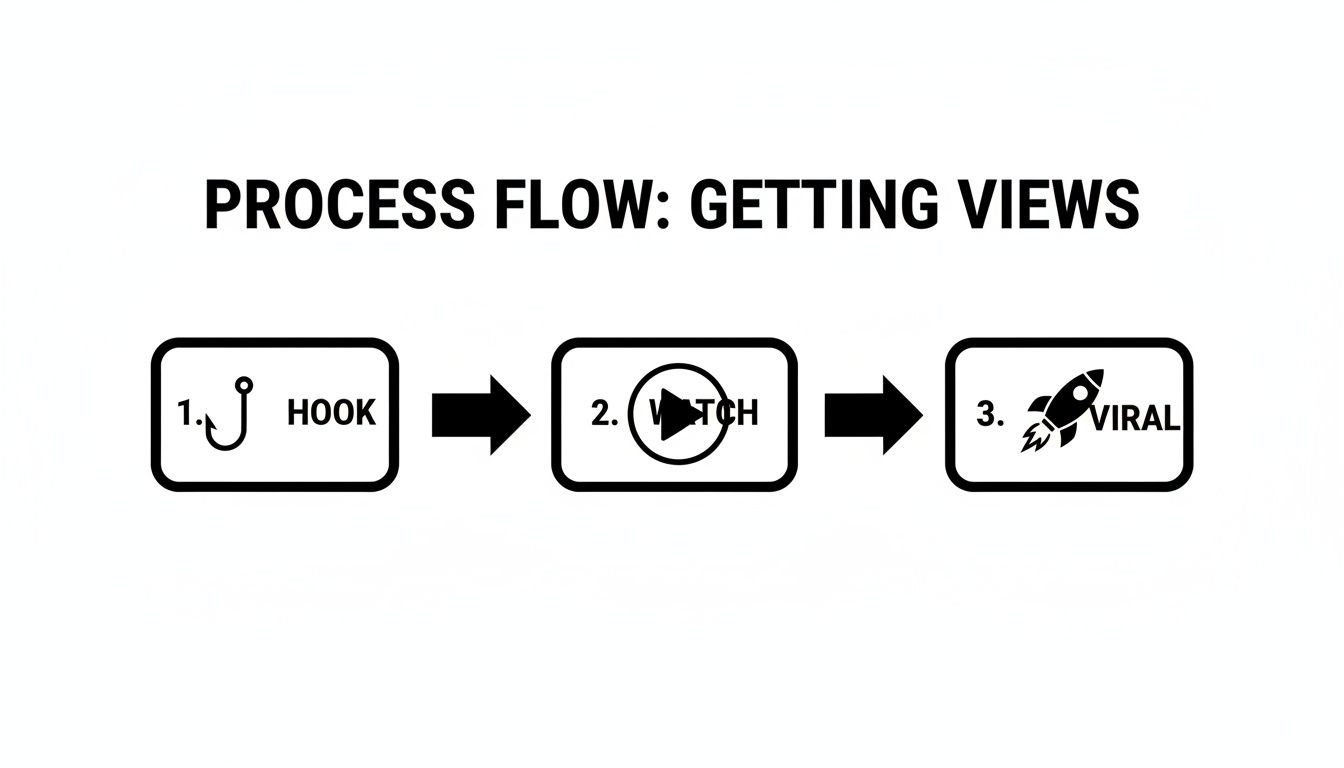
As you can see, a strong hook is the start of everything. Without it, you never get the watch time needed to go viral.
Finding and Using Trending Sounds
Honestly, your For You Page is your best trend-spotting tool. Just scroll. If you hear the same audio snippet three or four times within a few minutes, that’s your sign. It's a trend on the rise.
If you want to be more strategic, head over to the TikTok Creative Center. It gives you a real-time, data-backed list of what's hot. You can filter by region and even spot sounds that are just starting to pop off. The trick is to catch the wave as it's building, not after it has already crashed.
Once you’ve got a sound, don't just copy the last video you saw. Adapt it.
Let's say the trend is a popular sound where people point to text bubbles revealing surprising facts. A personal finance coach could use that exact format but make the text bubbles say things like, "Money myths you probably believe," or "3 side hustles that paid my rent this month."
See what happened there? It uses a familiar, algorithm-friendly format but delivers value specific to a niche audience. People are drawn in by the trend they recognize but stick around for the unique information. For more ideas on this, our guide on how to use TikTok sounds has a ton of creative strategies.
Trending Content Type Breakdown
Not all trends are created equal. Some are quick wins for views, while others are better for building a community. Understanding the difference helps you pick the right tool for the job.
| Trend Type | How to Find It | Best For | Potential View Impact |
|---|---|---|---|
| Trending Audio | Scrolling the FYP, TikTok Creative Center, Spotify Charts | Quick visibility, joining a mass conversation | High to Viral |
| Meme Formats | Know Your Meme, seeing formats repeat on the FYP | Humor, relatability, community inside jokes | Medium to High |
| Niche Challenges | Following top creators in your industry, hashtags | Engaging a specific audience, building authority | Low to Medium |
| Stitch/Duet Bait | Posing a question, sharing a controversial take | Driving engagement and user-generated content | Highly Variable |
Ultimately, a mix of these is your best bet. Use the big audio trends for reach and the niche formats to connect with your core followers.
Adapting Formats and Challenges Authentically
It's not just about sounds. Trending video formats and challenges are basically pre-made templates you can drop your own content into.
Don’t force a trend that just doesn’t fit your brand or personality. The best videos feel natural. Authenticity always, always wins out over a desperate attempt to go viral.
Think about how you can adapt these common formats:
- A Day in the Life: A small business owner could do "A Day in the Life of Packing Your Orders," which feels personal and connects them with customers.
- Things I Wish I Knew: A fitness trainer could make a video on "5 Things I Wish I Knew Before I Started Lifting," offering real, valuable advice.
- Point-of-View (POV): A real estate agent could create a "POV: We're touring your dream home," making the viewer feel like they're right there.
By jumping on these trends, you're essentially borrowing the momentum of a concept that's already proven to work and steering it toward your own goals. You don't have to reinvent the wheel—just put your own custom tires on it and get where you're going faster.
When and How Often to Post for Maximum Reach
You can make the perfect video—killer hook, trending sound, the whole nine yards—but if you post it while your audience is sleeping, you're just shouting into the void. Getting your timing and frequency right isn't about some magic, one-size-fits-all formula. It’s about being strategic and meeting your audience right when they're ready to scroll.
Think about it like this: dropping a new TikTok is like a grand opening. You want to open the doors when the most people are walking by. On TikTok, that's the For You Page, and peak hours are rush hour. The algorithm loves fresh content, so if your video gets a burst of likes, comments, and shares right after you post it, TikTok sees that as a green light to push it out to even more people.
That’s why posting consistently during these peak times is such a powerful lever for getting more views. The algorithm is built to reward creators who keep the platform buzzing with fresh content that grabs immediate attention. It’s no surprise that creators who post regularly in the evenings—when major markets like the US (projected to hit 48.8 million users by 2025) and the massive Asia-Pacific region (with 682 million users in 2023) are winding down their day—often see a real spike in views. People are kicking back, and that’s when their average daily usage of 58 minutes tends to peak. You can dig into more of these valuable TikTok statistics on electroiq.com if you're a data nerd like me.
Stop Guessing: Find Your Personal Primetime
Forget those generic blog posts telling everyone to post at 6 PM on a Tuesday. That might work for some, but your audience has its own unique habits. The good news? Your personal best posting times are hiding in plain sight, right inside your own analytics.
TikTok makes it incredibly easy to find them. Here’s where to look:
- Head to your profile and tap the three-line menu in the top-right.
- Choose “Creator Tools,” then tap “Analytics.”
- Switch over to the “Followers” tab.
- Scroll down until you see the “Follower activity” chart.
This little dashboard is your secret weapon. It shows you the exact days and hours your followers were most active over the past week. Look for the spikes—those are your golden windows. You might find out your crowd is all online between 7 PM and 10 PM on weekdays but shows up earlier in the afternoon on weekends. That's actionable intel.
My Two Cents: Don't just laser-focus on the single busiest hour. I always tell people to identify two or three solid peak windows. This gives you more flexibility and lets you post multiple times without spamming your followers all at once.
The Big Question: How Often Should You Really Post?
The debate over how often to post can get heated, but the truth is simpler than you think: consistency will always beat raw quantity. The algorithm favors accounts that are reliable, the ones that show up day after day.
For most people trying to grow, posting 1-3 times per day is the sweet spot. It’s frequent enough to stay on the algorithm's radar and keep your audience engaged, but it's not so much that you'll burn out in a week.
Here’s a quick breakdown of different posting cadences and who they work best for:
| Posting Frequency | Who It's For | The Main Advantage |
|---|---|---|
| 3-5+ Times a Day | Creators in super competitive niches or those who love to experiment with lots of ideas. | You gather data fast and have more chances to jump on a trend before it peaks. |
| 1-3 Times a Day | The vast majority of creators and brands looking for steady, sustainable growth. | This is the balanced approach. It keeps the algorithm happy without killing your creativity. |
| 3-5 Times a Week | People creating high-effort, polished content that takes a lot more time to produce. | You’re playing the long game, focusing on quality to build a dedicated fanbase. |
At the end of the day, the right frequency is whatever you can stick to without letting your quality slip. One amazing video posted at the perfect time will do more for you than five half-baked ideas thrown up at random. Find a rhythm that works for you and keeps your audience excited for what's next.
Writing Captions and Hashtags That Get You Discovered
You can pour your heart into creating the perfect video, but if you slap on a weak caption and random hashtags, it's like hiding a masterpiece in a closet. No one will ever see it.
Your caption and hashtags are crucial signals to the TikTok algorithm. They're how you tell it what your video is about and, more importantly, who it’s for. Think of it as SEO for TikTok—you’re literally optimizing your video for discovery on the For You Page.
Getting this right is what separates videos that die at a few hundred views from those that take off and reach millions. It’s not about just spamming trending tags; it’s about creating a smart, balanced mix that helps you get found by both broad and niche audiences.
Crafting a Winning Hashtag Strategy
So many creators make the same mistake: they only use massive, generic hashtags like #fyp or #viral. Sure, these might give you a quick, fleeting impression, but you're swimming in an ocean with millions of other videos. Your content gets buried in seconds.
A much better approach is to build a layered hashtag strategy. You don't need a ton of them—in fact, just three to five well-chosen hashtags is the sweet spot.
Here’s the blend I recommend for every video:
- Broad/Trending Tags (1-2): Go ahead and use a big one like
#tiktokor whatever major trend is happening. This tells the algorithm your content is timely and relevant right now. - Niche/Community Tags (1-2): This is where you find your people. Think
#booktok,#cleantok, or#skincare101. These tags attract a super-engaged, targeted audience that actually cares about your topic. - Specific/Descriptive Tags (1-2): Get granular here. These act like specific keywords describing exactly what's happening in your video. Think
#ikeahackor#mealprepideas.
Let’s say you made a video about organizing your kitchen pantry. A killer hashtag combo would be: #fyp (broad), #organizationhacks (niche), and #pantryrestock (specific). This gives you the best of all worlds, maximizing your reach while still zeroing in on the viewers most likely to love your content.
Your hashtags are metadata. You are teaching the algorithm who you are and who your audience is with every single post. Get this right, and TikTok will do the hard work of finding your viewers for you.
Writing Captions That Drive Engagement
Your caption has one main job: get people to interact. Likes are nice, but comments, shares, and saves are the signals that scream to the algorithm, "This video is valuable, push it out to more people!"
So, stop just describing what’s in the video. Your caption should be a conversation starter. Instead of "Here’s my morning routine," try asking a question that’s easy to answer.
Caption Formulas That Actually Work
Need some inspiration? Forget the boring, generic stuff. Here are a few formulas I’ve seen work time and time again to get the comments flowing.
- The Question Prompt: End your caption with a simple question that anyone can answer.
- Example: “Just tried the viral feta pasta. What's one food trend I should try next? 👇”
- The Story Tease: Create a bit of mystery. Open a curiosity loop that makes people want to know more, often leading to rewatches and comments.
- Example: “This was the single best decision I made for my business last year, and it almost didn't happen…”
- The Direct Call-to-Action (CTA): Sometimes, the best approach is to just tell people what to do.
- Example: “If you found this helpful, share it with a friend who needs this!”
When you combine a smart hashtag strategy with a caption that sparks a conversation, you've created a powerful engine for discovery. You’re no longer just crossing your fingers and hoping for views; you're building a reliable system that helps the algorithm find the perfect audience for you, every single time.
Using Duets, Stitches, and Collabs to Grow Faster
If you're only creating content in a vacuum, you're taking the slowest possible route to growth on TikTok. The whole platform is built around conversation, and its most powerful tools—Duets, Stitches, and collaborations—are your ticket to jump right into the middle of it. Think of these features as a direct line to new, highly engaged audiences.
When you interact with another creator’s video, you’re doing more than just making another piece of content. You're strategically tapping into their existing community and putting your face in front of viewers who have already shown they’re interested in your niche. It's a massive shortcut that can seriously boost your visibility.
Duets vs. Stitches: What’s the Difference?
At first glance, Duets and Stitches can seem pretty similar, but they serve completely different purposes. Knowing when to use which is the key to making them work for you. Here’s a simple way to think about it: a Stitch lets you borrow a video's setup, while a Duet lets you join its performance.
A Stitch is where you clip a few seconds from someone else's video and use it as the intro to your own. Their clip plays first, then it cuts to you. This format is perfect for:
- Adding commentary: Did a creator in your niche make a bold claim? Stitch their video to add your own expert take.
- Answering a question: Find a video where someone is asking a question you can answer. This instantly positions you as an authority.
- Building on a joke: See a funny video? Stitch it and add your own punchline or an unexpected twist.
A Duet, on the other hand, plays your video right alongside the original in a split-screen. Both videos play at the same time. This is ideal for:
- Reaction videos: Show your genuine reaction to a wild or hilarious clip in real-time.
- Direct interaction: "Sing along" with a musician, follow a dance tutorial, or try out a workout routine side-by-side.
- Side-by-side comparisons: Use a Duet to showcase a "before and after" or to compare two different products or techniques.
A Stitch is for when you have something to say about a video. A Duet is for when you want to interact with it. Your choice depends entirely on the story you want to tell.
Finding the Right Videos to Engage With
The secret here isn't just to Stitch or Duet random viral videos. You want to find content that's already got some traction but still has room for you to add a fresh perspective. You’re looking for videos in that sweet spot—popular enough to have an active audience but not so saturated that your response gets totally buried.
Start by searching for keywords and hashtags relevant to your niche. A great trick is to filter your search by "Last 7 days" and "Most liked" to find content that's just starting to blow up. Look for videos that pose a question, share a controversial opinion, or highlight a common problem. These are what creators call “engagement bait” for a reason; they are practically begging for a response.
The Power of Direct Collaborations
While Duets and Stitches are fantastic for getting your name out there, a direct collaboration with another creator is like pouring gasoline on the fire. A true collab means partnering with someone to create original content together, with the clear goal of cross-promoting to each other's audiences.
This is arguably one of the most effective tactics for how to get more views on TikTok because it comes with a built-in endorsement. When a creator your target audience already knows and trusts introduces you, a huge chunk of that trust is immediately transferred to you.
Finding the right partner is everything. Look for creators who are at a similar growth stage but maybe serve a slightly different slice of the same audience. For example, if you're a meal prep expert, collaborating with a fitness trainer is a no-brainer. Their audience is interested in health and would love your content, and vice versa.
Don't just slide into their DMs with a cold "Let's collab." Instead, engage with their content genuinely for a week or two first. Then, send a clear, concise message with a specific video idea that offers mutual value. Try something like, "Hey! I have an idea for a 'What I Eat in a Day' video where you share the workout and I share the meal plan. I think both our audiences would love it." An approach like this shows you’ve actually put thought into it and makes it much easier for them to say yes.
Analyzing Your Performance to Create Repeatable Success
The real secret to blowing up on TikTok isn’t just about posting more; it’s about understanding what you’ve already posted. The platform gives you all the data you need to turn a one-hit wonder into a reliable formula. It’s time to get a little nerdy and dig into your own analytics.
Your TikTok Analytics dashboard is a treasure trove of information, but it's incredibly easy to get distracted by vanity metrics like likes and follower counts. While getting a ton of likes feels great, the algorithm really only cares about one thing: how long you keep people on the app. The metrics that measure that are what actually dictate your reach.
Metrics That Actually Move the Needle
To figure out what’s truly working, you have to look past the surface-level numbers. The two most powerful indicators of a great video are hiding in plain sight.
For every single video you post, you should be obsessing over these two stats:
- Average Watch Time: This is the big one. It tells you exactly how long, on average, people are sticking around to watch your video. A high average watch time is a massive green flag for the algorithm, signaling that your content is genuinely engaging.
- Watched Full Video Percentage: This is the ultimate stamp of approval from your audience. A high percentage here means you didn't just grab their attention with a strong hook; you held it all the way to the end.
Both of these are direct measures of audience retention. If you can keep these numbers consistently high, TikTok will reward you with more views. Think of every second a person watches as a vote telling the algorithm, "Show this to more people!"
When you shift your focus from views to watch time, you stop chasing random viral moments and start building a real foundation for consistent growth. The algorithm's job is to keep users on the platform, and it will always favor creators who help it do that.
Finding Your Winning Formula
Once you start paying close attention to these key metrics, you'll start to see patterns. Go look at your last ten or fifteen videos. Line up the top performers next to the ones that flopped and start playing detective.
Ask yourself a few questions about your biggest hits:
What was the hook? Did you open with a bold statement, a weird visual, or a question that made people stop scrolling dead in their tracks? Figure out what kind of opening consistently leads to the best watch time.
What about the sound? Did your best videos use a super popular trending audio, or was it a more niche sound that connected with your specific audience? Start a list of the audio styles that seem to work for you.
Was it the topic or format? Did a quick tutorial video do way better than a longer vlog-style video? Identifying the content pillars that consistently hold attention is your roadmap for what to create next.
This cycle of analyzing and iterating is the engine that drives all real growth on TikTok. By understanding why certain videos took off, you can stop guessing and start building a strategy based on what your audience has already shown you they want to see. For a deeper dive, our guide on understanding your TikTok video analytics breaks down every metric you'll ever need.
Got Questions About Getting More TikTok Views? We’ve Got Answers.
Let's be real: trying to figure out the TikTok algorithm can feel like you're trying to solve a puzzle in the dark. You're not alone if you've got a ton of questions swirling around.
This is where we cut through the noise. We’re tackling some of the most common, and sometimes frustrating, questions creators have. Think of this as your go-to FAQ for breaking past those view count plateaus and getting real clarity on what actually moves the needle.
We'll get into the stuff people are always wondering about. How long does this really take? Does that sneaky delete-and-repost trick actually work, or is it just an old myth? And what’s the deal with using a VPN to tap into a global audience? We're covering it all.
