
Before you even think about hitting record on your first video, the real work of building a personal brand begins. It all starts with getting crystal clear on two things: who you are and who you're creating for. This isn't just a brainstorming session; it's about laying a solid foundation that will guide every single piece of content you make.
Laying the Groundwork for Your Personal Brand
The creators who truly succeed on platforms like TikTok have done this foundational work long before they ever went viral. They've moved past a general interest and hammered out a specific, powerful brand concept. This acts like a compass, ensuring they never get lost.

Without this clarity, you risk making content for everyone, which is a surefire way to connect with no one. The goal here is to establish a sharp direction so that from day one, your content is laser-focused and immediately pulls in the right people.
Find Your Unique Niche
The biggest mistake I see new creators make is trying to be too broad. They pick a massive topic like "fitness" or "cooking," thinking a bigger net will catch more fish. In reality, it just makes you invisible in an ocean of other creators.
The secret is to niche down. Find that unique sweet spot where your passions, your skills, and an audience's genuine need all overlap. It's about getting so specific that you become the go-to person for a very particular problem.
Think about these transformations:
- Broad: Fitness → Niche: Bodyweight fitness for remote workers over 30.
- Broad: Cooking → Niche: 15-minute vegan meal prep for busy parents.
- Broad: Finance → Niche: First-time home buying tips for millennials in high-cost-of-living cities.
A powerful niche isn't just a topic; it's a solution to a specific problem for a specific person. When you nail this, your content stops being random noise and becomes an essential resource.
This kind of specificity instantly frames you as an expert. If someone is desperately searching for quick vegan recipes, they're going to follow the creator who specializes in exactly that, not some generic food blogger.
Profile Your Ideal Follower
Okay, you've got your niche. Now, who exactly are you talking to? It's time to get incredibly specific by creating an "ideal follower" profile. This goes way beyond basic demographics like age and location. You need to understand their world.
Give this person a name. What keeps them up at night? What are their biggest goals and dreams? What frustrates them daily? What other accounts are they already following?
Let’s stick with the "bodyweight fitness for remote workers over 30" niche. We can call our ideal follower Alex.
- Alex's Struggles: He has back pain from sitting all day, feels a little isolated working from home, and can't find the motivation to hit a gym he doesn't have time for anyway.
- Alex's Goals: He just wants more energy during the workday, wants to build some real-world strength without buying a ton of equipment, and needs a routine that actually fits into his packed schedule.
- Alex's Content Habits: He probably follows some productivity gurus, other people in his industry, and a few big fitness accounts that feel totally unrelatable.
Getting to know Alex this well is your secret weapon. For a deeper dive into this process, check out our full guide on how to identify your target audience.
From now on, every video you create is a direct conversation with Alex. You're speaking to his specific pain points and offering solutions that feel like they were made just for him. That's how you turn a casual viewer into a loyal fan.
Developing a Memorable Brand Identity and Voice
Once you’ve figured out your niche and exactly who you’re talking to, it’s time to give your brand a personality. This is where you build the tangible, recognizable elements that make you stand out in an endless sea of content. A solid brand identity isn’t just about having a cool logo; it's the whole package—the messaging, the visuals, and the voice—that works together to build trust and a real connection.
Think about the creators you can't get enough of. You know it’s their video before you even see their username, right? That’s what a consistent identity does. It's the unique blend of colors they use, the specific way they write their captions, or the core idea they hit on again and again. That consistency signals professionalism and makes your brand feel like one people can count on.
Define Your Core Messaging
Before you even think about colors or fonts, you need to get crystal clear on what you stand for. Your core messaging is the absolute bedrock of your brand's voice. It’s a simple framework that nails down three critical questions, making sure every single thing you post reinforces the same powerful ideas.
- Your Mission: Why are you even doing this? This is your "big why," the purpose that pushes you beyond just chasing views.
- Your Value: What specific change or result do you offer your audience? Get specific about the tangible outcome someone gets from following you.
- Your Differentiator: What makes your way of doing things special? This is your secret sauce—the unique perspective, method, or personality that only you bring to the table.
Nailing these down is your best defense against creating generic, forgettable content. It gives you a filter for every video idea. Just ask yourself, "Does this support my mission and deliver my unique value?" That clarity is what elevates a random channel into a purpose-driven brand.
Your brand isn’t what you say it is. It’s what your audience feels it is. A clear messaging framework ensures they feel exactly what you intend, building a genuine connection with every post.
To make this practical, let's map it out. A simple framework can help you move from abstract ideas to concrete statements you can use every day.
Brand Messaging Framework Template
Use this template to define the core components of your personal brand's messaging strategy.
| Messaging Component | Your Brand's Definition | Example (Fitness Coach) |
|---|---|---|
| Mission | Why do you exist? | To help busy professionals integrate fitness into their demanding lives, proving that you don’t need to live in the gym to be healthy. |
| Value Proposition | What result do you deliver? | I provide simple, effective 20-minute workout routines and meal prep hacks that build strength and energy without sacrificing your career. |
| Differentiator | What makes you unique? | My "corporate athlete" method is designed by a former consultant, focusing on efficiency and mindset, not just reps and sets. |
Having this written down is a game-changer. It becomes your North Star for all content creation, from video scripts to one-sentence bios.
Crafting a Cohesive Visual Identity
Let's be real—people are visual. One study found that just using a signature color can boost brand recognition by a whopping 80%. Your visual identity is your brand's uniform. It’s what makes someone stop their scroll because they instantly know it's you. You don't need to be a professional designer, but you do need to be intentional.
Start by making a few key decisions:
- Color Palette: Pick two or three primary colors that capture your brand's vibe. A financial advisor might lean into blues and grays to convey trust, while a creative coach might go with bright yellow and magenta to feel more energetic and inspiring.
- Font Selection: Choose one or two fonts for your text overlays and stick to them. A clean, easy-to-read font like Poppins or Montserrat is always a safe bet for clarity on a small screen.
- Visual Style: What's the overall feel you're going for? Is your content bright and airy? Dark and cinematic? Or maybe it's completely raw and unfiltered. This aesthetic should feel authentic to you and appeal to the audience you want to attract.
When these elements work together, they create a predictable and pleasant experience for your viewers. The moment they see your signature font over that specific color, their brain says, "Oh, I know them." That subconscious familiarity is pure gold.
Writing a Bio That Converts
Your social media bio is your digital handshake. You’ve got maybe three seconds to grab someone's attention and convince them you’re worth their time. A killer bio doesn't just say who you are; it tells your ideal follower what’s in it for them.
Let’s break down the difference.
- Generic Bio: "Fitness enthusiast. Helping you get fit. DM for coaching."
- Compelling Bio: "I help remote workers fix back pain with 15-min workouts. No equipment needed. 👇 Free 7-Day Mobility Guide"
See the difference? The second one is a powerhouse. It instantly calls out the target audience (remote workers), hits on their specific pain point (back pain), offers a clear and easy solution (15-min workouts), and finishes with a powerful call-to-action that provides immediate value (the free guide). It's an entire marketing funnel packed into a couple of short lines.
Creating a Sustainable Content Creation System
Having a killer brand identity is your launchpad, but consistency is the fuel that actually gets your personal brand off the ground on a platform like TikTok. The algorithm loves frequency, but the thought of posting daily is enough to make anyone break out in a cold sweat.
The secret isn’t about grinding harder; it's about building a smarter system. You need to move from the chaotic, "what on earth do I post today?" scramble to a repeatable process. This turns content creation from a daily source of stress into a manageable, powerful habit that prevents burnout while keeping the great ideas flowing.
Establish Your Content Pillars
The real trick to having an endless well of ideas is to define 3-5 core content pillars. Think of these as the main themes you’ll always circle back to. They act as your North Star, ensuring every single video you create is on-brand and hammers home what you want to be known for.
Let's stick with our "bodyweight fitness for remote workers" example. The pillars might look something like this:
- Quick Workouts: 10-15 minute routines designed to be done right in a home office.
- Ergonomic Hacks: Content focused on fixing posture, avoiding back pain, and setting up a healthier workspace.
- Healthy Habits: Simple advice on nutrition, hydration, and mindset shifts for a more productive life.
- Common Mistakes: Pointing out and correcting the frequent form errors people make when working out at home.
Once you have these pillars, brainstorming is no longer a chore. Instead of staring at a blank screen, you just ask, "What quick workout can I demonstrate?" or "What's a huge mistake people make with their desk setup?" This structure gives you instant clarity.
Develop a Practical Daily Workflow
Consistency comes from a realistic workflow, not from random bursts of late-night inspiration. You need a simple, repeatable process for planning, shooting, and editing that actually fits into your life. Trying to do it all at once is a fast track to burnout. The key is to batch your tasks.
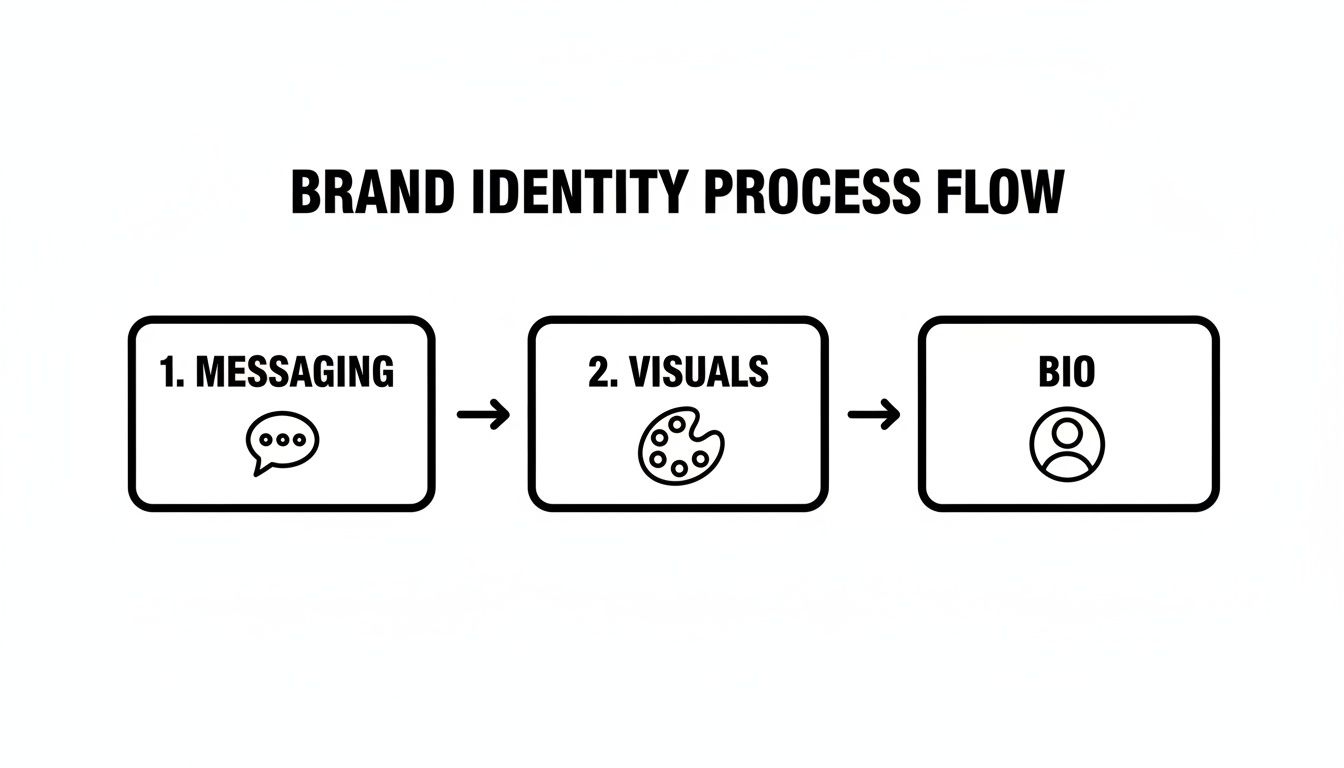
This process is built on the foundation of your brand identity—your messaging and visuals guide what you create.
Here’s a sample workflow you can steal and adapt:
- Morning Idea Spark (5 minutes): Kick off your day by looking at a few video prompts aligned with current trends. Using a tool designed for this can completely eliminate the creative struggle by sending fresh ideas for your niche straight to your inbox.
- Weekly Game Plan (1 hour on Sunday): Map out your videos for the upcoming week. For each day, pick a pillar and jot down a basic concept or script. Planning ahead is a game-changer; you can find more strategies in our guide on how to plan social media content.
- Batch Filming (2 hours, twice a week): Set aside a couple of blocks of time to film multiple videos at once. It’s way more efficient to get your lighting and camera set up once to shoot 3-4 videos than it is to do the whole song and dance every single day.
- Edit & Schedule (1-2 hours, twice a week): Take the footage you shot, edit it, and schedule your posts. This creates a buffer so you’re never scrambling to post something last minute.
This batching method is how the pros stay so consistent without letting content run their lives. It breaks the process down into focused, manageable chunks instead of a relentless daily chore.
Remove Creative Friction with Timely Ideas
The biggest roadblock to consistency? Running out of good ideas. Even with solid content pillars, it’s tough to keep up with what’s timely, which sounds are trending, and what video formats are grabbing attention right now. This is where the right tools give you an undeniable edge.
Think about Khaby Lame. He started on TikTok in 2019 with zero followers, posting simple reaction videos. By early 2026, he was the platform's top creator with over 162.5 million followers. His story is the ultimate proof that consistent, authentic content is how you win.
Posting daily—or close to it—builds incredible momentum. The algorithm rewards that consistency by pushing your videos to the For You Page (FYP), which is where 81% of users find new content they weren't even looking for. This is your golden ticket. Getting a steady stream of fresh, niche-aligned ideas every morning means you can replicate that success.
When you automate idea generation, you take the guesswork out of the equation. Imagine waking up to a list of proven concepts made for your brand, complete with trending audio and hook ideas that are working today. You get to spend your energy on actually making great content, not just thinking about it.
From Views to a Vibrant Community
Putting out great content is a huge part of building a personal brand, but it's really only the first step. The real breakthrough happens when you stop just broadcasting and start actively building a community. This is what separates a one-hit-wonder from a brand with serious staying power. It's how you turn casual viewers into die-hard fans.

This shift doesn't happen by accident. You have to intentionally spark conversations and make your followers feel like they’re part of something. It’s about transforming your comment section from a simple metric into a lively hub where your community thrives.
Use Trends, But Make Them Yours
Jumping on every trending sound might seem like a fast track to visibility, but it can easily backfire if it feels forced or off-brand. The trick isn't to chase every trend, but to thoughtfully adapt them to fit your niche and your message.
Before you jump on a trend, ask yourself a few quick questions:
- Does this fit my content pillars? Can I connect this trend back to one of my core topics in a way that actually helps my audience?
- Does it match my voice? If your brand is all about serious, educational content, a goofy dance challenge might just confuse your followers.
- Can I add my own spin? How can you put your own twist on this to make it distinctly you, rather than just copying everyone else?
A great example? A financial advisor could use a trending "day in the life" sound, but instead of showing their morning coffee, they could quickly illustrate the steps of opening a Roth IRA. They're tapping into the trend's reach while still reinforcing their expertise.
The fight for attention is real. With an estimated 707 million video uploads on TikTok every month—that's 16,000 per minute—you need an edge. Adapting trends to your niche is that edge. We've seen this play out with the explosion of TikTok Shop, which hit $26.2 billion in global GMV in Q1 2025 alone. Creators who authentically ride these waves are the ones converting viewers to buyers. You can dig deeper into these TikTok trends and statistics on TheFrankAgency.com.
Write Captions That Start a Conversation
Your video might be the star of the show, but your caption is your opening line. Too many creators just throw a few hashtags in there or repeat what's in the video. A great caption does so much more.
It should be written to get a response. Think of it less like a description and more like a prompt.
Your goal is to make commenting feel like the natural next step after watching your video. Treat every caption as an invitation to engage.
Instead of just stating a fact, frame it as a question. Don't just share a tip; ask your audience for their best advice on the same topic. This simple shift from a statement to a question can make a huge difference in your engagement.
Master the Art of the Call-to-Action
A Call-to-Action (CTA) is simply you telling your audience what to do next. "Follow for more" is fine, but the best CTAs are specific and varied. Mixing them up keeps your content feeling fresh and gives people multiple ways to connect.
Think about rotating through these types of CTAs:
- Engagement CTAs: These are all about boosting your immediate metrics like likes, comments, and shares.
- Example: "What's the #1 thing you struggle with when it comes to [your topic]? Let me know below."
- Example: "Double tap if this resonated with you!"
- Community-Building CTAs: These make followers feel like part of an exclusive group.
- Example: "Tag a friend who needs to hear this today."
- Example: "Save this for the next time you're planning your [activity]."
- Conversion CTAs: These move people off the platform and deeper into your world.
- Example: "My free guide breaks this all down. Grab it at the link in my bio."
Using a smart mix of these doesn't just boost your numbers; it builds a stronger, more layered relationship with your audience.
Practice Active Community Management
Your job isn't done when you hit "publish." Not even close. Getting in there and actually responding to comments and DMs is one of the most powerful things you can do for your personal brand.
This isn't just about being polite; it’s a killer growth strategy. When you take the time to reply, you make the original commenter feel seen, you show everyone else that you're an accessible, engaged creator, and you send a powerful signal to the algorithm that your content is sparking real interaction.
Block out time for this every single day. And don't just drop a generic "thanks!" Ask follow-up questions. Offer a little extra insight. Treat every comment as a chance to build a real connection. This is how you turn casual viewers into true fans.
Using Analytics to Refine Your Brand Strategy
Making content is just one piece of the puzzle. The other, more crucial piece? Listening to what your audience and the algorithm are telling you. A powerful personal brand isn't built on guesswork; it's sculpted by data. By getting comfortable with your analytics, you can stop guessing and start making strategic moves that actually grow your brand.
It’s easy to get caught up in vanity metrics like views and likes. A video going viral feels amazing, but those big numbers don't paint the full picture. To build something that lasts, you have to dig deeper into the data that shows how people really engage with you and your content. This is where you'll find the gold.
Key Metrics That Actually Matter
Chasing views is a fast track to creative burnout. Instead, shift your focus to the metrics that signal a real connection with your audience. These are the numbers that tell you if your content is truly hitting home and making people want to stick around.
On a platform like TikTok, you have to look beyond the surface-level stuff. Here’s what you should be tracking:
- Average Watch Time: This is a huge one. It tells you exactly how long you're holding someone's attention. Is your hook working? Is your story compelling enough to keep them watching?
- Audience Retention Chart: This graph is your best friend for diagnosing problems. A big drop in the first three seconds means your hook needs work. If people are leaving halfway through, maybe the middle part dragged on too long.
- Profile Conversion Rate: This shows you the percentage of people who watched a video, clicked on your profile, and then hit that follow button. It's a direct measurement of how effective your content is at turning casual viewers into community members.
- "For You" Page Traffic Source: This percentage shows how much of your traffic is coming from TikTok's discovery engine. If this number is high—think over 80%—it’s a great sign that the algorithm is pushing your content to new people.
Getting a handle on these numbers is non-negotiable. For a full breakdown of where to find this data and how to read it, our guide on how to see TikTok analytics is the perfect place to start.
Your analytics are a direct feedback loop from your audience. They're not just numbers; they're the clearest instructions you'll ever get on what to create next.
Interpreting the Data to Make Smarter Decisions
Knowing what to track is the first step. The real magic happens when you turn those numbers into action. This is where you put on your strategist hat. You're looking for patterns that tell you what to do more of, what to do less of, and what to try next.
Let's say you're that fitness creator focusing on remote workers. You sit down to review your analytics and you spot a few trends:
- Your 15-minute workout videos are pulling an average watch time of over 45 seconds, but your quick nutrition tips are only holding people for 10 seconds.
- One video, "3 Stretches to Fix Desk Posture," led to a massive spike in profile visits and new followers.
- The "talking head" videos where you discuss motivation get a lot of initial views, but the retention chart shows a huge drop-off after just five seconds.
The data is giving you a clear roadmap. It's screaming at you to double down on practical, quick-fix stretching and workout content. It's also hinting that your audience prefers watching you do something rather than just talk, so maybe you should find more active, visual ways to share those mindset tips.
Performing Regular Brand Check-Ups
Your brand is a living thing—it has to evolve. A "brand check-up" is simply a scheduled time to make sure you're still heading in the right direction. Set aside an hour once a month to look at your performance and be honest with yourself.
Ask these questions:
- Which video from the last 30 days got the most shares or saves? What was it about that video?
- What's the main vibe or question I'm seeing in my comments?
- Did any videos completely bomb? What can I learn from what didn't work?
- Does my bio still perfectly capture the value I offer my audience today?
This cycle of creating, measuring, and adjusting is what builds momentum. It ensures you’re always putting your energy where it counts, turning random content creation into a focused, powerful brand-building machine.
Got Questions? Let's Clear a Few Things Up
Diving into building a personal brand always brings up a few common questions. These are the little nagging uncertainties that can pop up right when you're ready to hit the ground running. Let's tackle them head-on so you can move forward with total clarity.
You've got a plan, you know your content pillars, and your workflow is sketched out. But what about those "what ifs" that can kill your momentum before you even start? I've heard them all, and here are the straight-up answers.
How Long Does This Actually Take?
Look, there's no magic number. Anyone promising you'll be famous in 30 days is selling you a fantasy. How quickly you build your brand really comes down to your niche, how good your content is, and—this is the big one—your consistency.
That said, I've seen countless creators who commit to posting solid, valuable content every day start seeing real traction in about three to six months. It's not about one viral video; it's about the steady drumbeat of showing up. The algorithm loves activity, so one great video a day is infinitely better than dropping seven all at once on a Sunday.
Think of your first few months as a live experiment. Your job is to test ideas, see what your analytics are telling you, and sharpen your unique voice. Focus on giving value every single day instead of chasing that one-in-a-million viral hit.
Can I Do This Without Showing My Face?
Yes, one hundred percent. A "faceless" brand can be incredibly powerful. In some ways, it's even stronger because it forces you to get creative and lean into other powerful brand assets. The trick is making something else your signature.
You can build a huge, loyal community around things like:
- A distinctive voiceover: Your tone, cadence, and way of speaking become your identity.
- A unique editing style: Maybe it’s your specific cuts, color grading, or text animations that people recognize instantly.
- Cinematic B-roll: High-quality, aesthetic footage that tells the story for you.
- Animated explainers: Using sharp graphics to teach complex topics simply.
Whatever you choose, the key is to be radically consistent with it. Your brand becomes about the specific aesthetic and value you deliver, not what you look like. This works especially well for niches like cooking, home organization, tutorials, or motivation, where the focus is on the action itself.
What if I'm Interested in Too Many Things?
This is not a problem—it's your superpower. Most interesting people have multiple passions. The answer isn't to force yourself into a single box. Instead, you find the unique intersection where two or three of your interests overlap to serve a very specific group of people. This is a strategy I call "niche stacking."
Let's say you can't choose between "travel," "personal finance," and "hiking." Don't. Combine them. Your new, hyper-specific niche is now "budget travel for solo female hikers."
See what happens? You instantly stand out from the thousands of generic travel bloggers and finance gurus. By weaving your interests together, you create a brand-new category where you're the only expert. Take a minute and brainstorm how your top passions could solve a very specific problem for a very specific person.
Ready to stop guessing and start creating content that actually connects? Viral.new sends fresh, niche-specific TikTok ideas straight to your inbox every morning. You can get started for free and say goodbye to creative block for good.
