

If you're creating content without a clear plan, you're essentially just posting into the void. It’s a common mistake, but it's what separates creators who get crickets from those who build thriving communities and businesses.
So, where do you start? Before you even think about filming your next TikTok, you need to lay a solid foundation. This means getting crystal clear on two things: what you want to achieve and who you're talking to.
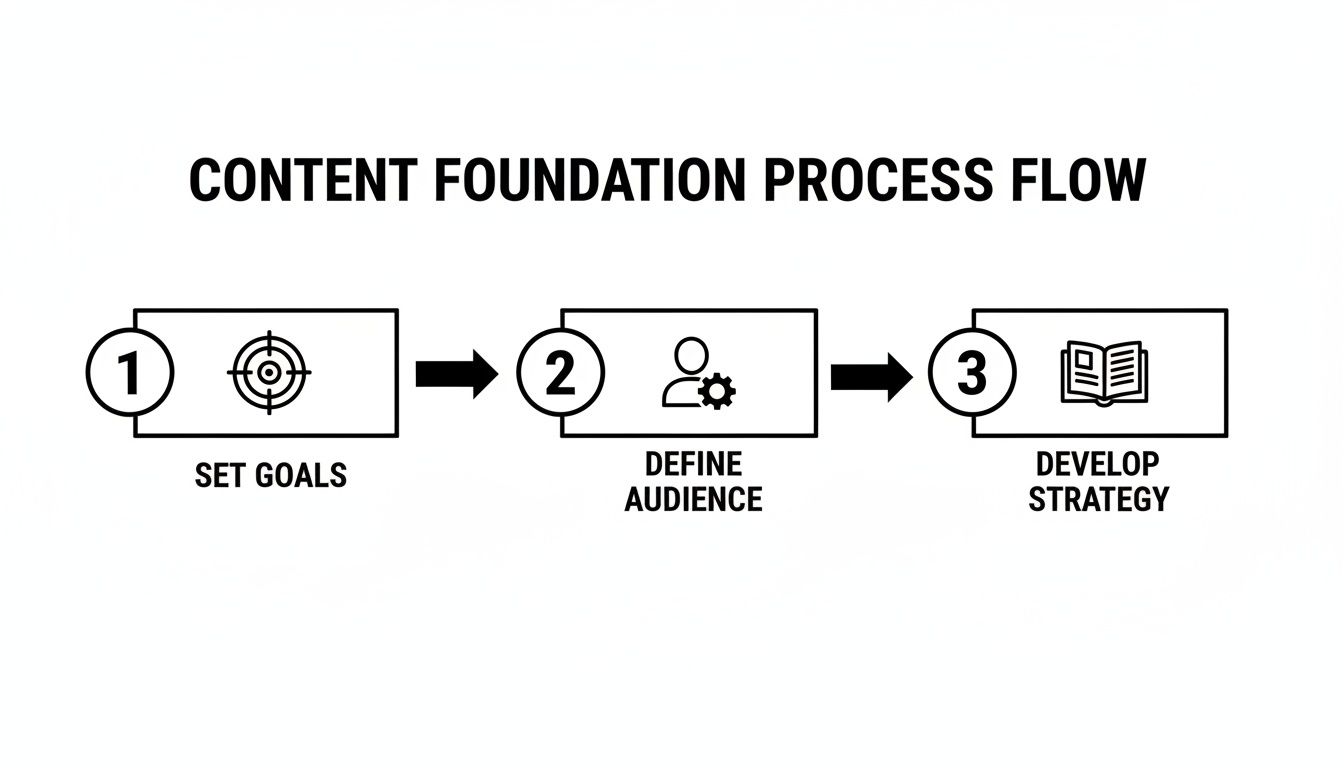
Nailing down your goals and audience first ensures every single piece of content you create has a distinct purpose. It's the bedrock of a strategy that actually works.
Set Goals That Go Beyond Likes
It’s easy to get caught up in vanity metrics. Seeing likes and follower counts go up feels great, but those numbers don't pay the bills. Your social media goals need to be directly tied to real business outcomes.
Are you trying to drive traffic to your website? Generate leads for a new service? Or maybe build a loyal community that keeps coming back for more?
To make your goals actionable, I always recommend the SMART framework. It’s a classic for a reason.
- Specific: Get granular. Instead of "grow my account," try "Increase my TikTok followers by 1,000 in the next 30 days."
- Measurable: How will you track success? This could be website clicks, email sign-ups from your bio link, or the number of saves on your videos.
- Achievable: Be ambitious but realistic. Aiming for a million followers in your first month is probably not going to happen.
- Relevant: Does this goal actually support your bigger business objectives? How does growing your TikTok audience help your next product launch?
- Timely: Give yourself a deadline. A goal without a finish line is just a dream.
Let’s say you’re a fitness coach. A solid SMART goal might sound like this: "Generate 50 qualified leads for my new online coaching program through TikTok content within 60 days by driving traffic to the lead magnet in my bio." See? This goal is specific, measurable, and directly impacts your bottom line.
Your social media goals are your compass. Without them, you're just making noise. With them, you're building a business. Every topic you choose and every call-to-action you use should serve those goals.
The social media space is more crowded than ever. With social media ad spending projected to hit $276.7 billion in 2025 and nearly 5.42 billion global users, a strategic, goal-oriented plan isn't just a nice-to-have—it's your only shot at breaking through the noise.
Truly Understand Who You Are Talking To
Once you know what you want to achieve, you need to get laser-focused on who you're talking to. And I mean really focused. A vague idea of your audience just won't cut it.
You need to go deeper than basic demographics. What are their real pain points? What keeps them up at night? What are their secret aspirations? What makes them stop the endless scroll?
This is where creating a detailed audience persona comes in. It helps you craft content that feels like you're speaking directly to one person.
Think about things like:
- Their struggles: What specific problems are they trying to solve that you can help with?
- Their aspirations: What are their biggest dreams and goals? How can you help them get there?
- Their online habits: What kind of content do they love? Which TikTok trends are they jumping on? Who do they already follow and trust?
- Their language: How do they talk about their problems? Using their slang and phrasing makes your content feel instantly more authentic and relatable.
Our fitness coach, for example, isn't just targeting "people who want to get fit." They're targeting "busy professionals aged 30-45 who struggle to find time for the gym, feel overwhelmed by complicated workout plans, and want a simple, effective way to stay healthy without derailing their career."
That level of detail is a game-changer. It transforms your content from generic advice into a specific, must-have solution for a real person.
To help you nail this down, I've put together a simple framework. Use this table to map out your own goals and define your audience persona. It's a quick exercise that pays off big time.
Goal Setting and Audience Persona Framework
A summary table to help you define your goals and build a clear audience persona for effective content planning.
| Element | Key Questions to Answer | Example (For a Fitness Coach) |
|---|---|---|
| Business Objective | What is the primary business result you want to achieve? | Launch and sell a new online coaching program. |
| SMART Goal | What specific, measurable, achievable, relevant, and time-bound social media goal supports this? | Generate 50 qualified leads in 60 days via TikTok. |
| Core Pain Point | What is the biggest frustration or problem your audience faces? | "I'm too busy with my career to figure out a consistent fitness routine." |
| Desired Outcome | What is their ultimate aspiration or the transformation they seek? | "I want to feel healthy and energetic without it taking over my life." |
| Content Habits | Where do they hang out online? What content do they consume? | Watches quick, under-60-second workout tutorials and "day in the life" videos from other professionals on TikTok. |
| Key Demographics | What are their basic identifying characteristics? | Professionals, age 30-45, high-stress jobs, tech-savvy. |
Filling this out gives you a powerful one-page reference sheet for all your future content ideas. It keeps you grounded in your strategy and ensures you’re always creating for the right person with the right purpose.
Uncover Your Goldmine with a Smart Content Audit
Before you can map out where you're going, you need a crystal-clear picture of where you’ve been. Your existing content is a goldmine of audience insights, but you have to know how to dig for it. A content audit isn't about judging your past work; it's about finding the data-driven clues that will shape your future strategy.
Think of yourself as a detective. You’re not just glancing at vanity metrics like likes. You're digging deeper to uncover the real story behind your performance, figuring out exactly what makes your audience stop scrolling, engage, and ultimately, convert.

Analyze Your Own Content Performance
First things first, let's look at your own data. For TikTok creators, this means going straight to your Analytics tab and looking far beyond the simple view count. Your mission is to spot the patterns and themes hidden in your top-performing videos.
I find it easiest to track this in a simple spreadsheet. Create columns for the video topic, format (like a tutorial, skit, or talking head), the hook you used, your call-to-action (CTA), and then your key metrics.
As you fill it out, ask yourself these questions:
- What topics earned the most shares and saves? These are huge indicators of high-value content that your audience wants to come back to.
- Which video formats held the highest average watch time? This tells you what style of content is actually keeping people glued to their screens.
- What hooks consistently stopped the scroll? Look for patterns in the first three seconds of your most-viewed videos. Was it a question? A bold statement?
- Which CTAs drove the most profile visits or link clicks? This is how you directly connect your content to your business goals.
Don't just identify what worked. The real magic is in understanding why it worked. Was it the relatable scenario, the surprising statistic, or the trending audio you used? Figuring out the "why" is how you turn a one-hit wonder into a repeatable formula.
Peek at What Your Competitors Are Doing
Auditing your own content only gives you half the picture. The other half comes from seeing what’s working for others in your space. This isn't about copying them. It's about spotting opportunities and identifying content gaps you can swoop in and fill.
Start by picking three to five direct competitors or even just creators who serve a similar audience. If you want a more structured way to do this, our guide on how to perform a TikTok competitor analysis breaks down the whole process.
As you look through their profiles, keep an eye out for:
- Their go-to formats: Are they all-in on educational carousels, behind-the-scenes footage, or user-generated content?
- Audience conversations: What questions are people asking in their comments? These are basically free content ideas being handed to you.
- Untapped topics: What are they not talking about? This is your chance to stand out and become the go-to resource for a specific sub-topic.
Knowing where engagement is happening across the industry is also incredibly valuable. For instance, recent data shows TikTok holding a strong 4.86% engagement rate, right behind Facebook's 5.07%. This just reinforces how powerful the platform is, but you have to know what kind of content actually captures that engagement. You can find more insights like this in Dreamgrow's roundup of 2025 social media marketing statistics.
Once you’ve done this audit, you'll have the hard evidence you need to build the rest of your content plan with total confidence.
Nail Your Core Content Pillars and Hooks
Alright, you've got your goals locked in and a crystal-clear picture of who you're talking to. Now for the fun part: building the creative framework that will actually guide what you post every single day. This is where we stop talking strategy and start brainstorming real ideas.
We'll do this by defining your content pillars and mastering the art of the hook. Think of pillars as your main content "buckets" or subjects, and hooks as the scroll-stopping first three seconds of your videos.
Content pillars are the 3-5 core themes you’ll consistently talk about. They’re the foundation of your entire content plan, making sure every video you post reinforces your brand and actually connects with your target audience. Without them, your feed becomes a random jumble of ideas that confuses potential followers and makes it hard to build a loyal community.
These pillars shouldn't come out of thin air. They should grow directly from the audience persona work you've already done, addressing their biggest frustrations, dreams, and curiosities.
Defining Your Content Pillars
To get started, just look at your audience persona and ask yourself what broad categories of content would genuinely help them.
Let’s go back to our fitness coach who targets busy professionals. Their content pillars could look something like this:
- Quick Workouts: 15-minute routines you can squeeze in at home with little to no equipment. This is a direct solution to their audience's #1 problem: no time.
- Productivity & Wellness Hacks: Tips on meal prepping for the week, managing work stress, and finally getting a good night's sleep. This speaks to their desire for a balanced, healthy life, not just a workout plan.
- Client Success Stories: Real-world results from people just like them. This isn't just bragging; it's social proof that helps viewers see themselves achieving the same success.
- Myth-Busting Fitness Advice: Cutting through the noise and debunking common fitness misconceptions that overwhelm and paralyze beginners. This positions the coach as a trustworthy, no-nonsense expert.
See how each pillar acts as a distinct "bucket" the coach can pull from? This structure is a lifesaver. It stops you from constantly wondering what to post and ensures you're delivering a well-rounded mix of valuable content. If you're drawing a blank, you can find a ton of social media content ideas for small business that you can easily adapt to your niche.
A great content pillar doesn't just entertain; it solves a specific problem for your specific audience. It's the intersection of what you know and what they need to hear.
This completely changes how you approach content creation. Instead of waking up and asking, "What should I post today?" you'll ask, "Which pillar should I create for today?" That second question is so much easier to answer and keeps every single post on-brand and on-purpose.
Crafting Hooks That Stop the Scroll
On platforms like TikTok, you have maybe two or three seconds to grab someone's attention before they swipe away. That's it. This is where the hook comes in.
A hook is the very first line or visual in your video. Its only job is to make someone stop scrolling and commit to watching. You could have the most brilliant video idea in the world, but with a weak hook, it will die a silent death in the feed.
The best hooks play on curiosity, stir up a little controversy, or tap into a deeply shared experience. They create an "open loop" in the viewer's mind—a little itch they have to scratch by watching the rest of your video.
Here are a few proven hook formulas you can steal and adapt:
- Challenge a Common Belief: Start by questioning something everyone in your niche accepts as fact.
- Example: "Everyone tells you to do cardio to lose weight. They're wrong."
- Hit Them with a Surprising Stat: A shocking number is an instant attention-grabber.
- Example: "90% of diets fail. Here's what the other 10% do differently."
- Start with a Relatable "You" Statement: Speak directly to a viewer's pain point so they feel seen.
- Example: "You're not lazy. Your productivity system is just broken."
- Use the "Number + Thing" Formula: This classic listicle style signals that your video will be quick, clear, and valuable.
- Example: "Here are the 3 biggest mistakes I see people making in the gym."
Your hooks are the front door to your content pillars. For every video idea you have, try brainstorming three or four different hooks. Test them out, watch your analytics, and see what really connects with your audience. Getting good at this is non-negotiable if you want to create content that actually gets seen.
Get Your Content Creation Workflow Dialed In
A brilliant strategy is useless if you can't actually execute it. The pressure to post every single day is a one-way ticket to burnout, which is why a solid, sustainable workflow isn't just nice to have—it's essential for long-term growth. It's time to move from that chaotic, "what on earth do I post today?" panic to a structured process that actually works.
The goal here is to build a system that makes consistency feel easy, not like a constant uphill battle. We'll do this by mapping out a content calendar and then getting hyper-efficient with how we create everything.
Map Out Your Month with a Content Calendar
Think of your content calendar as your command center. It's the roadmap that shows you what you're posting and when, turning your content pillars from abstract ideas into a concrete plan. You don't need fancy software; a simple Google Sheet or a Notion board works perfectly.
Start by mapping out the next month. Plug in your video ideas, assigning each one to its main content pillar. This bird's-eye view is incredibly powerful. You can instantly see if you're balancing your educational videos with more entertaining stuff, or if you've forgotten to plan around an important launch or holiday. A calendar ensures you're delivering a well-rounded mix of content that keeps your audience hooked.
Here’s a quick look at how you could structure a week using a simple table format.
Sample Weekly Content Calendar
| Day | Platform | Content Pillar | Format | Hook/CTA Idea |
|---|---|---|---|---|
| Monday | TikTok | Quick Tip | Tutorial Video | "Stop doing X, do this instead..." |
| Tuesday | TikTok | Myth-Busting | Talking Head | "You've been lied to about..." |
| Wednesday | Reels | Behind the Scenes | Day in the Life | "Come with me to..." / "What's in your DMs?" |
| Thursday | TikTok | Deeper Dive | Educational | "3 mistakes everyone makes with..." |
| Friday | TikTok | Q&A Session | Reply to Comment | "Great question! Here's how I..." |
| Saturday | Reels | Personal Story | Storytelling | "How I went from 0 to 10k by..." |
| Sunday | TikTok | Community Poll | Interactive | "Which one are you? A or B? Let me know!" |
Having a plan like this eliminates that daily "what do I post?" anxiety and keeps your feed feeling cohesive and strategic.
Master Your Workflow with Content Batching
Content batching is the single biggest productivity hack for creators. Seriously. Instead of creating, editing, and posting a new video every single day, you dedicate a block of time to knock out a ton of content all at once. It’s like meal prepping for your social media—do the hard work upfront, and the rest of your week (or even month) is a breeze.
The real magic of batching is that it lets you group similar tasks together. This stops you from constantly switching gears—the mental whiplash from scripting to filming to editing—so you can stay in a creative flow state and produce better work, faster.
A typical batching day could be broken down like this:
- Ideation & Scripting (2 hours): Brainstorm and write out all your scripts, hooks, and calls to action for the next two weeks' worth of videos.
- Filming (3 hours): Get your lighting and camera set up just once. Then, film everything back-to-back. Pro tip: bring a few different shirts to change into so the videos look like they were filmed on different days.
- Editing & Prep (3 hours): Now, take all that raw footage and edit it down. Add your captions, find some trending audio to use, and write out all your post descriptions.
After one super-focused day, you could easily have 10-15 videos filmed, edited, and ready to schedule. This frees up the rest of your time to actually engage with your community, which is just as important.
Leave a Little Room for Spontaneity
While batching gives you a solid foundation, you can't be too rigid, especially on a platform like TikTok where trends move at lightning speed. You have to be able to jump on a viral sound or a new format when it pops.
A good rule of thumb is to batch about 80% of your content. Keep the other 20% of your schedule open for those timely, trend-driven videos that can give your account a massive boost.
The reality is, the volume of content needed to stay relevant is huge. Some research suggests brands might need to churn out 48 to 72 posts per week across different platforms to really compete, a pace that’s impossible without an efficient system. You can see more on social trends in Hootsuite's latest report.
Ultimately, a dialed-in workflow isn't just about saving time. It's about building a sustainable system that lets you show up consistently with amazing content, all without burning yourself out. And once you've got a bank of content ready, you can start thinking about smart content repurposing strategies to get even more value from every single video you create.
Measure What Matters and Optimize Your Plan
Getting your content created and scheduled is a massive step, but your plan shouldn't just gather dust. The best creators I know treat their content plan as a living document—one that gets smarter with every piece of data that comes in. This is where we close the loop, turning raw analytics into your sharpest strategic tool.
You don't need to drown in a spreadsheet of every possible metric. The secret is to track what actually matters—the numbers that tie directly back to the goals you set from the very beginning. This feedback loop is how you stop guessing what your audience wants and start knowing.
Focus on Metrics That Align With Your Goals
Let's be real: vanity metrics like likes and follower counts feel great, but they don't pay the bills. To get real value from your analytics, you have to connect them back to your original business objectives. The data you prioritize will shift depending on what you're trying to accomplish.
Here’s a simple way to match your goals to the right metrics, especially on a fast-moving platform like TikTok:
- Goal: Brand Awareness? Then your world revolves around Reach and Views. These two numbers tell you exactly how many unique eyeballs are seeing your content and how far your message is spreading.
- Goal: Building Authority? Zoom in on Average Watch Time and Shares. A high watch time is a clear signal that you're holding people's attention and delivering real value. Shares are even better—it means someone found your content so useful they were willing to vouch for it with their own audience.
- Goal: Driving Sales? Now we're talking about Profile Visits and Link Clicks. These are bottom-of-the-funnel metrics that show how many people are taking that crucial next step from passively watching to actively engaging with your offer.
By zeroing in on the right data points, you get a much clearer picture of what’s actually moving the needle for your brand.
Establish a Simple Review Cadence
You don’t need to be glued to your analytics screen 24/7. In fact, that’s a surefire way to burn out and make knee-jerk decisions. What you need is a consistent, manageable schedule for checking in on your performance and spotting what’s working.
For most creators, a weekly or bi-weekly review is the sweet spot. Set aside 30 minutes to look at your top-performing videos from that period.
But don't just stare at the numbers. Ask yourself why a particular video took off. Was it the hook? The trending audio you used? The topic itself? Jot down these observations in a simple log or spreadsheet. After a few weeks, you'll start to see patterns emerge that will become the foundation of your future content ideas.
Your analytics aren't a report card; they're a roadmap. They show you where your audience's attention is going so you can meet them there with more of what they love. This regular review is the engine that keeps your whole content plan running smoothly.
Use A/B Testing to Refine Your Approach
Once you start seeing those patterns, you can get a little more strategic by running simple A/B tests. All this means is testing one small variable at a time to see which version performs better. No fancy software needed—you can do this right from your profile.
Here are a few easy A/B tests to get you started:
- Test Your Hooks: Create two very similar videos, but change only the first three seconds. Does starting with a provocative question outperform a bold, declarative statement?
- Test Your Calls to Action (CTAs): For one week, end all your videos by saying, "Check the link in my bio for more." The next week, try asking, "Comment with your biggest question below." See which one drives more of the action you're looking for.
- Test Your Formats: Have an educational topic you want to cover? First, post it as a simple talking-head video. A week later, re-create it as a screen-recording tutorial. Which one held people's attention longer (i.e., had a better average watch time)?
This cycle of measuring, reviewing, and testing is what turns a good content plan into a truly great one. It keeps your strategy nimble, responsive, and more effective over time, ensuring you're creating content that not only gets seen but gets real results.
Common Questions About Social Media Content Planning
Jumping into a real content strategy can feel like a big commitment, and it's totally normal to have questions. Even with the best plan on paper, the day-to-day reality of creating content will always throw a few curveballs your way.
Let’s dig into some of the most common hurdles creators face when they start planning their social media content more seriously. We'll cover everything from how often you really need to post to the best tools for the job and how to keep going when life gets crazy.
How Often Should I Be Posting on Social Media?
This is the million-dollar question, isn't it? The honest-to-goodness answer is that it depends, but consistency will always beat frequency.
Showing up with three high-quality videos every single week is infinitely better than posting seven times one week and then vanishing for the next two. You’re training your audience (and the algorithm) to expect content from you.
That said, platforms like TikTok and Instagram Reels tend to reward a higher volume of content. If you're just starting out and trying to get some traction, aiming for one post per day is a fantastic goal. It gives the algorithm more to work with and gives you more chances to see what actually sticks with your audience.
If a post a day sounds like a nightmare, don't sweat it. Start smaller. The goal is to find a rhythm you can actually maintain.
- Just getting started? Aim for 3-5 times per week. This keeps you in the game without leading to instant burnout.
- Found your groove? Posting once a day is the sweet spot for a lot of creators who have their workflow dialed in.
- Running like a machine? Some top creators post 2-3 times per day, but they’re usually masters of repurposing content or rely on super simple, repeatable video formats.
The point isn't just to post for the sake of posting; it's to show up with purpose. Your content calendar and a solid batching workflow are what make a daily schedule feel possible instead of impossible.
What Are the Best Tools for Planning and Scheduling?
You can absolutely get by with a simple notebook or a Google Sheet, but a few dedicated tools can make your life so much easier and save you a ridiculous amount of time. You don't need a huge, complicated software suite to get the job done.
Think about what you actually need. Are you mostly just scheduling posts for yourself, or do you need to collaborate with a team or get approvals from a client?
Here’s a quick rundown of a few popular tools and who they’re really for:
| Tool | Best For | The Lowdown |
|---|---|---|
| Planable | Agencies & Teams | Its visual collaboration and approval workflow is a game-changer. Perfect for teams that need client or boss sign-offs before anything goes live. |
| Later | Solo Creators & Visual Brands | Famous for its visual Instagram planner and dead-simple interface. It’s a great choice if aesthetics and easy scheduling are your top priorities. |
| Buffer | Small Businesses | Offers a clean, no-fuss scheduling experience. Their free plan is amazing for getting started on a few channels without spending a dime. |
| Notion/Google Sheets | DIY Planners | If you want total control and don't want to pay for another subscription, building your own content calendar in these tools is a super powerful option. |
Many of these platforms, like Later and Planable, have free plans or trials that are more than enough to get you started. The "best" tool is simply the one that clicks with your brain and your budget, helping you stay organized without overcomplicating things.
How Can I Stay Consistent When I Get Busy?
Life happens. A crazy week at your day job, an unexpected family trip, or just a good old-fashioned creative block can completely wreck your posting schedule if you aren't ready for it. Since consistency is the engine of social media growth, you need a system that can handle a little chaos.
The secret isn’t more willpower. It’s a better process.
Here are a few real-world strategies to keep the content train moving:
- Get Serious About Content Batching: This is the big one. Set aside one chunk of time—maybe a Sunday afternoon—to create a bunch of content at once. Filming 8-10 TikToks in a single session is way more efficient than scrambling to create a new video from scratch every single day.
- Build an "Emergency" Content Stash: Always have 3-5 simple, evergreen videos filmed, edited, and ready to deploy. This is your safety net for days when you have zero time or creative juice. Think quick tips, myth-busting, or answering a question you get all the time.
- Lean on Simple, Repeatable Formats: Not every video has to be an Oscar-worthy production. Figure out a few "low-lift" video styles you can whip up in minutes. This could be a text-on-screen video using a trending sound or a quick "reply to comment" video.
At the end of the day, a solid plan is your best defense against inconsistency. When you think ahead, batch your work, and have a backup plan, you can keep your content flowing and your audience happy, no matter how hectic life gets.
Feeling the pressure to come up with fresh ideas every single day? Viral.new is your creative shortcut. We send AI-powered, trend-aligned TikTok concepts straight to your inbox every morning. You can stop staring at a blank screen and start making videos that actually get seen.
