
A TikTok competitor analysis is simply the process of systematically looking at what your rivals are doing—what content they're making, how it’s performing, and how their audience is reacting. Think of it as turning their public activity into your private playbook. It’s all about finding strategic advantages by seeing what works, what falls flat, and where you can carve out your own space to win.
This isn't just snooping. It's about making smart, data-backed decisions instead of just throwing content at the wall and hoping something sticks.
Why TikTok Competitor Analysis Is Your Secret Weapon
Let's be real. Trying to grow on TikTok can feel like you're just shouting into a hurricane. You pour hours into a video, and it gets a few dozen views. Meanwhile, your competitor posts a seemingly simple clip, and it explodes. This is exactly where a solid competitor analysis stops being a "nice-to-have" and becomes your most powerful strategic tool.
It’s what separates random acts of content from a repeatable system for growth. It’s your map for turning pure guesswork into a plan that actually works.
Decode the Algorithm and Content Trends
The TikTok algorithm can feel like a total black box, but your competitors are leaving you clues every single day. By digging into their best-performing videos, you can start to reverse-engineer what the algorithm is rewarding right now.
- Spotting Formats: Are quick, 15-second tutorials getting all the love in your niche, while longer 60-second stories are flopping? A quick analysis will show you which structures are actually grabbing attention.
- Identifying Sounds: You'll see which trending sounds aren't just popular in general, but are driving real engagement for brands just like yours. This lets you jump on trends that have proven relevance to your audience.
- Understanding Pacing: When a competitor's video hits 3.2 million views, you can bet its hook and pacing are on point. Breaking those elements down gives you a blueprint for content that keeps people watching past the first three seconds.
By studying what’s already resonating with your rival’s audience—an audience that almost certainly overlaps with yours—you get a massive head start. You’re learning from their wins and their losses, without having to spend your own time and money to do it.
Find and Fill Critical Content Gaps
Your competitors aren't covering everything. I guarantee it. A systematic analysis will shine a spotlight on the topics, questions, and content styles they’re completely ignoring. This is your golden ticket to becoming the go-to source for a part of the audience that nobody else is talking to.
Imagine a beauty brand notices all its competitors are doing the same polished makeup tutorials. The gap? Maybe it's raw, behind-the-scenes footage of product development or brutally honest, unfiltered user reviews. An insight like that, found through simple competitor analysis, can become the cornerstone of an entire content strategy. It helps them build a loyal community that's sick of seeing the same old thing.
When you focus on these gaps, you stop fighting for attention in a crowded field and start building your own. You go from being just another brand on the platform to an essential voice people seek out.
Building Your Competitor Analysis Framework
A solid game plan is everything when it comes to TikTok competitor analysis. Without a structured approach, you'll find yourself drowning in a sea of vanity metrics and random observations that don't actually help you create better content. The goal here is to build a repeatable process that consistently delivers real insights, not just a spreadsheet full of numbers.
This is the difference between mindlessly scrolling and conducting strategic intelligence.
Define Your Core Objectives
Before you even open the TikTok app, you have to know what you’re looking for. Vague goals like "get more followers" are a dead end. Your objectives need to be sharp, measurable, and tied directly to what you want to achieve on the platform.
Think about the difference here:
- Vague: "See what competitors are doing."
- Specific: "Identify the top three content formats driving shares in our niche so we can improve our own content's virality."
Here's another example:
- Vague: "Grow our account."
- Specific: "Increase our average video view duration by 20% by analyzing the hook strategies in top-performing competitor videos."
That level of clarity transforms your analysis from a passive scroll-fest into an active hunt for actionable data. It gives your research purpose.
Identify Your True Competitors
Figuring out who your competitors are on TikTok is more nuanced than you might think. You're not just competing against other businesses in your category; you're fighting for a slice of your audience's attention on the "For You" page. That means your competition is anyone capturing the eyeballs you want.
I've found it helpful to group competitors into three buckets:
- Direct Competitors: These are the obvious ones. They sell a similar product or service to the same people. If you're a vegan snack brand, so are they. Simple.
- Indirect Competitors: These brands solve the same problem for your audience, just with a different solution. For that vegan snack brand, an indirect competitor could be a popular creator who shares healthy, plant-based recipes. They're both competing for the "healthy vegan lifestyle" attention space.
- Aspirational Competitors: These are the brands—often completely outside your niche—that are just killing it on TikTok. You admire their creativity, their community, or their storytelling. Watching them provides incredible inspiration for what's possible.
The competitive landscape is always in flux. In 2025, for instance, TikTok's competitors saw their combined U.S. app install share jump to a whopping 44%. This data, highlighted by SensorTower.com, shows that even dominant players aren't immune to shifts in user attention. It's a powerful reminder to keep an eye on emerging creators and platforms grabbing your audience's time.
Gather Your Essential Tools
With your goals set and competitors mapped out, it's time to tool up. Trying to track everything manually is a recipe for burnout and missed insights. A smart toolkit combines the free resources on the platform with specialized third-party software for deeper analysis.
Start with what TikTok gives you for free:
- TikTok Creative Center: This is an absolute goldmine. I use it constantly to spot trending hashtags, sounds, and even top-performing ads to see what's getting traction right now.
- Native Analytics: While it only shows your own data, your account's analytics are the baseline. Every competitor metric you track should be compared against your own performance.
To get a much fuller picture, you'll want to look at third-party platforms. These tools are designed to track competitor metrics over time, analyze content performance at scale, and uncover audience sentiment in ways you simply can't do by hand.
This whole process boils down to a simple, effective loop: decode what they're doing, spot the patterns, and learn how to apply those lessons to your own strategy.
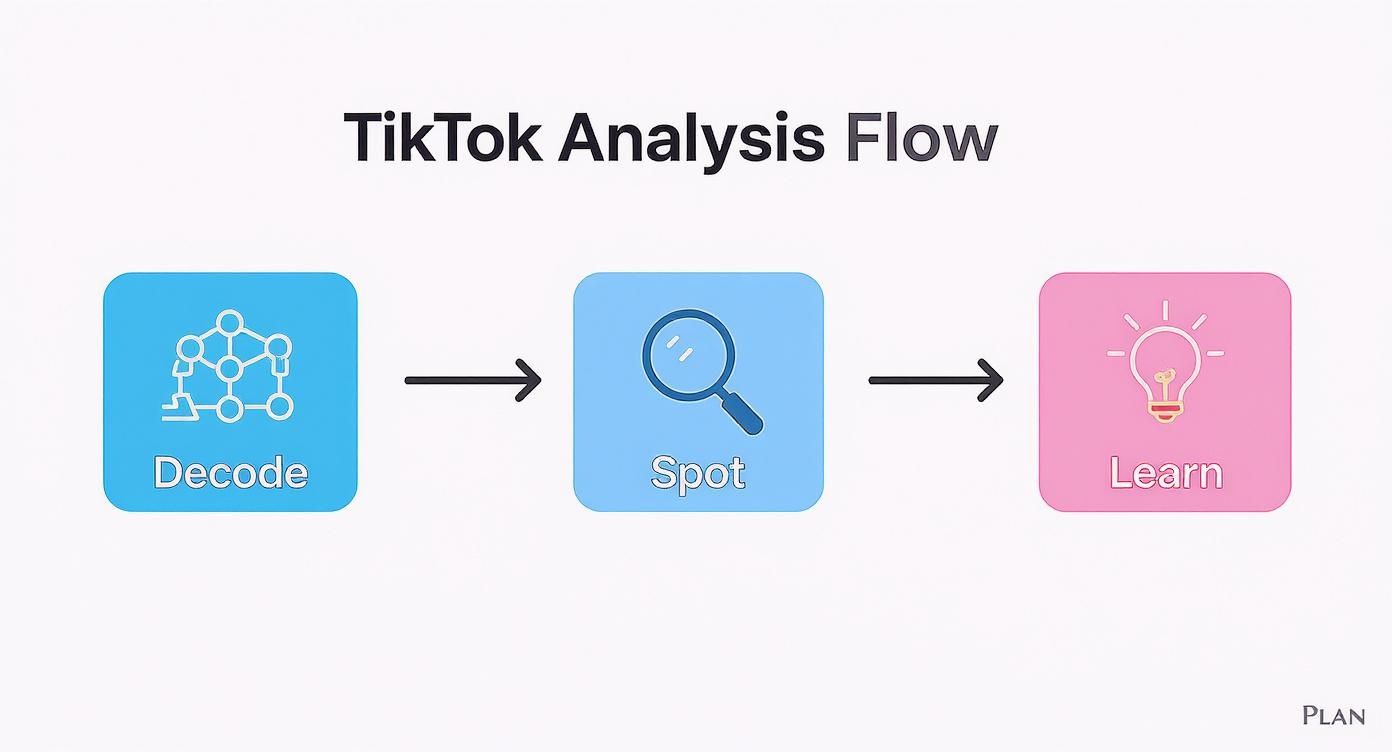
This flow is your foundation. You observe (decode), identify what's working (spot), and then turn those takeaways into action for your own content (learn).
Identifying The Metrics That Actually Matter

When you start digging into a competitor's TikTok, it's incredibly easy to get lost in a sea of numbers. Follower count, in particular, is the ultimate "vanity metric." A huge following might look impressive on the surface, but it tells you nothing about whether their content is actually connecting with people or driving any real business results.
To get a true read on what's working for them, you have to look past the surface and focus on the KPIs that signal genuine audience connection. This means digging into how their audience really behaves.
To do this right, you need a mix of quantitative (the numbers) and qualitative (the context) data. The table below breaks down the essential metrics I always track in an audit.
Essential TikTok Competitor Analysis Metrics
| Metric Category | Specific KPIs to Track | What This Tells You |
|---|---|---|
| Reach & Awareness | Average Views, Median Views, Follower Growth Rate | Reveals their overall visibility on the For You page and how consistently their content is being served to new audiences. |
| Audience Retention | Average Watch Time, Completion Rate, Comments about the video's end | Shows how effective their content is at holding attention. High retention is a key signal to the TikTok algorithm. |
| Engagement & Community | Likes, Comments, Shares, Saves | Measures how actively the audience interacts. Shares and saves are particularly strong indicators of high-value content. |
| Content Strategy | Video Formats (e.g., tutorial, skit), Content Pillars, Trending Sounds, Visual Hooks | Helps you decode their content formula. You can see which themes and creative tactics resonate most with their audience. |
| Audience Sentiment | Tone of Comments, Questions Asked, User-Generated Content (UGC) Mentions | Provides crucial context behind the numbers. It tells you why people are engaging and what they truly think and feel. |
This blend of data points gives you a complete picture, moving you from simply observing what your competitors post to truly understanding their strategy.
Deconstructing Their Content Formats And Pillars
First things first, you need to categorize their content. Instead of just looking at one-off videos, try to spot the recurring content pillars—the core themes they build their entire strategy around. This gives you a bird's-eye view of their whole approach.
What are their main buckets of content? You'll likely see patterns emerge, such as:
- Educational Tutorials: Short, punchy how-to guides that solve a specific audience problem.
- Behind-the-Scenes (BTS): Raw, unpolished glimpses into their company culture or how their products are made.
- User-Generated Content (UGC): Featuring videos from real customers, which is a massive trust-builder.
- Comedy Skits: Using relatable humor to forge a more personal connection with viewers.
Once you’ve identified these pillars, you can start comparing their performance. Is one category consistently blowing the others out of the water with views and shares? That’s a massive clue about what your shared audience really wants to see.
Analyzing The Anatomy Of A Viral Video
Next, it's time to zoom in on their home runs—the specific videos that clearly went viral. Don't just make a note of the view count; you need to dissect the video's structure from the first second to the last. You're searching for the repeatable elements that made it pop.
Pay close attention to these key components:
- The Hook (First 3 Seconds): How did they stop the scroll? Was it a jarring visual, a bold statement typed on the screen, or a provocative question?
- Trending Sounds: Did they hop on a popular audio clip? More importantly, how did they adapt it to their brand? The best accounts make trends their own instead of just copying them.
- Visual Pacing and Editing: Watch the cuts. Are they using rapid-fire transitions to keep the energy high, or is the pacing slower and more cinematic? This has a huge impact on watch time.
A powerful hook is everything. I once analyzed a competitor whose views skyrocketed. The pattern wasn't the topic—it was that every viral video started with on-screen text posing a controversial question before anyone even spoke.
This micro-level analysis helps you understand the tactical choices that drive engagement. It’s not just about what they post, but how they package it for maximum impact on the For You page.
Going Beyond Numbers With Qualitative Data
Quantitative data (views, likes, shares) tells you what happened. But it's the qualitative data that tells you why it happened. This is where you'll find the most valuable insights about audience sentiment.
You have to manually scroll through the comment sections of their most important videos. What's the vibe? Are people asking thoughtful questions, tagging their friends, or leaving passionate reviews (good or bad)? The comments are a direct line into the mind of your target audience.
Look for recurring questions that you could answer better in your own content. Positive comments confirm they're on the right track, while negative feedback reveals pain points you can swoop in and solve. This context is what turns a basic audit into a game-changing strategic analysis.
This deep dive is essential because TikTok users are incredibly active. Globally, daily engagement averages a staggering 58 minutes per user, and the platform’s engagement rate is 4.3 times higher than Instagram Reels. With projected ad revenue hitting $25 billion in 2025, understanding what captures this audience is non-negotiable. You can explore more of these powerful statistics in recent industry reports.
Analyzing Competitor Content to Find Patterns
Okay, you’ve gathered a mountain of data on your competitors. That’s a great first step, but raw numbers alone won't get you very far. The real magic happens when you zoom out and start connecting the dots.
This is where you stop being a data collector and become a pattern detective. You’re looking for the repeatable formulas and hidden opportunities in their content. Think of every video, every comment, and every view spike as a clue. Put them all together, and you’ll start to see the bigger picture of what your audience really wants and what the algorithm rewards.
This whole process is about building a strategy based on proven concepts, not just creative guesswork. You're essentially letting your rivals do the hard work and then using their lessons to build your own advantage.
Pinpointing Strengths and Weaknesses with a SWOT Analysis
A classic SWOT analysis (Strengths, Weaknesses, Opportunities, Threats) is an incredibly useful way to frame your findings for TikTok. It gives you a structured way to see what a competitor is crushing, where they're dropping the ball, and exactly where you can swoop in.
Start by mapping out each competitor against these four areas:
- Strengths: What are they undeniably good at? Maybe they have an amazing user-generated content (UGC) strategy that builds tons of social proof. Or maybe their on-camera host is super charismatic and creates a real connection with viewers.
- Weaknesses: Where are their obvious blind spots? A common one is inconsistent posting, which just kills momentum on TikTok. Another is ignoring their comments section, leaving their community feeling like they’re shouting into the void.
- Opportunities: Based on their weaknesses, where can you shine? If their tutorials are dry and technical, that’s a golden opportunity for you to create educational content that’s actually fun and engaging.
- Threats: What are they doing that could directly hurt your growth? Maybe they’ve locked down a partnership with a huge creator in your niche, or they consistently own a key hashtag you’re trying to rank for.
Framing your analysis this way forces you to think beyond a simple list of "what they posted." You start to see the strategic landscape and can make deliberate choices about where to compete—and where to carve out your own uncontested space.
Identifying Their Core Content Pillars
No successful TikTok account is just throwing spaghetti at the wall. Underneath the surface, you’ll almost always find a clear set of content pillars—usually three to five core themes they hit over and over again. Finding these is like discovering the blueprint to their entire content engine.
Scroll through their last 30 to 50 videos and start categorizing. Do you see a pattern of product demos, behind-the-scenes clips, and customer testimonials? Boom. Those are their pillars.
Documenting these helps you understand the foundation of their strategy. But more importantly, it shows you what they aren't talking about. This exercise often reveals untapped topics. For example, if every competitor is focused on product features, you might find a massive opening by creating content about the outcomes or lifestyle the product delivers. That’s a content gap just waiting for you to fill it.
Understanding Posting Cadence and Performance Triggers
Finally, dig into their posting schedule to understand the rhythm behind their biggest hits. How often are they publishing? Do you see a pattern, like a high-effort educational video every Monday and a quick, low-lift trend on Fridays? That cadence is rarely an accident; it's often the result of their own testing and can give you a solid baseline for your own experiments.
You should also be on the hunt for performance triggers. When a video suddenly outperforms their average by 10x, get curious. Was it posted at a certain time of day? Did they use a sound that was just starting to trend? Was the hook exceptionally strong? Uncovering these triggers helps you see what moves the needle beyond just the topic itself.
The short-form video world is a battleground, with platforms like YouTube Shorts and Instagram Reels fighting for eyeballs. Yet TikTok continues to lead the pack with its incredible content virality and growing e-commerce tools, which are expected to attract 51.5 million U.S. shoppers in 2025 alone.
This is why understanding its unique performance triggers is so critical. To get a better sense of the platform’s scale, you can find more insights about TikTok statistics and trends. Recognizing these nuances is how you turn a one-off analysis into a repeatable content plan that actually works.
From Insights to Action: Building Your TikTok Content Engine

Alright, this is where the magic happens. You’ve put in the work, you've dissected what makes your competitors tick (and what doesn't), and you're sitting on a pile of valuable intel. Now it’s time to turn all that raw data into a smart, repeatable content system that actually grows your account.
The goal isn't just to copy what's working for others. That's a surefire way to blend in. Instead, we're going to cherry-pick the principles behind their success, adapt them to your unique brand voice, and strategically fill the gaps they’ve completely ignored.
First, Build Your Content Matrix
Let’s get your ideas organized. The best way I’ve found to do this is with a content matrix. It sounds fancy, but it's really just a simple framework to make sure you're creating a balanced mix of content. Think of it as the blueprint for your entire TikTok calendar.
Your matrix needs to balance two crucial elements:
Proven Concepts: These are the formats, topics, and styles you already identified as winners in your analysis. They're your low-risk, high-reward plays because you have concrete proof that your target audience loves them.
Innovative Gaps: This is where you get to shine. These are the opportunities you uncovered—the unanswered questions, underserved topics, or unique formats your competitors aren't touching. This is your ticket to standing out.
By mapping your ideas this way, you ensure you're not just chasing trends. You're building a content plan that reliably hits the mark while also carving out a unique space for your brand.
Turn Vague Ideas Into Actionable Briefs
A great idea is just an idea until you can execute it well. To make sure your hard-earned insights actually make it into your final videos, you need to create clear, actionable content briefs for every single post. This is a non-negotiable step if you work with a team, but it's a game-changer even if you're a solo creator.
A solid brief is the bridge between your spreadsheet and the camera. It’s a simple, one-page guide that gives the creator everything they need to produce a video that’s strategically on point.
A well-crafted brief is the ultimate translation tool. It turns a line on a spreadsheet like "Competitor X's tutorial videos get high shares" into a specific, shoot-ready concept that fits your brand like a glove.
Keep your briefs concise but packed with detail. Here’s what I always include in mine:
- Core Concept: Nail the video's purpose in a single sentence.
- Target Content Pillar: Which of your core themes does this support? (e.g., "Behind the Scenes," "Product Education").
- The "Why" (Insight): Briefly state the data that sparked this idea. (e.g., "Competitor Y's Q&A videos have the highest comment rates, so let's do our own version.").
- The Hook (First 3 Seconds): Literally write out the opening line or on-screen text. Use the hook styles you already know are effective.
- Key Talking Points: Bullet out the main message or steps to cover. No need for a full script, just the core beats.
- Call to Action (CTA): What do you want people to do? (e.g., "Ask me your questions in the comments!").
- Vibe Check: Jot down notes on pacing, tone, and visual style.
- Sound/Music: Suggest a specific trending sound or just a general musical direction.
This process removes the guesswork. It empowers you or your team to create content that’s strategically sound from the very first frame.
Create a Repeatable Daily and Weekly System
A one-and-done analysis won't cut it on TikTok. The platform moves way too fast. The final piece of the puzzle is building a lightweight system to keep your strategy fresh without having to do a massive audit every week.
It’s all about creating a simple rhythm of observation and action. Here’s a practical way to break it down:
Daily Check-In (15 Minutes)
- The Goal: Spot brand-new trends and quick wins.
- The Action: Take a few minutes to scroll the For You Pages of your top 3-5 competitors. What's new? Look for emerging sounds, challenges, or formats that are popping off right now. This is your source for low-effort, trend-based videos you can film today.
Weekly Review (1 Hour)
- The Goal: Analyze recent performance and fine-tune next week's plan.
- The Action: Do a quick scan of your competitors' posts from the last seven days. Did they have a breakout video? Note what it was and why you think it worked in your analysis log. Compare their performance to yours and make small tweaks to the content briefs you have queued up for the coming week.
This two-tiered system keeps you both reactive to what's happening in the moment and proactive with your overall strategy. Your analysis becomes a living document, a constant feedback loop that keeps you sharp, relevant, and consistently ahead of the curve. This is how you stop chasing viral moments and start building a deliberate engine for growth.
Common Questions About TikTok Competitor Analysis
When you first dive into analyzing your TikTok competition, a few common questions always pop up. Getting these sorted out from the start helps you build a process that's actually sustainable and gives you real insights, rather than just getting bogged down in the details.
How Often Should I Analyze My Competitors?
The best cadence isn't a strict, one-size-fits-all schedule. It’s really a two-part rhythm that combines quick daily check-ins with less frequent, deeper strategic reviews. If you try to do a massive audit every single week, you'll burn out fast and miss the bigger picture.
Here's how I recommend breaking it down:
Daily Trend Monitoring (15-20 minutes): Think of this as your daily pulse check. Spend a little time each morning scrolling the "For You" pages of your top 3-5 competitors. You're not doing a deep analysis here; you're just looking for fast-moving trends. Is there a new sound popping up? A simple format everyone's trying? A challenge that's just starting to gain traction?
Quarterly Strategic Reviews (2-4 hours): This is where you go deep. Once a quarter, block off a few hours to run through the full, comprehensive analysis we've been talking about. This is your chance to spot major shifts in their content strategy, see how your performance truly stacks up, and find those bigger strategic gaps you can take advantage of over the next three months.
This dual approach keeps you nimble enough to hop on a daily trend while making sure your overall strategy is guided by solid data, not just whatever went viral yesterday.
What Are The Best Free Tools For TikTok Analysis?
You really don't need a pricey software subscription to get meaningful insights. Honestly, some of the best data is available for free, if you know where to look.
Your number one free resource should be the TikTok Creative Center. It's an absolute goldmine for seeing what the algorithm is rewarding right now. You can see top-performing ads, trending hashtags, and, most importantly, which songs and sounds are blowing up in real-time. This is the best way to make sure your content doesn't feel dated.
Beyond that, your most powerful tool is simply a well-organized spreadsheet paired with your own two eyes. When you manually log the metrics and observations you gather, you're building a custom database of what works and what doesn't. This manual work also forces you to actually watch the videos, giving you a level of context that automated dashboards can never provide.
Don't underestimate the power of just being a student of the platform. The best insights often come from noticing the little nuances in a competitor's content firsthand, not from a chart.
Should I Look At Competitors Outside My Industry?
Yes, you absolutely should. In fact, it’s one of the most effective ways to break out of a creative echo chamber. Your direct competitors are all pulling from the same small pond of industry trends, which is why so much content in a given niche looks the same. Looking outside your industry is how you find ideas that feel truly fresh and unexpected to your audience.
For example, a B2B software company could learn a ton about building community by watching how a popular beauty brand uses user-generated content. A local coffee shop could borrow storytelling techniques from a travel vlogger who's a master at capturing an experience.
You're not looking to copy their content outright. The goal is to break down the principles that make their content successful. Look at their hooks, their editing, their engagement tactics. Then ask, "How could I apply that idea to my own brand?" It’s a shortcut to innovation—you get to bring a proven concept to your audience before anyone else in your space does.
Feeling overwhelmed by the daily hunt for fresh ideas? Viral.new delivers AI-powered, trend-aligned TikTok concepts directly to your inbox every morning, so you can spend less time brainstorming and more time creating content that connects. Check out how it works at viral.new.
