
Let's be honest, staring at a blank content calendar feels like a creative dead end. That's where an AI content generator for social media comes in. It’s no longer just a neat trick; it’s become a key piece of a smart, modern content strategy. This isn't about replacing your creativity—it's about supercharging it with data.
The New Reality of Social Media Content

The rules of the social media game have completely changed. It’s not enough to just have a great idea anymore. You need the right idea at the right time, and you need to get it out there before the trend dies. This pressure comes directly from the algorithms that now dictate who sees what.
The Algorithm Is Your First Audience
Platforms like TikTok and Instagram are more than just places to post videos; they are massive curation engines. Your first viewer isn't even a person—it’s an algorithm scanning your content for clues that it’s worth pushing to a wider audience.
It's a subtle but massive shift. In fact, an estimated 80% of social media content recommendations are now driven by AI, which means your success hinges on feeding these systems the signals they're looking for, like watch time and topical relevance. You can read up on AI's growing role in social media over at sqmagazine.co.uk for more on this.
This creates a serious challenge. How can you consistently create content that real people love and that the algorithm wants to promote? Trying to do this by manually tracking trends and holding endless brainstorming sessions is a fast track to burnout.
Using AI to Bridge the Gap
This is exactly why an AI content generator for social media has become such an indispensable tool. It’s built to analyze the same data the platform algorithms use, spotting patterns and surfacing trends in your niche long before you might. You stop guessing what might go viral and start working from a list of ideas already grounded in what's currently working.
Let's look at how this changes the game.
Comparing Traditional vs AI-Powered Content Planning
Here’s a quick look at how an AI content generator for social media transforms the creative workflow, highlighting key differences in speed, relevance, and effort.
| Aspect | Traditional Brainstorming | AI-Powered Ideation |
|---|---|---|
| Speed | Slow, manual process. Hours or days of research. | Fast. Generates dozens of ideas in minutes. |
| Relevance | Based on intuition and past performance. Can miss new trends. | Data-driven. Aligned with current algorithmic signals. |
| Effort | High mental load, prone to creative blocks and burnout. | Low effort to generate ideas, freeing up energy for production. |
| Variety | Limited by personal experience and team knowledge. | Taps into a vast dataset, offering diverse and unexpected angles. |
| Scalability | Difficult to scale consistently without a large team. | Easily scalable to produce ideas for multiple platforms daily. |
The takeaway is simple: AI helps you make smarter bets with your creative energy.
By using AI for your initial ideas, you’re basically getting a cheat sheet for what the platform algorithms are hungry for. It’s not about losing your authentic voice—it’s about making sure that voice gets the best possible chance to be heard by a massive audience.
Think of it like this: you can build a house with a hammer and nails, or you can use a nail gun. The goal is the same, but the speed, efficiency, and final result are worlds apart. This guide is here to show you how to pick the right tool and use it to build a powerful, sustainable content engine that actually works.
How to Choose the Right AI Social Media Tool
Let's be honest, picking an AI content generator for social media can feel like a chore. There are dozens of them out there, and they all seem to promise you'll go viral overnight. But here’s what I’ve learned: the secret isn't just finding an AI, it's about finding the right one for your specific workflow and what you’re actually trying to achieve.
First, you need to understand the fundamental difference between a general AI chatbot and a tool built specifically for social media. Think of a broad AI model like a Swiss Army knife. It's useful for a lot of things—writing emails, summarizing articles, you name it—but it’s not a master of any one craft. Crucially, it has no clue what’s actually trending on TikTok right now.
On the other hand, a purpose-built tool is more like a surgeon's scalpel. It’s designed for one very specific, high-stakes job: cooking up timely and relevant video ideas. These platforms are usually hooked into live data, constantly analyzing new sounds, formats, and conversations happening in your corner of the internet.
General Models vs Specialized Generators
So, what does this look like in practice? Let's break it down.
| Feature | General AI (e.g., ChatGPT) | Specialized Tool (e.g., Viral.new) |
|---|---|---|
| Trend Awareness | Lacks real-time data; might suggest trends that were popular last month. | Analyzes live platform data for what's trending now. |
| Niche Specificity | Gives you generic ideas that you have to heavily rework. | Tailors concepts directly to your industry and audience. |
| Actionability | Spits out text-based concepts you have to figure out how to film. | Offers structured, shootable ideas with hooks and CTAs. |
| Workflow | You have to wrestle with complex prompts and manually refine everything. | Delivers ready-to-use ideas straight to your inbox every day. |
For instance, if you ask a general AI for "TikTok ideas for a local coffee shop," you’ll probably get something predictable like "show a latte art tutorial." It’s not wrong, but it’s not exciting either. A specialized tool, drawing on current trends, might suggest: "Use the trending ‘POV’ audio to show a customer's reaction to their first sip of your new seasonal blend." See the difference? One is a generic concept, the other is an instantly shootable, relevant idea.
Key Features That Actually Matter
When you're comparing different AI content generators for social media, try to look past the flashy marketing promises. Focus on the features that will genuinely make your life easier and your content better.
Here’s what I consider non-negotiable:
- Niche-Specific Analysis: The tool has to get your industry. A generator for an e-commerce brand should be suggesting product-focused videos, while a tool for a business coach needs to pump out authority-building content.
- Real-Time Trend Integration: Social media moves fast. Your AI needs to spot and translate emerging trends into video ideas before everyone else jumps on the bandwagon.
- Actionable Prompts: A good tool gives you a blueprint, not just a topic. You want outputs that include a hook, the core message, a call-to-action, and maybe even a suggestion for the audio.
The right tool doesn't just give you more ideas—it gives you better ideas, faster. It should feel less like a search engine and more like a strategic partner that understands your goals and speaks the language of the platform you’re creating for.
At the end of the day, it all comes down to what you need. If you genuinely enjoy crafting intricate prompts and have the time to translate generic ideas into gold, a broad AI might work for you. But if your goal is to consistently create relevant, high-performing content without all the friction, a specialized generator is pretty much a no-brainer.
How to Write Prompts That Actually Generate Viral Ideas
The secret to getting incredible ideas from an AI content generator for social media is simple: what you put in is what you get out.
If you just ask for "TikTok ideas," you’re essentially handing a world-class chef a random bag of groceries and expecting a Michelin-star meal. It's not going to happen. To get concepts with real viral potential, you have to guide the AI like a creative director, giving it the context it needs to deliver gold.
Think of your prompt as a creative brief for your new robot intern. The more detail you pack in, the more the AI’s output will actually align with your brand. This means ditching the one-line requests and feeding it the building blocks of your content strategy.
This isn't just a neat trick; it's quickly becoming how the game is played. In fact, by 2026, an estimated 78% of social media marketers will be using AI to brainstorm ideas, from snappy hooks to complete video concepts. For fast-paced platforms like TikTok, it’s a lifesaver.
The Anatomy of a Powerful Prompt
So, what separates a game-changing prompt from a useless one? It all comes down to specifics. Vague prompts get you vague ideas.
Let’s look at a real-world example.
- Weak Prompt: "Give me TikTok ideas for a skincare brand."
- Strong Prompt: "Generate 5 TikTok video ideas for a vegan skincare brand targeting millennials with sensitive skin. The tone should be educational but fun. Focus on our key content pillars: ingredient transparency, myth-busting common skincare mistakes, and showing real customer results."
See the difference? The first prompt will spit out the same tired ideas everyone has seen a million times. The second one, though, gives the AI an audience, a tone, and concrete content themes to work with. The resulting ideas will be far more relevant and ready to shoot.
A great prompt isn't a command; it's a conversation. You're not just telling the AI what to do—you're teaching it who you are, who you serve, and what you stand for. This context is what turns a generic tool into a hyper-focused content partner.
The 4 Essential Ingredients for Every Prompt
To make this easy and repeatable, just bake these four elements into every prompt you write. Getting into this habit essentially trains the AI to think like your brand's social media manager.
- Audience: Who are you actually talking to? Be specific. "Busy working moms," "Gen Z gamers," or "first-time homebuyers."
- Unique Value: What makes you different? Is it your "eco-friendly packaging," "fastest delivery in the city," or a "no-nonsense coaching style"?
- Desired Tone: How should the content feel? "Funny and relatable," "aspirational and luxurious," or "authoritative and trustworthy."
- Content Pillars: What are your core topics? Think "tutorials," "behind-the-scenes," or "customer stories."
Building this framework into your workflow is the fastest way to kill the frustration of getting bland, useless ideas. It's also an amazing tool for those days when you're feeling stuck. For more tips on that, check out our guide on how to overcome creative block. A structured prompt ensures your AI is always working for you, not against you.
Turning AI Concepts Into Shootable Videos
Getting a great idea from your AI tool is one thing. The real work—and where a lot of creators hit a wall—is figuring out how to turn that text into something you can actually film. An abstract prompt like “showcase your product with a ‘day in the life’ format” sounds good, but it doesn't tell you where to point the camera.
This is the make-or-break step. It’s what separates the people who post consistently from those who are constantly stuck trying to figure out what to do next. You have to learn how to break down an AI-generated idea into a simple, actionable plan. It's really just about turning one sentence into a sequence of shots.
From Idea to Shot List
Let's stick with that AI idea: "Showcase your new eco-friendly water bottle using a ‘day in the life’ format." If you're new to this, that might feel a bit intimidating. But an experienced creator immediately sees a simple three-part story.
Every solid short-form video has these three parts:
- The Hook: The first 1-3 seconds that grab attention and stop the scroll.
- The Core Message: The middle of the video, where you deliver the story or value.
- The Call-to-Action (CTA): The end, where you clearly tell people what you want them to do.
Let's break down our water bottle idea using this structure:
- Hook Shot: Start with a quick clip of you looking tired, reaching for the bottle first thing in the morning. Maybe add a text overlay like, "My secret to staying hydrated with zero effort."
- Core Message Shots (Montage): Now, you'll need a few rapid-fire clips showing the bottle throughout the day—on your desk while you work, at the gym, in your car. This is how you visually tell the "day in the life" story.
- CTA Shot: End with a clean, clear shot of the bottle itself. Text overlay: "Get yours at the link in bio!"
Just like that, a vague concept becomes a concrete list of 3-5 short clips you need to film. This is how you turn a potentially day-long struggle into a 15-minute shoot.
Think of your AI idea as the final destination on a map. Your job is to draw the simple, turn-by-turn directions to get there. Breaking it down into a hook, a middle, and an end is the fastest way to create that path.
Weaving in Trends and Audio
A solid shot list is a great start, but it's only half the story on platforms like TikTok and Instagram. To give your content the best chance to pop, you need to pair your idea with the right trending audio and visual style. Some of the better AI tools will even suggest ideas that are already tied to what's popular.
If your tool doesn't give you a specific audio suggestion, just spend a few minutes scrolling your "For You" page. See what sounds are catching on in your niche. Is there a certain clip everyone is using for montages? A funny dialogue that fits your brand's voice?
Finding the right audio before you film is a huge shortcut. It sets the pace and energy for the entire video, which helps you time your shots to the beat or dialogue perfectly. This simple habit makes your content feel way more native to the platform. If you want to dive deeper into what makes videos tick, check out our guide on how to create viral TikTok videos. Getting these fundamentals right is how you make sure your great ideas actually get seen.
Building an Efficient Content Production System
A killer idea from an AI content generator for social media is a great place to start, but consistency is what actually builds an audience. You can't just post whenever you feel like it. Platforms like TikTok reward a steady flow of content, so you need a simple, repeatable system to turn those AI concepts into a packed content calendar without all the friction.
This isn't about working harder—it's about working smarter. The most successful creators I know don't just wake up and decide what to shoot. They batch their work. They'll take a week's worth of AI-generated ideas and turn them into finished videos in a single afternoon, freeing them from that daily pressure to come up with something on the spot.
Think of it as a simple journey from a raw concept to a finished video.
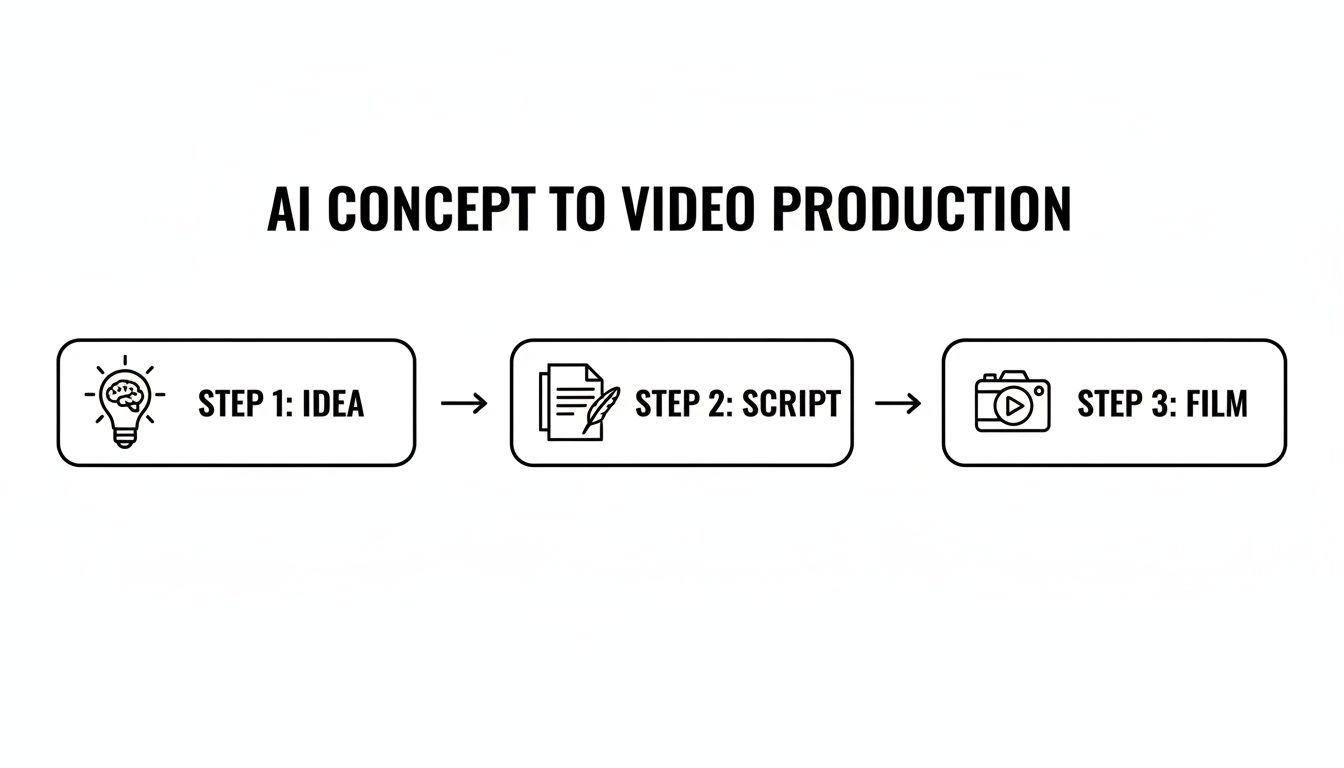
Each stage naturally flows into the next, creating a clear production line that takes all the guesswork out of the process.
Creating Your Low-Friction Workflow
Your main goal here is to eliminate as many decisions as possible on filming day. Seriously. The more you prepare upfront, the faster you can get things done. This is where a simple content calendar—even a basic spreadsheet or a note in your phone—becomes your secret weapon. Just map out your AI ideas for the week and assign each concept to a specific day.
Once your ideas are on the calendar, it's all about finding production shortcuts. These small efficiencies really add up, and they can slash the time it takes to get a video from your camera roll onto your feed.
Here are a few of my favorite shortcuts:
- Create Editing Templates: Find yourself using the same text styles, filters, or intro animations over and over? Save them as a template in an app like CapCut. This stops you from having to rebuild the same look from scratch every single time.
- Pre-Select Your B-roll: So many videos need generic B-roll shots—you typing, walking, or just using your product. Film a dozen of these clips all at once and keep them in a dedicated folder. Then, you can just drag and drop them into your edits whenever you need them.
- Batch Your Filming: This is a game-changer. Set aside one or two blocks of time each week just for filming. During these sessions, knock out all the talking-head segments for multiple videos at once. The oldest trick in the book? Change your shirt between takes to make it look like you filmed on different days.
Building a system isn't about being rigid; it’s about creating freedom. When your production process is automated, your creative energy can be fully dedicated to what truly matters—delivering your message with personality and impact.
This systematic approach, powered by a solid AI content generator for social media, turns content creation from a chaotic daily scramble into a predictable, sustainable process. It’s the engine that drives consistent growth, helping you show up for your audience every single day without burning out.
Using Analytics to Make Your AI Smarter
Using an AI content generator for social media isn't a "set it and forget it" kind of deal. The real magic happens when you create a feedback loop—feeding your own performance data back into the AI to teach it what your specific audience actually clicks on.
This is how you turn a generic idea machine into a strategic partner that genuinely understands your brand and gets smarter with every post.
Instead of getting distracted by vanity metrics like likes and followers, you need to laser-focus on what the algorithms for short-form video actually care about. These are the numbers that signal to TikTok or Instagram that your content is worth pushing out to a much bigger audience.
Metrics That Truly Matter
When you're digging into your analytics, these are the stats that tell the real story. They paint a much clearer picture of success than a simple view count ever could.
- Average Watch Time: Honestly, this is probably the most important metric of all. A high average watch time is a direct signal to the algorithm that your content is genuinely good at holding people's attention.
- Completion Rate: What percentage of people actually made it to the end of your video? A high completion rate is a massive green flag for the algorithm.
- Shares and Saves: These are gold. When someone shares or saves your video, they're saying it was so valuable they either had to show it to someone else or wanted to find it again later.
Think of your analytics as a direct conversation with your audience. They're telling you exactly what they want to see more of. Your job is to listen and translate those insights back into your AI prompts.
Once you start looking at these numbers, powerful patterns begin to emerge. Maybe you notice that videos with a "problem/solution" hook have a 20% higher completion rate. Or maybe your "behind-the-scenes" content gets double the shares.
These aren't just fun facts; they're your new instructions for the AI. To really get a handle on this, you'll need a solid grasp of your TikTok creator analytics.
Now, instead of giving the AI a vague prompt, you can get incredibly specific: "Generate 5 new video ideas for my 'myth-busting' series. Start each one with a hook that introduces a common problem my audience has."
This data-first approach makes sure your content strategy is always evolving, sharpening the impact of every single video you create.
Still Have Questions About Using AI for Social Media?
It's completely normal to have a few hesitations when you first start playing with an AI content generator for social media. The whole point isn't to let a robot take over your account, but to bring on a smart assistant that frees up your time and keeps your ideas sharp.
Let's get into some of the big questions I hear all the time.
Is My Content Going to Sound Like a Robot?
Only if you let it. The secret is to think of AI as your creative springboard, not your final copywriter. It's fantastic for brainstorming initial concepts, outlining a video's structure, or flagging a trend you might have missed.
But the magic—the part that actually connects with people—comes from you. Your personality, your unique way of explaining things, and your genuine perspective are what make the content feel human.
Can AI Actually Keep Up with Fast-Moving TikTok Trends?
This is a big one, and the answer depends on the tool. Your standard, all-purpose AI model is almost always going to be a step behind. But specialized social media AI platforms? That's a different story. These tools are built specifically to monitor what's blowing up in real-time.
They’re constantly analyzing new sounds, video formats, and conversation topics, then translating that data into video ideas that actually make sense for your niche. This is how you stay relevant without spending hours scrolling your For You page.
Think of it this way: a generic AI might suggest an "unboxing video." A dedicated AI content generator for social media will tell you to unbox your product using that specific trending audio everyone is hearing this week, giving you a much better shot at getting noticed by the algorithm.
Ready to stop guessing and start creating content that works? Viral.new delivers fresh, trend-aligned TikTok ideas directly to your inbox every morning, tailored to your specific niche. Get your next viral video concept at https://viral.new.
