
Beating creative block isn't about waiting for a lightning bolt of inspiration to strike. It's about building a reliable system that helps you churn out ideas, even on days when you're feeling completely tapped out. The real secret is to switch from a mindset of "this has to be perfect" to one of genuine curiosity, tweak your creative space, and use structured exercises to get the gears turning again. This turns creativity from a frustrating waiting game into an active, repeatable process you can count on.
Why Creative Block Hits Modern Creators So Hard

If you're a short-form video creator, you know the feeling all too well: staring at a blank screen, the pressure to post something brilliant mounting with every passing minute. It’s uniquely frustrating, and it can feel like a personal failure. But here’s the thing—it’s not. That feeling of being completely out of ideas is a predictable side effect of the world we create in.
You're not just imagining it, either. The demand for new content has exploded, with expectations surging by 5x to 20x in recent years. We're not just being asked to make more content, but more engaging content, and faster than ever. If you're curious about the data, you can read the full market report about creative block solutions.
Before we get into the fixes, it's helpful to understand exactly what's causing the problem. These triggers are incredibly common for creators working on fast-paced platforms.
Common Creative Block Triggers for Video Creators
| Trigger | Description | Example Scenario |
|---|---|---|
| Algorithm Anxiety | The constant fear that if you don't post consistently, the algorithm will "punish" you with lower reach. | You post a half-baked video just to meet your daily quota, even though you know it's not your best work, because you're scared of losing momentum. |
| Comparison Culture | Endlessly scrolling through other creators' viral hits, which leads to feelings of inadequacy and self-doubt. | You see a competitor's video get a million views and immediately scrap your own idea, thinking, "Mine will never be that good." |
| Decision Fatigue | The mental exhaustion from making countless small creative choices for every single video (hook, audio, text, hashtags, etc.). | It's 10 PM, and you can't even decide which trending sound to use, so you give up and post nothing. |
| Perfectionism Paralysis | The need for every video to be flawless or go viral, which prevents you from ever hitting "publish." | You spend three hours re-filming a simple 15-second clip because you keep noticing tiny imperfections that no one else would see. |
Recognizing these patterns in your own workflow is the first step. They're not signs of weakness; they're logical responses to an overwhelming system.
Moving From a "Spark" to a System
Here’s the good news: Creativity isn't some mystical force you have no control over. It's a muscle. The more you work it, the stronger it gets. And better yet, it's a process you can build a system around.
This guide is built on one simple principle: you don't find inspiration, you build a system that generates it.
The key is to stop treating creative block like a personal failing. It’s a professional problem with a practical solution. Acknowledging this is how you start to take back control.
By understanding the specific pressures that floor us as video creators, we can develop targeted strategies to fight back. We're going to move past generic advice like "take a walk" and build a real playbook—full of mindset shifts, warm-up exercises, and workflows designed to keep your idea pipeline full, even on the tough days.
Resetting Your Mindset and Creative Environment
Before we even get into content formulas or brainstorming hacks, we have to talk about the two things that have the most power over your creative output: your mind and your space. A brilliant idea just can't take root in a cluttered room or a stressed-out brain. The real work of beating creative block happens here, long before you ever think about hitting record.
So many creators get stuck in the mud because they're chasing perfection. They believe every video has to be a potential viral hit, every hook needs to be flawless, and every edit must be seamless. That kind of pressure is a creativity killer, plain and simple.
The single most important shift you can make is moving from a mindset of perfectionism to one of genuine curiosity and experimentation. Give yourself permission to make "bad" videos. I'm serious. Start treating every piece of content not as a final exam on your talent, but as a small experiment. What did you learn? Did that hook fall flat? Did the audience react to that weird editing style? When you reframe failure as data, the fear of not being perfect starts to lose its grip.
Embrace Imperfection as a Creative Strategy
The goal isn't to churn out a masterpiece every day; it's to stay in motion. The constant pressure to perform skyrockets stress levels, which is a direct cause of creative block. It just drains your mental battery and shuts down the part of your brain that solves problems. You need to build a sense of psychological safety—where you feel free to take risks without worrying about judgment. This is what unlocks your mind to really innovate. You can learn more about how psychological safety fuels creativity on pikd.io.
The fastest way to get unstuck is to lower the stakes. Your next video doesn’t have to change the world. It just has to be made.
Think of it this way: a "bad" idea that you actually film, post, and learn from is infinitely more valuable than a "perfect" idea that just lives in your head. One gives you real-world feedback; the other just fuels your anxiety.
Declutter Your Physical and Digital Workspaces
Your environment has a direct line to your mental state. A chaotic desk or a desktop wallpapered with unsorted files creates this low-grade hum of stress that saps your creative energy before you even start. This isn't about having a picture-perfect studio; it's about removing friction.
Let's start with your digital world, since that's probably where you spend most of your time. A messy digital space makes finding assets, scripts, and footage a nightmare, adding totally unnecessary frustration to your workflow.
- Organize Your Project Files: Create a dead-simple folder structure you can repeat for every video. Something like:
[Date]_[VideoConcept] > 'Raw Footage,' 'Audio,' 'Graphics,' 'Final Edit'. This one habit will save you from so much future frustration. - Clean Up Your Phone: Your phone is your main creation tool. Get rid of old screen recordings, apps you never use, and blurry takes that are clogging up your storage and your brain.
- Curate Your Inspiration: Stop throwing everything into a chaotic "saved" folder on TikTok or Instagram. Create specific collections. Think 'Hook Ideas,' 'Audio to Use,' 'Editing Styles,' and 'Topic Inspiration.'
Your physical space is just as important. Even without a dedicated office, carving out a specific corner just for creating signals to your brain that it's time to focus. It doesn’t have to be big—just distinct from where you chill out.
Implement a Pre-Creation Ritual
A simple routine can be an incredible mental trigger, helping your brain switch from consumption mode to creation mode. One of the most effective I've found is the '20-Minute Clean Sweep' ritual. Before you sit down to brainstorm or film, set a timer for 20 minutes and just attack your immediate environment.
- Clear your desk of anything not related to your task.
- Close all the browser tabs and apps that have nothing to do with what you're working on.
- Spend five minutes just tidying the physical space around you.
- Write down the single most important creative task you want to get done.
This small act of taking control of your surroundings gives you a powerful hit of accomplishment and clarity. It quiets the external noise, making it so much easier to hear your own creative voice. By hitting reset on your mindset and environment first, you’re creating the fertile ground your ideas need to grow. Suddenly, beating creative block feels less like a battle and more like just getting back to your natural state.
When you’re staring at a blank screen, the last thing you need is some abstract, feel-good advice. You need to do something.
Think of these exercises as your creative first-aid kit. They're quick, practical warm-ups designed for a short-form video creator who needs a solid idea, like, yesterday. The goal isn't to land a viral masterpiece on the first try. It’s about breaking that stuck feeling, getting your brain moving, and building the muscle for on-demand creativity.
The Object Story Exercise
This is my go-to trick for getting out of my own head, and it's incredibly simple. Just grab a random object near you and give it a story. Your mission is to create a 15-second narrative for it.
Here’s how it works:
- Grab an object. Don’t overthink it. A coffee mug, a wilted plant, a single stray sock—anything.
- Ask three questions. Look at the object and answer: Where has it been? What’s its biggest secret? What does it want more than anything?
- Build a micro-narrative. Use those answers to sketch out a 15-second video. Suddenly, that mug isn’t just a mug; it’s a veteran of 1,000 all-nighters that holds the secret to finally finishing your novel. The plant isn't just a plant; it's secretly plotting to take over your apartment.
This little game forces you out of your niche-specific box and into pure storytelling mode, which is the heart of every great video.
The Trend Remix Challenge
Trending sounds are the engine of short-form video, but let's be honest, it can get repetitive. This challenge is all about finding a unique angle by mashing up two completely unrelated trends. It’s where you can twist that existing viral energy into something totally new.
For example, imagine taking a dramatic movie monologue that's trending and laying it over a super-mundane "day in the life" video. The contrast is instant comedy.
The process is dead simple:
- Open your "saved sounds" and randomly pick two.
- Brainstorm a scenario where both could exist in the same video, whether it makes sense or not. The weirder, the better.
- Outline a quick hook, story, and punchline for your new concept.
This simple exercise shifts you from being a passive trend follower to an active trendsetter. You're not just using a sound; you're reinterpreting it, and that’s a powerful way to stand out.
If you find yourself making a lot of remixes, you might also want to check out our guide on content repurposing strategies. It’s all about getting more mileage out of every single idea.
Reverse Engineer a Viral Video
Sometimes, the best way forward is to look back. Find a viral video—and I recommend picking one outside your niche—and break it down piece by piece. This isn't about copying. It's about forensics. You're trying to understand the why behind its success.
Pick a video that recently blew up and analyze it like a detective. Ask yourself:
- The Hook: What happens in the first three seconds? Is it a question? A bold claim? A weird visual that makes you stop scrolling?
- The Pacing: How quick are the cuts? When does the text pop up? Pay attention to the rhythm and flow of the edit.
- The Story: What’s the simple narrative here? Is it a problem-solution, a before-and-after transformation, or just a super relatable moment?
- The CTA: How does it end? Does it ask for a follow, a comment, or point to a link in the bio?
Once you've deconstructed it, apply that structure to one of your own content pillars. For instance, if you're a fitness coach who just analyzed a viral cooking video, you could borrow its fast-paced, text-heavy structure for a "3 Quick Exercises to Fix Your Posture" video.
You're not stealing the idea, you're borrowing the proven framework. This approach demystifies what makes content work and gives you a repeatable formula for your own concepts.
Building a Sustainable Idea Generation System
Quick exercises are great for snapping out of a temporary funk, but they don't fix the underlying problem of a staring-you-in-the-face empty content calendar. If you want to beat creative block for good, you have to stop chasing one-off sparks of genius and start building a reliable system that does the heavy lifting for you. This is about shifting from creative luck to a dependable workflow.
It all starts with something ridiculously simple: an Idea Capture System. I’m not talking about a fancy app. It can be a folder in your phone's notes or a small notebook you keep in your back pocket. The rule is dead simple: if an idea, a question, or a weird observation pops into your head, it goes into the system. Immediately.
You never know when a random thought you had while waiting for coffee could turn into your next viral hit. By capturing everything, you’re creating a personal "idea bank" you can withdraw from on days when your brain feels completely tapped out. This tiny habit is your first line of defense against the blank page.
Give Your Brainstorming Some Structure with Content Pillars
Once you start capturing ideas, the next step is to organize them. A game-changing model for creators is what I call the 'Content Pillars and Spoke' method. Instead of just brainstorming random video topics, you first define 3-5 core themes—your pillars—that your channel is truly about.
Let’s say you’re a fitness creator. Your pillars might be:
- Quick Workouts for people with no time
- Myth Busting common fitness advice
- Healthy Meal Prep ideas
- Mindset & Motivation tips
Now, every idea you come up with should connect back to one of these pillars. This approach doesn't just keep your content focused and on-brand; it makes brainstorming way less daunting. Instead of asking, "What video should I make today?" you can ask a much simpler question, like, "What’s one myth about meal prep I can bust in 30 seconds?"
The flowchart below gives you a few simple ways to generate those "spoke" ideas from your main pillars.
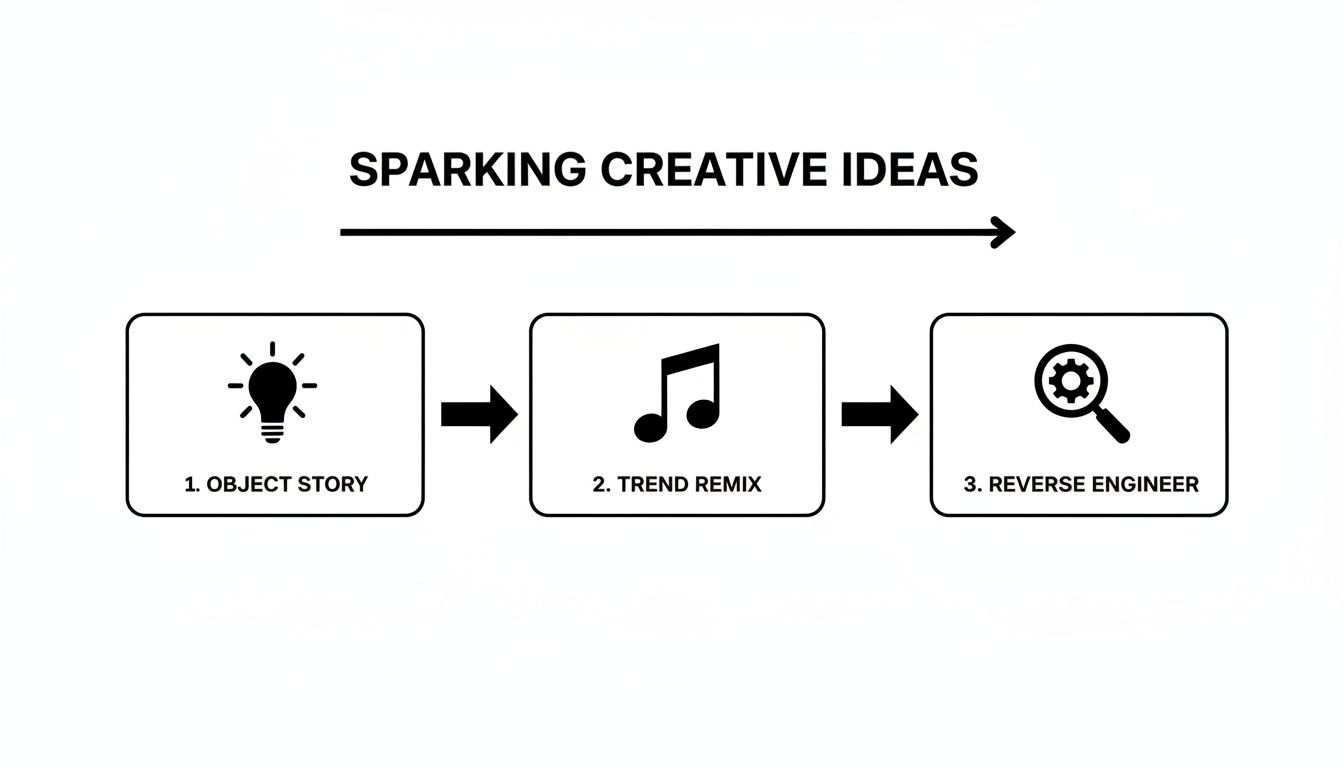
This visual shows how you can use different creative triggers—like telling an object's story or remixing a trend—to create fresh content ideas that always tie back to what your channel is known for.
Weave in Smart Tools to Fast-Track Ideation
Building a solid system also means using the right tools to speed things up. AI-powered tools like Viral.new are built to be your creative co-pilot, analyzing what’s trending and structuring video concepts for you. Instead of just spitting out a generic prompt, these tools can serve up ready-to-shoot ideas that are actually relevant to your niche.
This turns what used to be a time-sucking research session into a quick morning check-in. It frees up your mental bandwidth to focus on what you do best: creating and performing.
Make it Real with Daily Habits
A system is useless if you don't use it. Turning these concepts into a real, sustainable process comes down to integrating a couple of small habits into your daily routine.
Here are two you can start tonight:
- The 15-Minute Idea Dump: Before you call it a day, set a timer for 15 minutes. Your only job is to write down every single video idea that comes to mind, no matter how dumb it sounds. Don't filter, don't judge—just write. This brain dump clears your head and stocks your idea bank for tomorrow.
- Use Template Starters: Stop trying to reinvent the wheel every single time. Build a small library of proven video formats that you can apply to any of your content pillars.
A great idea is useless without a system to capture and execute it. Your system is the bridge between a fleeting thought and a finished video.
For instance, a "Myth vs. Fact" template works for any niche. A fitness creator can do, "Myth: You need hours of cardio to lose weight." A finance creator can do, "Myth: You need a ton of money to start investing." You’re just plugging your pillar topic into a proven format. This is key to keeping your production line moving, and a good TikTok content calendar template can help you map out which formats you'll use and when.
When you combine an always-on capture system with structured brainstorming, smart tools, and consistent daily habits, you build an idea engine that works for you. You’ll find that creative block becomes a rare annoyance, not a daily nightmare.
Troubleshooting Roadblocks to Stay Consistent
Let's be real: even with the best system in the world, you’re going to hit a wall. It happens to everyone. But hitting a snag isn’t a sign of failure—it's just part of the creative game. The trick isn't trying to avoid these roadblocks altogether, but knowing exactly what to do when you see one coming. That way, they become tiny detours instead of full-blown creative meltdowns.
Think of this as your field guide for the most common hurdles that knock creators off their game. Once you learn to spot them, you can have a counter-move ready, keep your momentum going, and bust through that creative block when it feels like a brick wall.
Navigating the Idea Graveyard
You’ve done the brainstorming. Your notes app is a chaotic jumble of video concepts, catchy hooks, and half-baked thoughts. But when it’s time to actually hit record, you feel nothing. Zero motivation. Welcome to the Idea Graveyard, where great ideas go to die from a lack of execution.
This usually happens when the pressure to create something perfect makes every single idea feel like a monumental task. The solution? Lower the stakes. Break the inertia with a small, easy win.
The fastest way out of the Idea Graveyard is to give yourself permission to create something small, imperfect, and immediate. The goal is motion, not perfection.
This is where you pull out the Micro-Video Challenge. Your mission is simple: pick one idea—any idea—from your list and bang out a 15-second version of it in under 30 minutes. Forget perfect lighting, slick edits, or a script worthy of an Oscar. Just film it, slap some text on it, and post it. The simple act of hitting "publish," no matter how small the video, shatters that paralysis and starts rebuilding your creative confidence.
Overcoming Viral Video Envy
You open TikTok for a little "inspiration," and there it is. Another creator in your niche just dropped a video with millions of views. Your stomach drops, your own ideas suddenly feel pathetic, and just like that, your creative drive is gone. This is Viral Video Envy, and it’s a creativity killer.
The issue isn't their success; it's how you're reacting to it. To fight this, you need to switch from emotional comparison to analytical appreciation. Instead of just feeling bummed out, turn their viral hit into a case study.
- Analyze the Hook: What did they do in the first three seconds to make you stop scrolling?
- Deconstruct the Story: What’s the simple A-to-B journey they took the viewer on?
- Study the Format: Is it a list? A tutorial? A reaction? How is the information structured?
When you break down why it worked, you transform a moment of envy into a powerful learning opportunity. You stop being just a competitor and become a student of the craft. This mindset shift is vital for staying sane and resilient long-term. It's also a core part of building a solid plan, which we talk more about in our guide on how to plan social media content.
Escaping the Content Echo Chamber
Ever get the feeling you're just saying the same thing over and over again? That's the Content Echo Chamber. It’s that stale place you end up when your videos all start to sound the same because you've worn out your main talking points. You feel like you have nothing new to say, and creative block sets in hard.
A fantastic way to shatter this is to bring other people into your process. Research shows that structured brainstorming with others can slash creative blocks by as much as 40% by introducing fresh perspectives and making you feel less alone. You can find more on the benefits of creative collaboration on htfmarketinsights.com.
Even if you’re a one-person show, you can still get this effect. Poll your audience on Instagram Stories and ask for their biggest questions. Hop on a call and "interview" a friend in a totally different field. Join a creator Discord and bounce some half-formed ideas off others. An outside perspective is the fastest way to break out of the echo chamber and find that spark again.
Your Questions About Creative Block, Answered
Even with the best game plan, some questions always seem to pop up when you're staring down a creative wall. Let's dig into a few of the most common ones I hear from short-form video creators. Getting a handle on these can totally change how you approach your next recording session.
Think of this as your quick-reference guide for those nagging uncertainties that can hold you back.
How Often Should I Actually Do Creative Warm-Ups?
Treat them like stretching before a workout. Ideally, you want to get into the habit of doing a quick 5 to 10-minute exercise before you hit record every single time. It’s like flipping a switch in your brain, telling it, "Okay, it's time to be creative now."
When you're feeling seriously stuck, that's your cue to dedicate a bigger chunk of time—maybe 30 minutes—to cycle through a few different exercises. The goal isn't intensity; it's consistency. Making it a daily ritual builds that mental muscle, so when a really tough block hits, you're already primed to push through it.
What's the Real Difference Between Creative Block and Just Being Lazy?
This is a huge one, and it's something a lot of creators beat themselves up over. Laziness is when you just don't feel like doing the work. Creative block is something else entirely—it's an inability to access your creativity, even when you genuinely want to create.
It's that frustrating feeling of hitting a mental wall, often paired with anxiety and guilt. While burnout can definitely sap your motivation and look like laziness from the outside, the source of the problem is completely different.
Here's the tell-tale sign: With creative block, you're trying to come up with ideas but drawing a blank. With laziness, you're avoiding the task altogether.
Knowing the difference is critical because the solutions are worlds apart. You can't just "power through" a real creative block with discipline. You have to tackle what's causing it, whether that's stress, perfectionism, or just plain mental exhaustion.
Will AI Tools Make My Own Creativity Obsolete?
Not a chance. A better way to look at AI is as a super-powered creative assistant, not a replacement for your voice. AI's real magic is in doing the heavy lifting during the brainstorming phase. It can sift through data, spot trends, and spit out dozens of starting points way faster than we ever could.
This frees up your most valuable assets: your time and mental energy. AI can't replicate your personal stories, your specific brand of humor, or the authentic connection you have with your audience. Let a tool like Viral.new get the ball rolling so you can focus on the irreplaceable human element that makes your content uniquely yours.
How Do I Know if My Creative Block Is Actually Burnout?
Creative block is a classic symptom of burnout, but burnout itself is a much bigger beast. It’s a state of deep emotional, physical, and mental exhaustion that builds over time. To know if you've crossed from a simple block into full-blown burnout, you need to look for other red flags.
Ask yourself honestly:
- Are you constantly exhausted, even when you get enough sleep?
- Do you feel cynical or disconnected from the work you used to love?
- Is there a persistent feeling of being ineffective or not accomplishing anything?
If your creative struggles are happening alongside these other feelings, that’s a serious warning sign of burnout. In this case, a few warm-up exercises won't cut it. The only real fix is to address the burnout head-on by taking a legitimate break, setting firm boundaries, and prioritizing rest. Pushing through will only dig the hole deeper.
Ready to fill your content calendar with ideas that actually work? Viral.new delivers fresh, trend-aligned video concepts tailored to your niche directly to your inbox every single morning. Stop staring at a blank screen and start creating content that connects. Get your first batch of ideas today.
