
You publish a TikTok that feels useful, clear, and perfectly timed. It reaches your usual audience, collects a few reactions, and then stops moving. A week later, a simpler video takes off because viewers watch the opening, stay for the payoff, and send it to friends. The difference often isn't the creator's size or the sound alone. It's whether the video gives TikTok enough evidence that unfamiliar viewers want to keep watching.
What Going Viral on TikTok Actually Means Today
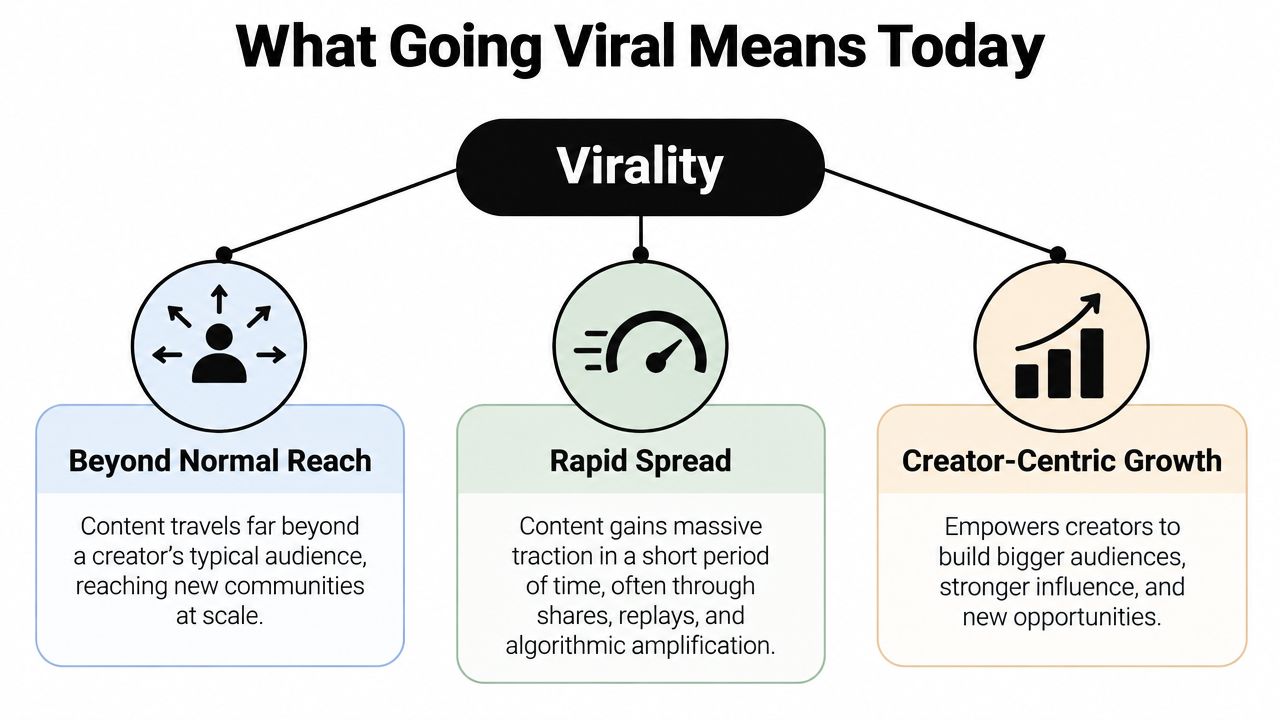
So, what is viral on TikTok? It isn't a universal view count. A video becomes viral when it expands rapidly beyond a creator's normal audience, reaching people who don't already follow that account. For one creator, that might mean a post spreading through a tightly focused community. For another, it might mean broad attention across several unrelated audience groups.
Consider two creators. The first normally reaches a small audience interested in home organization. A short video showing a practical way to store fresh herbs suddenly appears in recommendation feeds far beyond that creator's usual viewers. The second has a much larger following, but a new post performs close to its normal level. The first video has the stronger viral movement, even if the second video has more total views.
Reach is relative to your baseline
TikTok can test a post with viewers who have no connection to the creator. That makes relative lift more useful than a headline number. Ask whether the video escaped its usual audience, how quickly unfamiliar viewers responded, and whether people shared or rewatched it.
TikTok's scale explains why a small spark can travel quickly. The platform reached at least 1.59 billion users worldwide in January 2025, representing 19.4% of all people on Earth and about 27.5% of adults aged 18 and above, based on TikTok ad-planning data summarized by DataReportal. A niche idea can therefore find a very large potential audience, even when the original creator has a modest following.
Niche virality still counts
Global attention isn't the only useful form of virality. A silent product review can spread among shoppers, a finance explainer can circulate among people comparing options, and a productivity tutorial can become a reference post within a focused community. These videos may not become universal memes, but they can produce more relevant attention than a random trend.
Practical rule: Define viral by how far a post travels beyond your normal audience and whether the new viewers take meaningful action, not by a fixed number copied from another account.
How TikTok Decides What Gets Pushed to More Viewers
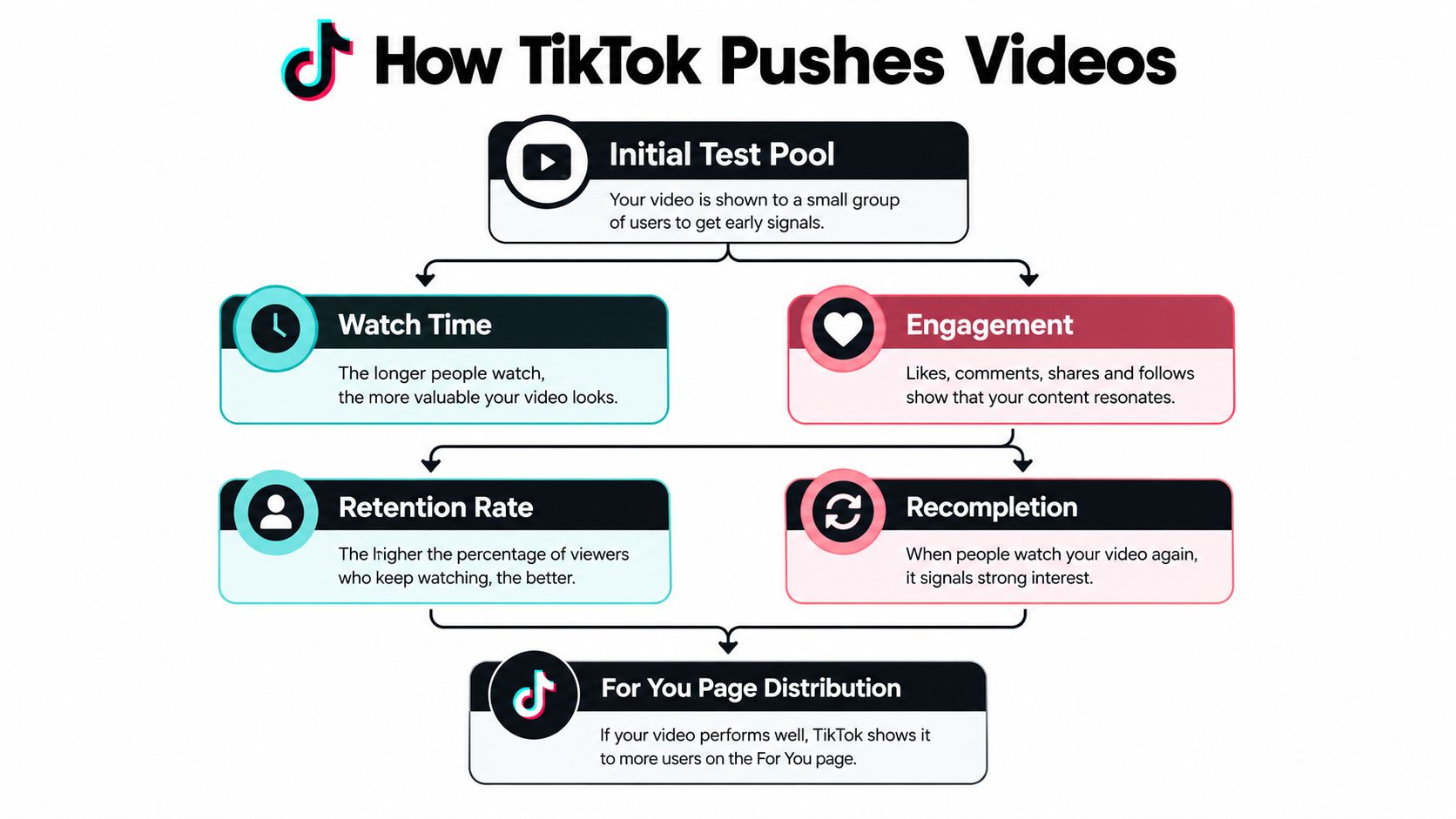
Think of TikTok as a talent scout with a limited stage. It gives a new video an initial opportunity, watches how viewers respond, and then decides whether the video deserves a larger audience. The platform doesn't need to know that a creator is famous before it gives the content a chance.
The distribution process in plain language
Initial testing: TikTok places the video in front of an early group of viewers. Their behavior gives the system its first clues.
Watch behavior: The platform measures whether people pause, continue watching, finish, or leave. A viewer who stays signals stronger interest than someone who swipes immediately.
Intentional engagement: Shares, saves, comments, and rewatches reveal more than passive exposure. A share tells TikTok that the viewer found the post useful, entertaining, or relevant enough to pass along.
Further distribution: If the signals remain strong, TikTok can expose the video to broader For You Page audiences. The process can continue as each new group responds.
Follower count can help a creator start with an existing audience, but it doesn't guarantee expansion. A small account with strong viewer behavior can outperform a larger account whose followers scroll away quickly. This is why a creator should evaluate the content's response, not assume that reach is reserved for established profiles.
For a deeper explanation of the recommendation process and practical ways to grow views with TikTok insights, study how watch behavior and audience signals connect. You can also review how the For You Page works to understand why discovery depends on viewer response rather than a simple follower broadcast.
TikTok operates in an unusually large and active environment. By early 2025, its monthly active user base had grown to about 1.59 billion globally, while summaries for 2026 placed average daily time spent at about 95 minutes per user. TikTok also recorded an average engagement rate of around 3.7% in 2025, described by industry trackers as the highest among major social platforms, according to Shno's TikTok marketing statistics. That environment creates substantial opportunity, but only when the video earns continued attention.
Why the First Three Seconds Determine Everything
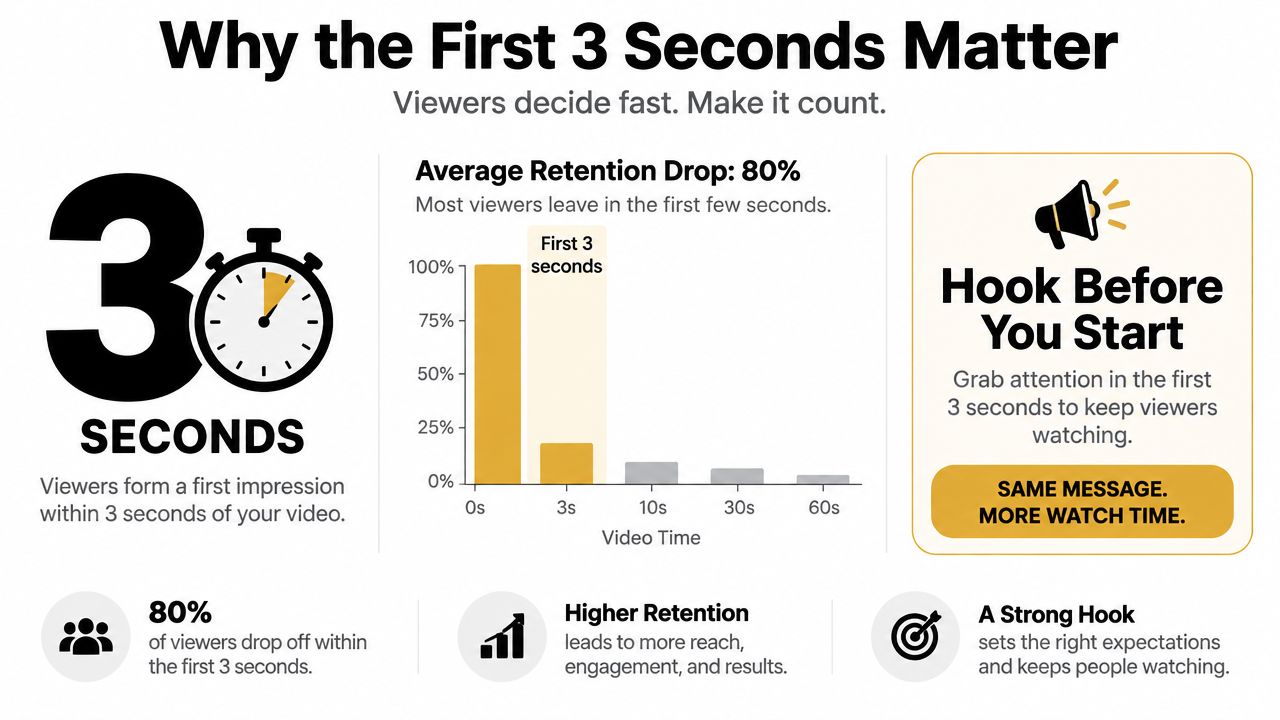
The opening isn't a greeting. It's the product demonstration, the argument, and the promise of the video compressed into a brief moment. If viewers don't understand why they should stay, they can swipe before the useful part begins.
Independent research on TikTok ad viewing found that 85.2% of users exited during the first 25% of the video, while only about 1% reached full completion, as reported in the ACM research paper on TikTok viewing behavior. Those findings identify early retention as the dominant bottleneck. A strong ending can't rescue a video that most viewers never reach.
Build the hook before the setup
Many creators begin with context:
- “I've been using this product for a while.”
- “Today I want to talk about something interesting.”
- “Here are some things I learned recently.”
Those openings make the viewer wait. Replace the introduction with the most relevant claim, visual, or question.
- Problem hook: “Your basil is wilting because you're storing it this way.”
- Outcome hook: “This simple storage change keeps herbs ready for cooking.”
- Curiosity hook: “The part of this organizer that most viewers overlook is the lid.”
- Audience hook: “If your videos lose viewers before the payoff, change this first.”
The hook doesn't need to reveal everything. It needs to establish immediate relevance and create a reason to continue. Show the result before explaining the process, place the product in use rather than on a table, or open with the mistake your audience recognizes.
You can find additional approaches in these video intro ideas for TikTok, but the central principle stays the same. Front-load the strongest visual, verbal point, or product claim before the setup.
Retention is a design problem
A weak opening often signals a weak sequence. If the viewer knows the answer immediately and sees no new information arriving, the video has little reason to continue. If the creator delays the payoff with unnecessary background, viewers may leave before the central idea appears.
Use movement, text, a direct statement, or a visible transformation early. Then keep the middle active by changing the visual, adding a specific detail, or advancing toward a promised result. The first seconds earn the next seconds, and each later moment should justify the viewer's decision to stay.
Viral Formats and Patterns That Keep Winning
A trending sound can help a video feel native to TikTok, but a sound is not a content strategy. Sounds fade, audiences tire of repeated jokes, and a format that works for a dance account may feel unnatural for a finance educator. Durable reach comes from matching structure to audience intent.
Recent trend coverage points to longer-form videos of 1 to 3 minutes outperforming 15-second clips on watch time, retention, and For You Page distribution, while faceless channels in productivity, finance, and AI tools are gaining traction, according to 2026 TikTok trend coverage. That doesn't mean every creator should make longer videos. It means length should serve the payoff.
Compare the main format choices
| Format | Useful when | Main risk |
|---|---|---|
| Short sound-led clip | You want fast cultural recognition or a simple joke | The idea may disappear when the sound loses momentum |
| One to three-minute explanation | Your topic needs steps, proof, or context | Slow pacing can create early exits |
| Faceless tutorial | The audience values information over personality | Generic visuals can make the post feel interchangeable |
| Carousel or photo mode | The viewer needs to scan tips, comparisons, or product details | The first frame may not create enough curiosity |
| Silent review | The product can communicate through close-ups and actions | Weak captions can leave the benefit unclear |
| Reveal-based post | The payoff is visual, surprising, or transformational | The reveal may arrive too late |
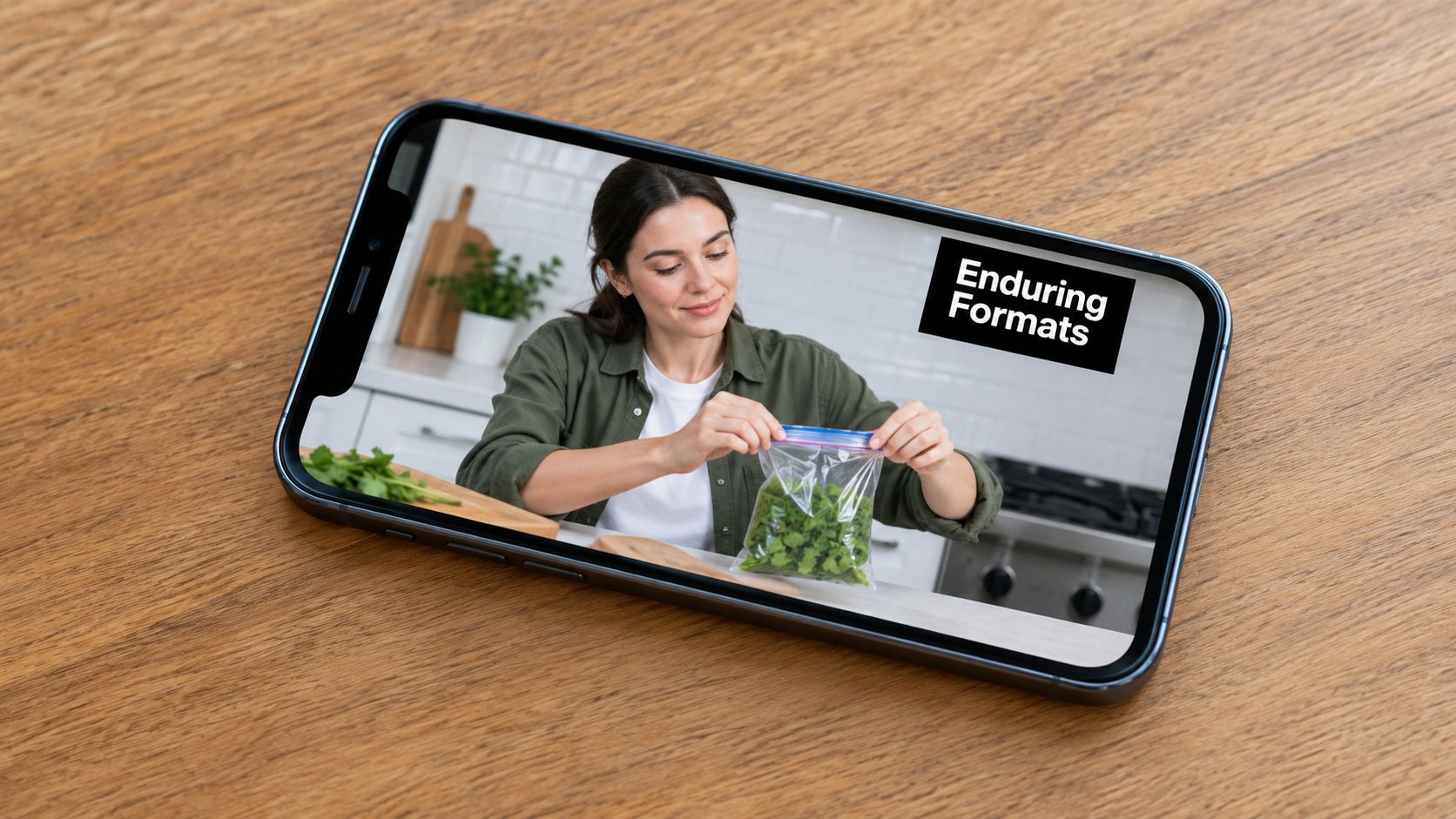
A cooking creator might use a silent herb-storage review with clear on-screen steps. A productivity creator could use a screen recording that starts with the finished workflow, then explains each action. A local business might use a reveal structure, showing an ordinary storefront before revealing a finished service or product.
Choose by intent, not imitation
Ask what the viewer wants to do after watching. Someone seeking a recipe wants a visible sequence. Someone comparing products wants evidence. Someone learning a software shortcut wants a clear result and enough detail to repeat it.
Coverage of September 2026 trends highlights static carousels, photo mode, silent reviews, reveal gags, and fast-moving audio revivals rather than one universal formula, as described by New Engen's TikTok trend roundup. Treat trends as raw materials. Keep the underlying format if it fits your niche, and replace the surface joke with a useful or entertaining payoff your audience wants.
Hooks Sounds and Engagement Triggers That Spark Sharing
A share usually happens when the viewer can immediately identify someone who needs the video. “Send this to a friend who always overcomplicates dinner” gives the viewer a social reason to act. A vague request for engagement doesn't provide that reason.
Start with a hook that names the audience, problem, or result. Then align the audio with the story instead of placing a popular sound underneath unrelated footage. The sound should support the mood, provide rhythm for cuts, or make the format recognizable. It shouldn't compete with spoken instructions or important captions.
Match the creative choice to the outcome
| Goal | Best Hook Type | Engagement Trigger to Add |
|---|---|---|
| Reach a defined audience | Direct audience callout | Ask viewers to send it to someone with the same problem |
| Teach a process | Outcome-first demonstration | Invite viewers to save the steps for later |
| Sell a product | Visual proof or before-and-after reveal | Show the use case and ask which variation they prefer |
| Encourage comments | Opinion question or comparison | Offer two clear choices rather than a broad prompt |
| Increase rewatches | Fast sequence with a hidden detail | Place a useful detail in the frame or make the ending loop naturally |
Retention benchmarks from industry tracking indicate that videos with strong first-three-second retention in the 70% to 85% range can receive about 2.2 times more total views than lower-retention videos. The same source describes broader distribution as often associated with completion around 70%, and reports a share-to-view threshold above 1.4% as a meaningful breakout signal, with posts meeting multiple signals reaching 14 times baseline reach, according to TikTok algorithm tracking data from GetPostKit. Treat these figures as practical benchmarks, not guarantees. Your audience, topic, length, and execution still change the result.
Give the viewer a reason to pass it on
A useful payoff is more shareable when it solves a recognizable problem. “Three ways to arrange a small kitchen” can earn saves, while “This is for the person whose kitchen counter is always crowded” can create a stronger sharing cue. A humorous reveal can work when the setup makes the viewer think of a specific friend.
Use comments to extend the idea, not to replace it. Ask a focused follow-up such as which option viewers would choose, what step causes trouble, or what related example they want next. Endings can also invite a rewatch by completing a visual loop or placing the final answer next to an earlier clue.
For practical guidance on pairing audio with a content idea, review how to use TikTok sounds. The strategic test is simple: remove the sound and ask whether the story still works. If it doesn't, the trend may be carrying the video instead of strengthening it.
Niche Examples and Tactics to Increase Your Viral Potential
The same viral principle changes shape across niches. A productivity account earns attention by reducing friction. A finance account earns it by making a confusing decision easier to understand. An e-commerce account earns it by showing the product solving a real problem.
Adapt the structure to the audience
Productivity: Open with a visible result, such as a clean task system or a faster workflow. Use a screen recording, captions, or a faceless demonstration, then explain the one decision that made the result possible.
Finance: Avoid vague promises. Start with a specific question your audience asks, compare two choices, and state what information would change the recommendation. Clear boundaries build more trust than exaggerated certainty.
E-commerce: Show the product in use within the first moments. Silent reviews, close-ups, packing demonstrations, and reveal formats work when the viewer can judge texture, size, movement, or convenience without waiting for a long introduction.
Local business: Use recognizable places and situations. A café can reveal a menu item, a salon can show a transformation, and a repair shop can demonstrate a common mistake. The local context makes the post more relevant than a generic trend.
Build a repeatable idea stack
Start with one content pillar, one audience problem, one format, and one interaction goal. For example, a kitchen brand could combine “storage” with “wilted herbs,” a silent review, and a save prompt. A creator can then produce several variations by changing the ingredient, the mistake, the visual proof, or the ending.
Keep a simple record of the patterns your own audience responds to. Note which opening earns attention, which payoff creates comments, and which topics produce shares or saves. Don't treat one successful post as a command to repeat it forever. Treat it as evidence that a particular combination of problem, format, and presentation deserves more testing.
Daily idea systems can reduce the pressure to invent from nothing. Viral.new, for example, delivers trend-aligned TikTok prompts to an inbox and tailors concepts to a described business or offer, including hooks and explanations of why an idea is trending. The value lies in translating a moving trend into a niche-specific starting point, not in copying the original post.
Turning Viral Moments Into Consistent Growth
A viral post is useful evidence, but it isn't a publishing system. The creator who studies the post can identify the opening, audience problem, format, payoff, and sharing reason that made it travel. The creator who only celebrates the view count learns very little for the next upload.
Use a pre-publishing check before filming:
- Audience: Can you name the person who needs this?
- Opening: Does the first visual or sentence create immediate relevance?
- Payoff: What specific result will the viewer receive?
- Format: Does the structure suit the topic and the viewer's intent?
- Sharing reason: Why would someone send this to another person?
- Next test: Which single variable will you change in the next version?
Virality works more like probability than permission. You improve the odds by creating stronger openings, protecting retention, choosing a format that fits the message, and designing a payoff people want to save or share. You can't control every distribution decision, but you can control whether the video gives viewers a clear reason to stay.
Trend cycles will continue to change. Sounds will return, disappear, and get replaced by carousels, silent reviews, tutorials, and reveal formats. A creator with a repeatable system can adapt the surface while preserving the underlying strategy: identify a real audience need, make the value obvious quickly, and deliver an ending worth passing along.
Viral.new helps creators and teams turn current TikTok patterns into ready-to-shoot, niche-specific ideas delivered to their inbox each morning. Visit Viral.new to keep a steady stream of hooks, formats, and trend-aligned concepts available for your next publishing session.
