
You post three times this week. One video gets decent views, one dies fast, and one pulls in comments but barely converts into followers. You check your profile, refresh your analytics, and the same thought hits again: why does TikTok feel bigger than ever while my account feels slower than ever?
That feeling is common. A lot of creators and brands assume that if TikTok keeps growing, their own reach should rise with it. But platform growth and account growth aren't the same thing. TikTok can add users, attract more creators, and push more videos into the feed all at once. When that happens, your posts can face more competition even while the app itself gets larger.
That gap is where people get confused. They ask, "Is TikTok still growing?" when the more useful question is, "Is my account growing fast enough for my niche, with this level of competition, using this content system?"
If you've been stuck in that loop, you're not broken and your account probably isn't either. You may just be measuring the wrong thing, or reacting to noisy short-term signals instead of the pattern underneath them. If your views are flat, this guide on why your TikTok videos are not getting views can help diagnose the visibility side of the problem.
Introduction Why Your TikTok Growth Feels Stuck
A creator can post consistently and still feel like nothing is moving. That usually happens when they track only follower count and ignore the engine behind it. One week they gain a few followers from a strong post. The next week they post the same number of videos and gain fewer. It feels random, but it usually isn't.
Think about two different creators.
One creator posts trend reactions that spike quickly, then disappear. Another posts short tutorials that earn fewer views at first, but bring in profile visits and repeat viewers. If both creators only look at total views, they may think they're performing similarly. If they look at growth rate, they start seeing the difference.
Growth feels personal, but it's often structural
TikTok has changed. The early years felt like riding a rising tide. Many creators could post decent short-form videos and get discovered because the platform itself was scaling quickly and user demand was exploding. Today, more people publish, more niches are crowded, and more posts compete for the same attention windows.
That means your account can be healthy even when it feels slower than it used to.
A flat week doesn't always mean weak content. Sometimes it means your content supply stayed the same while competition around that topic increased.
The better question to ask
Instead of asking whether your account is "growing," ask:
- Are followers growing steadily or only after spikes?
- Are views growing faster than content output, or slower?
- Are high-view posts turning into profile visits, saves, comments, and follows?
- Are you losing momentum because the platform is shrinking, or because your niche is getting noisier?
Those questions turn TikTok from a mood into a system. Once you understand TikTok growth rate, you can calculate it, compare it, and improve it with much less guessing.
What TikTok Growth Rate Really Means
TikTok growth rate is the speed of change in an account metric over time. A speedometer. Your follower count is the mileage on the car. Your growth rate tells you how fast you're moving right now.
A lot of people mix up size and speed. A large account isn't always a fast-growing account. A smaller account can grow much faster because it's converting attention into followers more efficiently.
Follower growth rate
This is the version most often meant. It measures how much your follower count increased during a set period compared with where you started.
Core formula: Follower growth rate = (new followers gained during the period ÷ starting follower count) × 100
Simple example. If an account starts the month with 1,000 followers and ends with 1,100, the account gained 100 followers. Divide 100 by 1,000, then multiply by 100. The monthly follower growth rate is 10%.
This matters when your goal is building audience ownership. Followers are not the only metric that matters on TikTok, but they do tell you whether viewers want more from you after seeing a post.
Reach growth and engagement growth
Follower growth isn't enough by itself. Some accounts grow reach before they grow followers. Others pull in followers from a smaller but highly relevant audience.
Use these as separate lenses:
- Reach growth helps when your goal is visibility. It asks whether more unique people are seeing your content over time.
- Engagement growth helps when your goal is resonance. It asks whether people are interacting with your posts more often or more.
- View velocity helps when your goal is breakout performance. It shows how quickly a video gains traction after posting.
Don't mix the metrics
Creators misread the dashboard. A post can get broad reach and still be bad for follower growth if the topic attracts casual viewers but not committed ones. Another post can get moderate views and be excellent for growth if it speaks directly to the right audience.
A clean way to think about it.
| Metric | Best used for | What it tells you |
|---|---|---|
| Follower growth rate | Audience building | Are viewers choosing to stay connected? |
| Reach growth | Discovery | Is distribution expanding? |
| Engagement growth | Content fit | Are people reacting and participating? |
| View velocity | Early traction | Is the post earning momentum fast? |
If your goal is brand awareness, reach may matter most. If your goal is a creator business, follower growth usually matters more. If your goal is sales, neither metric alone is enough. You need content that gets seen and also moves the right people toward action.
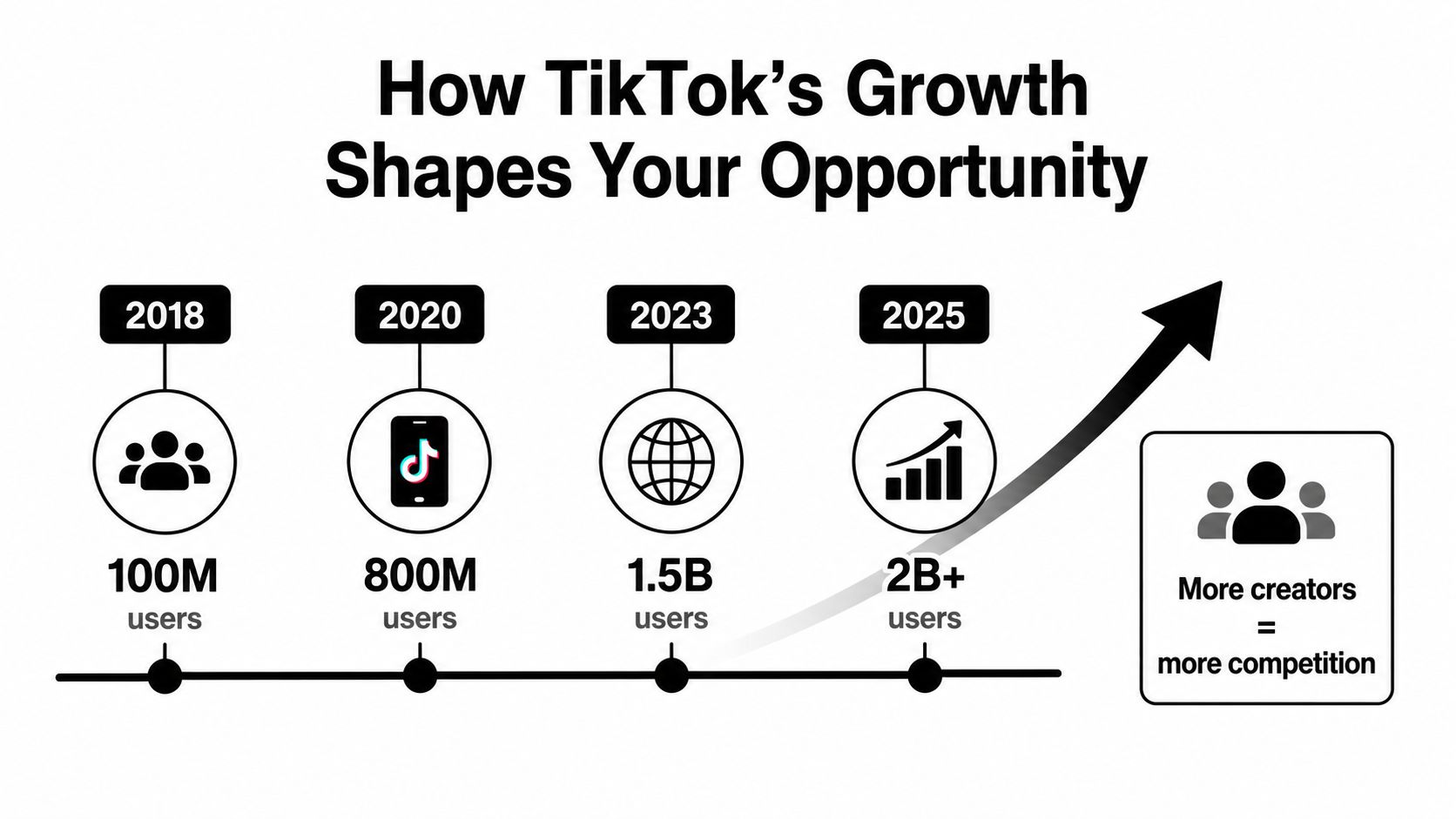
How TikTok Platform Growth Shapes Your Opportunity
You post a solid video. The hook is better than last month. The edit is tighter. Yet the views stall sooner than they used to. That can happen even while TikTok keeps getting bigger.
The missing piece is the gap between platform growth and creator growth.
TikTok expanded fast in its early years. One widely cited timeline says the platform grew from 271 million monthly active users in 2018 to about 1.9 billion by early 2026, according to this TikTok statistics timeline. During a phase like that, the app is adding new viewers at such a high rate that many creators can grow with average execution. There are more new people to match with more new posts.
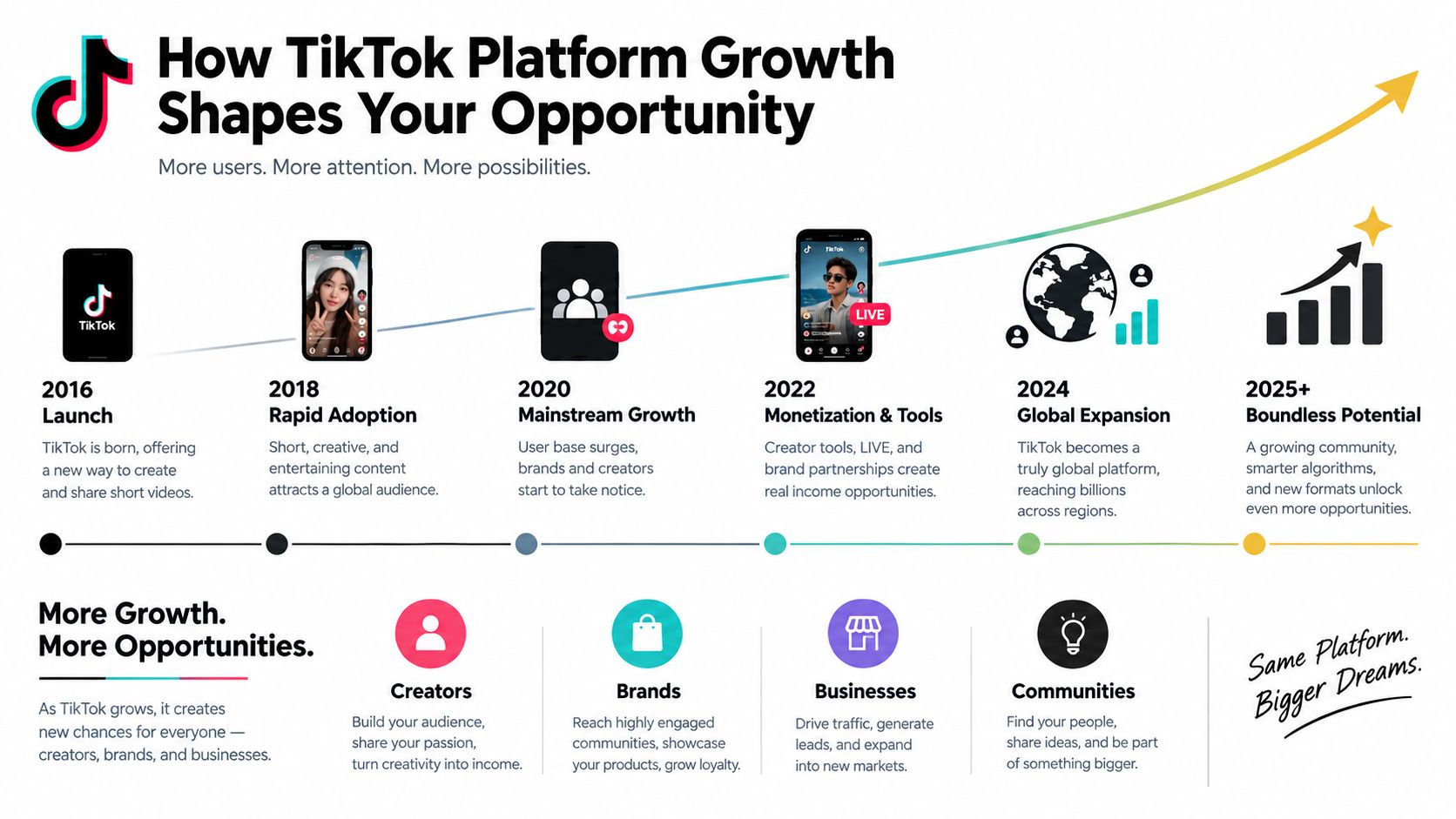
That period felt easier for a reason.
A growing platform works like a city adding new neighborhoods every month. Early shop owners can get foot traffic because more people are arriving. Later, the city may still grow, but if shops open faster than new residents arrive, each shop has to compete harder for attention. TikTok now looks more like that second situation.
Countly, summarizing Business of Apps reporting, says TikTok reached 1.6 billion users in 2024, up 6.1% year over year, in this market summary. That is still real platform growth. But it is a slower curve than the earlier rush. If content supply rises faster than audience growth, average per-post reach can shrink even on a larger app.
That is the part many creators miss.
More users does not automatically mean more reach for your account. It can mean more competition in the For You feed, more polished content in your niche, and a higher bar for holding attention in the first few seconds. The platform can be winning while your posts get a smaller slice of attention.
So what creates opportunity now? Usually three things:
- Stronger first-frame clarity, so viewers know fast why your video is for them
- Higher retention, so the system keeps testing your post with more people
- Better audience fit, so the viewers who do see your content are likely to care, return, and follow
Regional demand matters too. Countly's summary also points to the United States, Indonesia, and Brazil as large user bases. For brands and creators, that affects language choices, references, posting times, and whether a format travels well across markets.
If TikTok feels harder than it did a few years ago, that does not automatically mean your content got worse. In many cases, you are posting into a busier market where audience growth is slower than content growth. The winning adjustment is simple to state and hard to do. Make videos that earn a larger share of attention from the right viewers, not just videos that add to the pile.
TikTok Growth Rate Benchmarks by Account Size and Niche
You post three videos in a week. One gets solid watch time, one brings in a few followers, and one barely moves. Then you look at another creator in your niche and wonder whether your growth rate is healthy or weak.
The tricky part is that TikTok benchmarks work like clothing sizes. "Medium" on one brand does not fit like "medium" on another. A 10% monthly follower gain can be ordinary for a small account, hard to reach for a larger one, and misleading in a niche where people watch often but follow slowly.
Account size changes the math first. If an account grows from 500 followers to 575 in a month, that is a 15% gain. If another account grows from 100,000 to 105,000, that is a 5% gain, even though it added far more people. That is why percentage growth needs context.
A practical benchmark table
Public benchmark data for follower growth by account tier is limited, so it helps to use a mix of hard numbers and pattern-based guidance. For engagement, one public roundup reported TikTok engagement by views at about 4.20% to 4.30% across several quarters, then 3.85% in Q2 2026, according to Technology Checker's TikTok statistics summary. For platform competition, a separate report from Rival IQ's social media industry benchmark data is useful because it tracks how engagement shifts as more brands and creators compete for attention.
| Account Size | Healthy Monthly Follower Growth | How to Read the Benchmark |
|---|---|---|
| Nano accounts | Often uneven. One strong post can create a big percentage jump. | Judge 6 to 8 weeks together, not one breakout video. A small base makes growth look larger than it feels. |
| Micro accounts | Usually steadier if the topic and format are clear. | Watch follower conversion from profile visits and repeat viewers. This is often the stage where consistency starts to beat random virality. |
| Mid-tier accounts | Commonly slower in percentage terms, even when views stay decent. | Compare current growth against your own last 3 months. These accounts often feel the supply-and-demand squeeze first. |
| Large accounts | Lower percentage growth is normal. Absolute follower gains matter more. | Retention, returning viewers, and format refresh matter more than broad reach alone. Big accounts can still grow well while percentages look modest. |
Why the benchmark can feel tougher than expected
Here is the gap many creators miss. TikTok can keep growing as a platform while your per-post reach shrinks.
That is not a contradiction. It is a crowding problem.
If the audience pool grows, but the number of videos grows faster, each post competes for a smaller slice of attention. Earlier in this article, we covered reports showing platform growth alongside rising content volume. That helps explain why a benchmark that looked easy two years ago can feel harder now, even if your content quality stayed similar.
A simple way to picture it is a farmers market that keeps getting more shoppers, but adds new stalls even faster. The market is bigger. Each stall still has to fight harder to get noticed.
Niche changes what "good" looks like
A creator teaching tax tips, a skincare reviewer, a local restaurant, and a gaming clip account are playing different games.
Some niches attract fast views and slow follows. Others get fewer views but stronger trust, which lifts follow rate over time. Trend-heavy niches can spike quickly and fade quickly. Education, beauty, and local business content often depend more on repeat usefulness than on one viral moment.
Use benchmarks as guardrails:
- Small accounts with volatile results should look for repeatable gains, not perfect consistency.
- Growing niche accounts should track whether views turn into profile visits and follows.
- Mid-sized accounts with flat growth should study whether their topics have become too broad to attract the right returning viewer.
- Large accounts with steady engagement but slower follower growth may be serving existing followers well while struggling to attract new ones.
The key idea is simple. Platform growth creates possibility. Creator growth still depends on winning a larger share of attention than the rising supply of content around you.
A slower growth rate does not always mean decline. Sometimes it means your account is competing in a fuller room, and the next improvement comes from sharper positioning, stronger retention, and better follow conversion rather than just posting more.
How to Calculate and Track Your TikTok Growth Rate
You don't need a complicated dashboard to measure growth well. A notes app, TikTok Analytics, and a simple spreadsheet are enough.
The goal is to track change in a way that removes panic from the process. Single posts can be noisy. Trends are more useful.
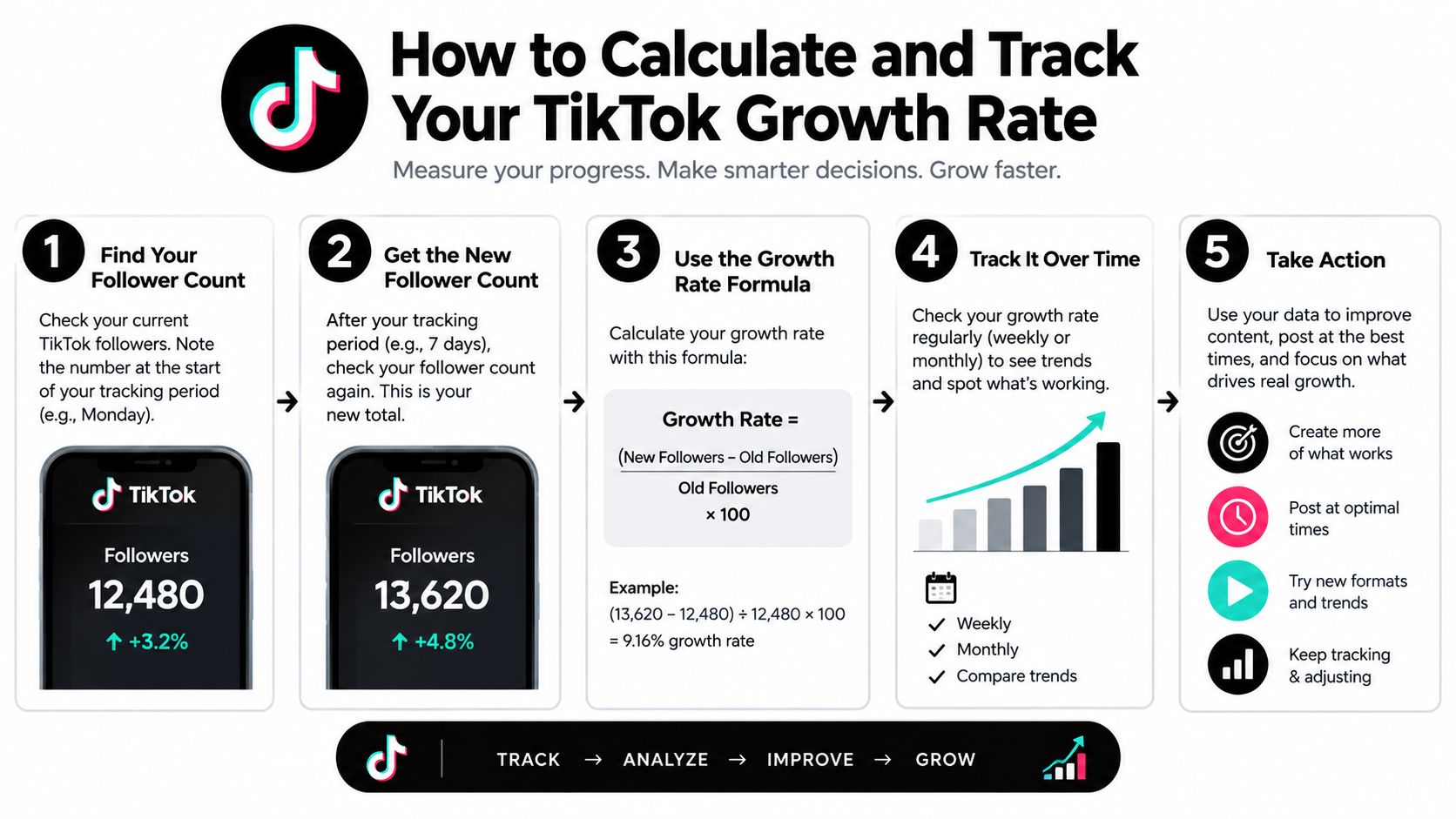
The basic calculation
Start with follower growth rate because it's the easiest to calculate and the easiest to compare over time.
- Choose a time period. Weekly works well for active creators. Monthly works well for brands.
- Record your starting follower count.
- Record your ending follower count.
- Subtract the start from the end. That's followers gained.
- Divide followers gained by starting followers.
- Multiply by 100.
If your starting number is tiny, one good post can distort the percentage. That's why weekly notes are useful, but monthly interpretation is usually smarter.
Where to pull the numbers
Inside TikTok, you can use your analytics dashboard to collect the inputs you need. If you need help locating those screens, this guide on how to see TikTok analytics walks through the setup.
Track at least these fields:
- Followers at the start of the week
- Followers at the end of the week
- Total posts published
- Top post of the week
- Posts that drove follows
- Notes on topic, hook, and format
That last row matters more than people expect. Numbers without context don't teach you much. Numbers attached to creative decisions do.
A simple weekly tracker
A basic Google Sheets setup works well. One row per week is enough for most creators.
| Week | Start Followers | End Followers | Followers Gained | Growth Rate | Posts Published | Best Topic |
|---|---|---|---|---|---|---|
| Week 1 | enter value | enter value | formula | formula | enter value | enter note |
| Week 2 | enter value | enter value | formula | formula | enter value | enter note |
Add one more column for observations. Write short notes like "storytime hook worked," "product demo got saves," or "trend brought views but no follows."
Use rolling averages so spikes don't fool you
If one viral post distorts the week, smooth it with a rolling average. Compare the average of the last few weeks instead of reacting to one breakout clip.
Three patterns matter:
- Steady upward trend means your system is working.
- Spiky pattern means you may depend too much on novelty or trends.
- Flat pattern with strong reach usually means your content is discoverable but not converting.
You can also track view growth and engagement growth, but don't overload your sheet at first. Start with follower growth rate, note what you posted, and keep the process simple enough that you'll maintain it.
What Drives TikTok Growth and How to Improve It
The biggest mistake creators make is treating growth like one lever. It isn't. TikTok growth comes from a chain of small wins. The right topic gets the click. The hook earns the first seconds. The pacing earns watch time. The framing earns comments, saves, or follows.

Start with the first decision viewers make
Most posts don't fail at the end. They fail at the opening. If the first line is vague, slow, or too familiar, people swipe before the rest of the video gets a chance.
Focus your testing on these inputs:
- Hooks that create immediate clarity. Say what the viewer is about to get.
- Formats you can repeat. Series beat one-off inspiration.
- Topics with a built-in audience need. Answer a question, solve a problem, or show a result.
- Native packaging. Use captions, sounds, framing, and pacing that feel like TikTok, not a recycled ad.
If you need a quick pulse on what themes and formats are currently spreading, this overview of what is viral on TikTok is a useful starting point.
Build a small testing system
Don't test everything at once. Change one variable at a time so you can learn from the result.
Try a simple weekly matrix:
| Variable | Version A | Version B |
|---|---|---|
| Hook | blunt problem statement | curiosity-driven opening |
| Format | talking head | screen recording or demo |
| CTA | follow for part two | comment for the template |
| Topic angle | beginner tip | myth or mistake |
A system like this keeps you from guessing. It also makes your content library more useful over time.
Practical rule: When growth slows, don't post more random videos. Post more informed variations of what already earns attention.
Reduce creative friction
A lot of "strategy problems" are planning problems. The creator knows they should test more, but they run out of ideas, publish late, or chase trends after they're already fading.
That's why many teams set up editorial workflows, prompt banks, and content operations automation tips to keep production consistent without turning content into a factory line. The point isn't to automate creativity. It's to remove the repetitive work around it.
For ideation, tools can help if they stay close to niche behavior instead of spitting out generic prompts. Viral.new is one example. It generates daily TikTok content ideas based on what's performing in your niche, then turns those patterns into ready-to-shoot prompts. That can be useful when you're trying to test more hooks and formats without spending your best energy on brainstorming.
A short walkthrough helps if you're mapping ideas into production:
Improve conversion, not just exposure
A lot of creators chase views when they should be improving conversion.
If a video gets seen but doesn't help your account grow, ask:
- Did the topic attract the right viewer?
- Did the profile make the follow feel worth it?
- Did the video promise a larger body of content?
- Did the caption and CTA point people toward a next step?
Growth gets easier when your videos don't act like isolated clips. They should feel like episodes from a creator worth returning to.
Interpreting Your Growth Rate and Next Steps for Creators and Brands
Your growth rate is a decision tool. It tells you what kind of problem you have.
If growth is flat, look at conversion. People may be seeing your content but not connecting your posts to a clear reason to follow. Tighten your topics, sharpen the hook, and make your profile feel more coherent.
If growth is steady, protect the system that created it. Keep your winning pillars, test small variations, and avoid dramatic pivots just because one trend looked tempting.
If growth is spiky, you probably have discovery without consistency. That's common for trend-heavy accounts. Turn the best-performing spikes into repeatable series so each breakout post teaches the algorithm and your audience what to expect from you.
Different next moves for different goals
For solo creators, the next step is usually content refinement. Pick a few formats that fit your voice, then keep testing hooks and angles inside those lanes.
For small businesses and e-commerce brands, the next move is often alignment. Make sure your videos match what customers care about, not just what the brand wants to say. Product demos, customer questions, behind-the-scenes clips, and educational comparisons often reveal whether the audience wants entertainment, proof, or utility.
Growth rate matters most when it changes your next choice. If the number doesn't affect what you post next week, you're only collecting trivia.
A simple 30-day checklist helps:
- Track your follower growth weekly
- Tag each post by topic and format
- Identify which posts led to follows, not just views
- Repeat your strongest concept with a new hook
- Cut formats that get attention but no audience growth
- Review your profile so new visitors know why to stay
If you're tired of staring at a blank content calendar, Viral.new gives you daily TikTok video ideas based on what's already performing in your niche. It's a practical way to test more hooks, formats, and trend angles without losing hours to brainstorming, especially when your growth depends on publishing consistently and learning faster.
