
You've found the perfect name, typed it into Instagram or TikTok, and received the same frustrating answer: someone else got there first. The obvious fallback is to add random digits, extra underscores, or a string that looks more like a password than a brand. Don't start there.
The strongest social media handle ideas when your name is taken usually preserve the recognizable part of your name and add useful context. A niche descriptor, audience identifier, professional initial, or carefully chosen brand word can make the handle clearer without making it feel improvised. Choose based on readability, niche clarity, audience fit, cross-platform consistency, and room to grow.
Handle scarcity is a normal problem, not a sign that your brand name is weak. By the start of April 2026, social media platforms contained about 5.79 billion user identities worldwide, up from 5.24 billion in early 2025, according to global social media user data. With so many identities in circulation, recognizable variations are part of modern brand building.
The examples below can be adapted for TikTok, Instagram, YouTube, LinkedIn, and other services. Check every option directly on the platforms you plan to use, then choose the variation you can keep using as your content, offer, and audience develop. If you're naming a fitness community or merchandise project, a custom running club merchandise guide can also help you connect the handle with a broader identity.
1. Name + Niche or Industry Descriptor
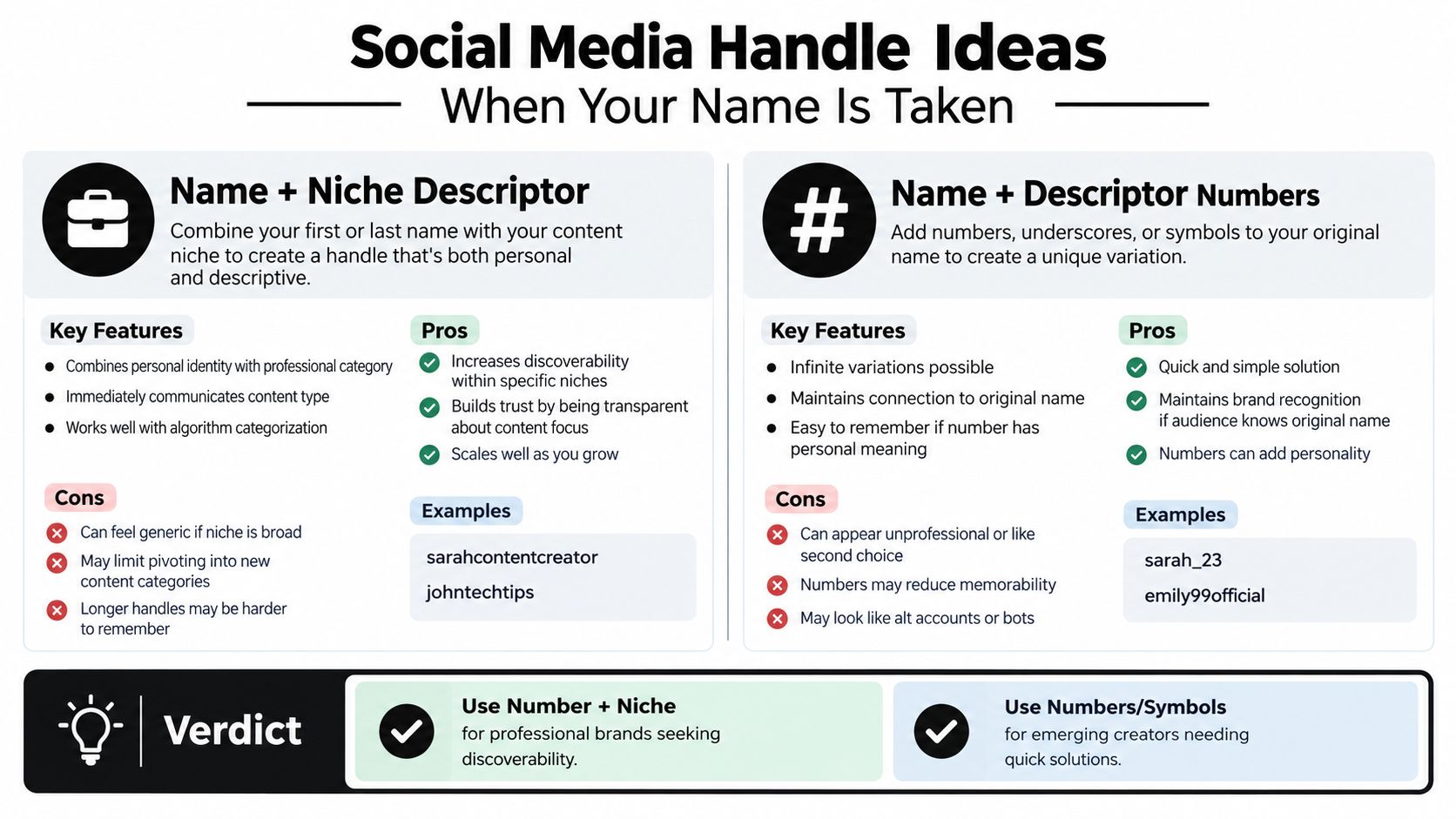
Adding a concise niche word is the clearest way to make a taken name more useful. Instead of forcing a random variation of Sarah, turn it into SarahContent, SarahSEO, or SarahRuns, depending on what the account delivers. The name remains personal, while the descriptor tells visitors why they should follow.
Try these formats:
- SarahContentCreator
- JohnTechTips
- EmilyEcommerce
- LisaFashionDaily
- MarkFitnessCoach
- AlexSmallBizGrowth
The best descriptor is specific enough to explain your category but broad enough to survive a pivot. TechTips gives John room to cover software, devices, and tutorials. iPhoneRepairOnly creates a narrower promise and may become a problem if the business expands into accessories or broader technology advice.
Choose the shortest useful word
Long handles create friction when people hear them in a video, type them into search, or copy them from a comment. Use a compact descriptor such as SEO, DTC, Co, Studio, Tips, Daily, or Growth when the meaning remains clear. A source on username strategy reports an average handle length of 12 characters and warns that handles longer than 15 characters can hurt sharing, while names under 8 characters are rarely available. Use that handle length guidance as a practical direction, not a rigid rule.
Before committing, search TikTok and Instagram for the language your audience already uses. A nutrition creator might choose MayaProtein instead of MayaWellness if protein recipes are the actual content focus. Then make sure the descriptor matches the business category you use in Viral.new's niche positioning strategy, so your handle, profile, and content all communicate the same promise.
2. First Name + Last Initial + Descriptor
Use your first name, last initial, and a professional descriptor when you want a handle that feels personal but still provides context. SarahM_Creates, JohnD_Coaching, and EmilyT_TravelTips identify a real person without relying on a full legal name.
This pattern works particularly well for consultants, coaches, designers, and creators who want to build authority around themselves. The initial distinguishes you from other people with the same first name, while the descriptor tells a new visitor what you offer.
Make the initial work for you
Choose the initial your audience can remember and pronounce easily. If your surname is difficult to spell, a single initial keeps the handle cleaner and gives you a degree of privacy. If your surname is already part of your professional identity, use it instead of the initial. SarahMorganDesign may be stronger than SarahM_Design if clients already search for the full name.
Compare these variations:
- MarketingMeg feels casual and memorable, but it doesn't reveal Meg's surname.
- MegR_Marketing feels more professional and is easier to connect with a full profile name.
- DesignDave is direct, but it may be too broad for a specialist.
- DaveK_ProductDesign communicates a more precise service.
Use an underscore or period only when it improves scanning. Separators can make two words easier to distinguish, but they can also create errors when someone says the handle aloud. Don't add a separator because the first version is taken. Test the handle in a sentence, such as, “Follow Sarah M Creates,” and listen for whether another person could type it correctly.
Keep the descriptor useful beyond your current format. JohnD_Reels may restrict him if he later publishes newsletters, courses, or podcasts. JohnD_Coaching gives him more room. Before reserving it, compare the wording with the business category you're building and check several descriptor options directly on every priority platform.
3. Name + Micro-Community or Audience Identifier
A handle can tell people not only what you do, but who you serve. SarahForMoms, JohnForFreelancers, and AlexStartupFounders position the account around a defined audience rather than a general topic.
This is a strong option when your content solves a clear problem for a recognizable group. GrowthForSmallBiz speaks directly to small-business owners. ContentForCreators makes the intended follower obvious. By contrast, broad labels such as ForWomen or ForBusiness may be too vague to create a compelling promise.
Use the audience's own language
Your target follower should recognize the identifier as a description of themselves. A personal finance creator serving independent contractors could compare MoneyForFreelancers, FinanceForSolopreneurs, and TaxTipsForCreators. The strongest choice depends on the subject the account can discuss consistently.
Before selecting a phrase, read comments, search results, and community discussions on the platform. Look for the words people use when describing their role, frustration, or goal. A phrase that sounds polished in a planning document may feel unnatural to the audience you want to attract.
Audience test: If your intended follower saw the handle without the bio, would they recognize that the account is for them?
This approach has a clear trade-off. A specific identifier improves positioning, but it can narrow your perceived scope. EmilyDTCBrandTips is excellent for direct-to-consumer brand advice, but it may confuse agencies, retailers, or service businesses if Emily later expands her offer. EmilyBrandGrowth leaves more room while still giving visitors useful context.
Use the same identifier in your video introductions, profile name, and bio. If the handle says JohnForFreelancers, his content should repeatedly address freelance pricing, client acquisition, workflow, or related concerns. That consistency teaches new visitors what the account stands for. For a broader personal-brand framework, see Viral.new's guide to building a personal brand.
4. Alliteration or Wordplay Variations
Alliteration makes a handle easier to repeat and gives it a stronger verbal rhythm. CreativeClaire, TrendyTasha, VibrantVince, and ProducerPete sound intentional rather than like emergency substitutions.
Start with three short word banks:
- Actions: creates, teaches, builds, makes, grows, sells.
- Promises: clarity, momentum, confidence, inspiration, results.
- Niche words: content, design, travel, fitness, fashion, finance.
Then combine those words with your name. SarahShows, MarkMakes, CreativeClaire, and StorytellerSam all create an association between the person and the account's activity.
Test the handle in real conversation
Say the handle aloud several times. Ask a friend to write it down without seeing it. If they produce multiple spellings, change the wording. A clever handle that people can't type is less useful than a plain one they remember immediately.
Also test how it looks in a comment. BossBabe_Bella may suit a playful lifestyle brand, while BellaBuildsBrands may fit a B2B consultant better. Wordplay should match the audience's expectations. A light, energetic phrase can work for lifestyle content, but a highly playful name may reduce trust for legal, financial, or technical services.
Avoid jokes that depend on a temporary trend or obscure reference. Your account may eventually appear in podcast introductions, email signatures, product packaging, and search results. The handle needs to remain understandable outside the original platform.
Use a rhyming dictionary or a name generator only to expand the list. Don't let a tool decide the brand position for you. Shortlist names that are easy to spell, clearly connected to your offer, and comfortable to say in a sentence such as, “You can find me at Creative Claire on TikTok.”
5. Compound or Mashup Name Variations
A mashup combines your name with a concept, action, or brand idea to create something that can stand alone. Sarahflow, Johnwave, EmilyShifts, ContentMeld, MarkMomentum, and AlexAccelerate feel more like brand names than patched versions of an unavailable username.
Use this pattern when you want to build beyond a personal account. A fitness creator might choose MayaMoves. A marketing consultant could use BrandBloom or AlexAccelerate. An ecommerce educator might select ShopShift. These names can support videos, a newsletter, a course, or a product line without requiring a complete identity change.
Build the word around a clear idea
Pick one name element and one meaningful concept. Useful concepts include Create, Build, Grow, Shift, Flow, Momentum, and Studio. Then remove unnecessary letters only if the result remains obvious.
Compare:
- SarahGrowthLab clearly signals business education.
- SarahGrow is shorter and more brandable, but less specific.
- Sarahflow sounds smooth and flexible, but the niche must come from the profile.
- ContentMeld suggests collaboration or combination, but doesn't identify a person.
Ask three people to pronounce the name after seeing it once. Then ask them to spell it. If they hesitate, add a clearer word or return to a descriptive format. Search the phrase on Google and across social platforms before investing in logos, domains, or packaging.
A mashup can take longer to teach than Name + Niche, so reinforce it through your display name and bio. For the first few weeks, explain the meaning naturally in captions or introductory videos. That gives the audience a way to connect the unfamiliar word with your expertise.
6. Name + Descriptor Numbers or Symbols
Numbers, periods, and underscores should be your fallback, not your first creative move. They can help you claim a recognizable variation, but they often make a handle harder to remember when the number has no meaning.
Better examples include Sarah_23, John.2024, Emily99Official, Mark_Creator1, and LivingMyBest22. The number should have a reason that you can explain privately or publicly, such as a meaningful year, milestone, or established brand reference.
Preserve meaning and readability
Avoid random strings such as Sarah123, John111, or Emily9876. They look interchangeable and can make people wonder whether they found the correct account. A separator can improve scanning, as in Alex_Content or Mark.Creator, but check whether the target platform permits the character and whether people can reproduce it accurately.
Don't use a version number that makes the account sound temporary. AlexContentV2 suggests a replacement account or unfinished experiment. If you're building a lasting brand, AlexContentStudio or AlexCreates will usually age better.
Availability tools can speed up the first pass. Social media username checkers commonly query public profile endpoints and classify a result as available, taken, or invalid. One documented implementation describes a 404 response as a usual availability signal and a 200 response as an indication that the handle is registered, while also describing checks across 15+ to 80+ platforms. Review how a TikTok username finder works, then verify the result directly on each service before publishing.
Use numbers only when they preserve recognition. If the number makes you explain the entire handle every time you say it, choose a descriptive word instead.
7. Reverse Name or Unconventional Spelling
A reversed name or phonetic variation can create a distinctive handle without abandoning your personal identity. Examples include hcirE for Eric, ailaJ for Jaila, Skye for Sky, Jax for Jack, and Kasey for Casey.
This style suits creators who already have some audience recognition or who want a more unusual brand surface. It isn't the best first choice for a new account that depends heavily on people searching the person's actual name. A follower who hears Jax may not know whether to type Jack, Jacks, or Jax.
Protect discoverability with the profile
If the handle uses an unconventional spelling, put the correct name in the display name. A profile could use Kasey | Casey's Marketing Tips as its visible name while keeping @KaseyBuilds as the handle. The bio can also include “also known as Casey” when the distinction matters.
Pronunciation is the deciding test. Ask someone who doesn't know you to read the handle aloud. If the result sounds unlike your name or brand, simplify it. A unique spelling should create personality, not force every introduction into a correction.
This option works particularly well when the variation remains visually close to the original. Skye retains the sound and meaning of Sky. A completely reversed word may be more distinctive, but it requires stronger support from the profile name, logo, and content.
Use the format when the benefit is clear: a short, ownable identity, a memorable personal nickname, or a brand concept that you can build around. Don't choose it merely because every straightforward option is unavailable. If clarity is your priority, a niche descriptor or audience identifier will serve you better.
8. Name + Year or Era Reference
Adding a year can mark a launch, relaunch, or specific creative era. Sarah2024, John_Content2025, Emily_Creates24, MarkTheCreator2025, and Alex_Daily25 are straightforward ways to separate an unavailable name from an existing account.
Treat this format as a lifecycle decision. A year makes sense for a temporary campaign, a fresh account after a pivot, or a project that intentionally documents a particular period. It makes less sense for a consultancy, creator business, or product brand that you expect to operate for a long time.
Decide whether the date will age well
A dated handle can become awkward once the year passes. If you choose one, plan how you'll handle the next rebrand. You could update the handle later, keep the original year as part of the account history, or use a broader era reference such as AlexCreates2020s.
Don't use an old year to suggest a launch that didn't happen. Don't change the handle annually just to keep it current, either. Frequent changes can make it harder for followers, collaborators, and searchers to find you.
A better long-term option may be a timeless descriptor such as SarahCreates, with the launch year in the bio or pinned introduction. That preserves the context without tying the account permanently to a date.
The year format is most useful when it communicates a deliberate beginning. If the account's main promise is expertise, trust, or a service that will expand, use a name and descriptor that won't need a future reset.
8 Social Handle Alternatives Compared
| Handle Strategy | 🔄 Complexity | ⚡ Resource / Time | 📊 Expected outcomes (⭐) | Best for / Ideal use cases | 💡 Key advantages |
|---|---|---|---|---|---|
| Name + Niche/Industry Descriptor | 🔄 Low–Medium, pick concise descriptor | ⚡ Low, keyword research & testing | 📊 ⭐⭐⭐⭐ Clear niche discoverability; higher collaboration potential | E‑commerce, coaches, educational creators, service businesses | 💡 Immediate niche signal; searchable; scales across platforms |
| First Name + Last Initial + Descriptor | 🔄 Low, structured, needs separators | ⚡ Low, brief availability checks | 📊 ⭐⭐⭐⭐ Professional, searchable authority with longevity | Coaches, consultants, educators, B2B creators | 💡 Balances personal/professional; intentional SEO value |
| Name + Micro‑Community / Audience Identifier | 🔄 Medium, requires precise audience wording | ⚡ Medium, audience research & A/B testing | 📊 ⭐⭐⭐⭐⭐ Highly targeted attraction; improves algorithm match | Community builders, niche brands, coaches, DTC | 💡 Attracts right followers; creates micro‑community identity |
| Alliteration or Wordplay Variations | 🔄 Medium–High, creative brainstorming required | ⚡ Medium, test pronunciation and spelling | 📊 ⭐⭐⭐⭐ High memorability and shareability; strong recall | Personal brands, entertainment, lifestyle, comedy | 💡 Distinctive, share‑worthy; builds brand voice |
| Compound / Mashup Name Variations | 🔄 High, significant naming & availability checks | ⚡ High, brainstorming, legal/availability checks | 📊 ⭐⭐⭐⭐⭐ Very distinctive; strong long‑term brand potential | Startups, creative industries, personal brands | 💡 Creates unique brandable identity; stands out long term |
| Name + Descriptor Numbers or Symbols | 🔄 Low, quickest fallback option | ⚡ Low, minimal setup, cross‑platform check | 📊 ⭐⭐ Quick availability but can feel like second choice | Emerging creators, gaming, music, quick fixes | 💡 Fast to secure; retains connection to original name |
| Reverse Name / Unconventional Spelling | 🔄 Medium, creative but risky for clarity | ⚡ Medium, test with audience for pronunciation | 📊 ⭐⭐⭐ Original and memorable for existing fans; less searchable | Artists, musicians, streamers, niche communities | 💡 Very original; can become signature personal trait |
| Name + Year or Era Reference | 🔄 Low, simple append | ⚡ Low, plan for future rebrand | 📊 ⭐⭐⭐ Signals freshness; effective short‑term but dates fast | New launches, pivots, trend‑focused creators, campaigns | 💡 Conveys newness/urgency; useful for timed launches or pivots |
Choose the Handle You Can Keep Building
Start with three candidates, not thirty. Choose one clear descriptive option, one professional hybrid, and one distinctive brandable option. For example, a marketing creator named Sarah could shortlist SarahContent, SarahM_Marketing, and Sarahflow. This gives you three different positioning choices without overwhelming the decision.
Next, check each candidate directly on TikTok, Instagram, YouTube, and any other platform that matters to your audience. Username checkers can make initial research faster, but they don't replace direct verification. Platforms can apply different character rules, display-name conventions, or availability conditions, so confirm the exact handle before you announce it.
Then run four tests:
- Spelling: Can someone type it correctly after hearing it once?
- Pronunciation: Can you say it naturally in a video introduction?
- Searchability: Does the handle resemble your name, niche, or audience promise?
- Future use: Will it still fit if you add a product, newsletter, service, or new content format?
Choose the closest consistent variation rather than forcing an exact match on one platform and a completely unrelated name everywhere else. A small difference, such as an underscore or compact descriptor, is easier to explain than five disconnected identities. Reserve the handle as soon as you've made the decision, then secure matching profile names, domains, and brand references where practical.
Your handle is only one part of the identity. Put the recognizable name in the display name, explain the offer in the bio, use the same profile image or visual system across platforms, and repeat the account name in video introductions. If the handle is a mashup or unusual spelling, teach people how to remember it through captions and pinned content.
The naming decision also needs to support publishing. Viral.new is an AI-powered TikTok content idea generator that can deliver fresh, trend-aligned prompts to your inbox each morning. It helps creators turn a chosen niche and audience position into practical video concepts, so the account doesn't stop at a polished username.
A strong handle creates clarity, but consistent publishing gives it meaning. Choose the name that makes your promise easy to understand, reserve it across your priority platforms, and build recognition through every useful piece of content. For another perspective on connecting a name with a wider business identity, review Skup's POD playbook for naming.
Viral.new gives TikTok creators and businesses fresh, trend-aligned video prompts aligned to their niche, audience, and offer, delivered to the inbox each morning. Visit Viral.new to turn your new handle into a consistent publishing plan with ready-to-shoot content ideas.
