
The right hashtag mix beats a random hashtag stack.
A lot of small businesses still treat TikTok hashtags like raffle tickets. Add enough broad tags, throw in #FYP, maybe tack on #smallbusiness, and hope the algorithm does the rest. That's weak strategy. Broad tags can help with categorization, but they also drop your video into crowded feeds where stronger accounts, sharper hooks, and better retention usually win.
Small business TikTok hashtags work better when they match intent. One tag can signal your market. Another can signal your niche. Another can tell TikTok you serve a location, a shopping behavior, or a specific community. That mix gives your post a clearer job. It also makes testing easier, because you can compare combinations tied to different business goals instead of repeating the same stack on every upload.
That matters more now because small-business tagging on TikTok has matured into a large discovery layer. Independent 2026 hashtag datasets show #smallbusiness at 34.1 million posts, #smallbusinessowner at 6.4 million, #entrepreneur at 9.5 million, and #supportlocal at 1.8 million, while another 2026 source reports #smallbusiness at roughly 44 million posts with weekly growth of 5.6% according to this 2026 TikTok hashtag roundup. Those aren't niche labels anymore. They're established content ecosystems.
Use the collections below by purpose, not by habit. Some help with broad discovery. Some narrow you into high-fit audiences. Some support local conversion, and some are only worth using when the format fits the trend. Hashtags can improve discoverability. They can't rescue a weak hook, confusing edit, or boring payoff.
1. #SmallBizTok
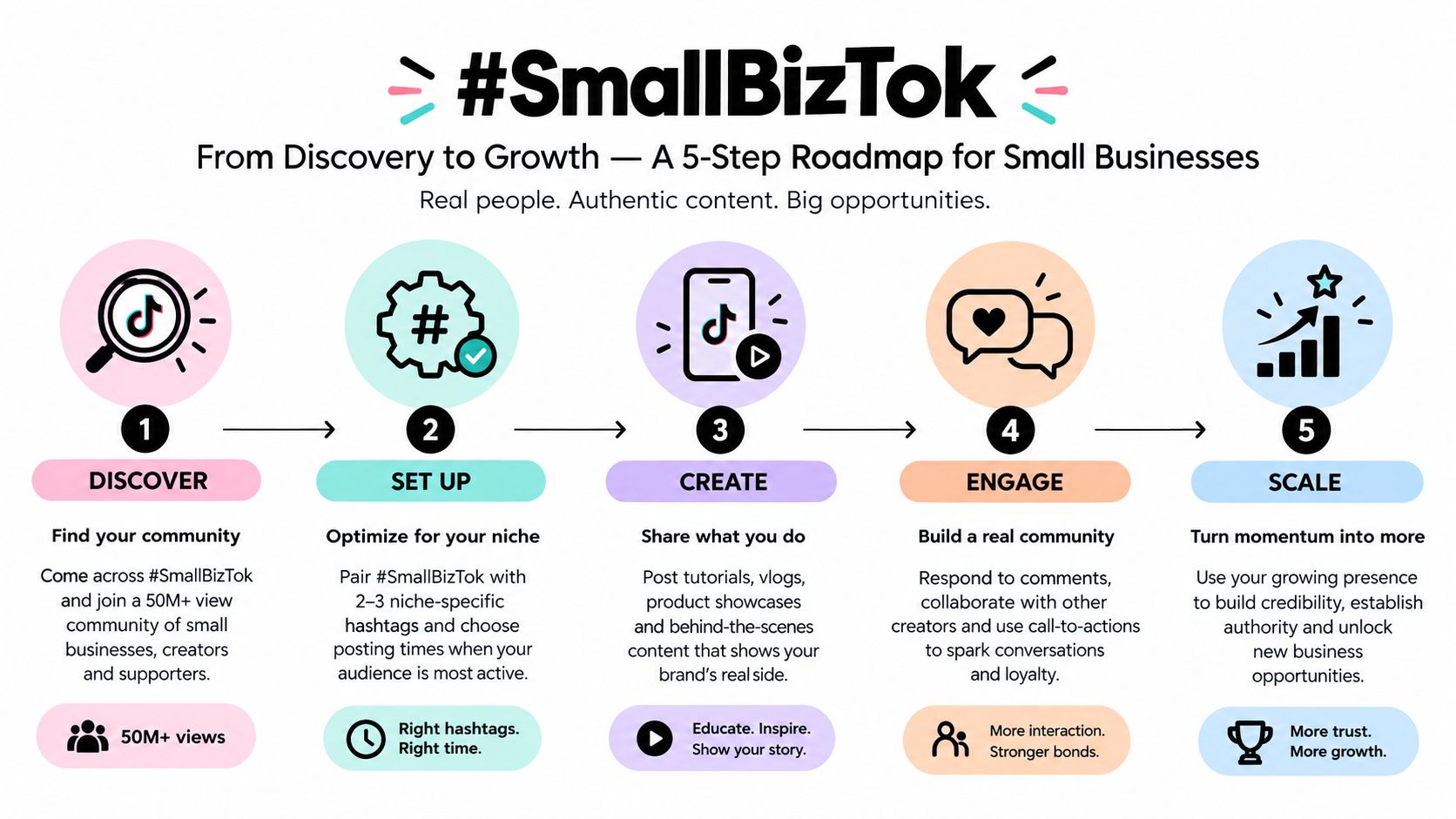
#SmallBizTok works when the video itself is unmistakably about building or running a business. Not just selling a product. The audience behind this tag usually wants process, proof, and personality. They'll watch order packing, customer problem-solving, pricing decisions, fulfillment mistakes, booth prep, and founder routines if the story starts quickly.
Makers, Etsy sellers, service businesses, and small product brands can earn qualified discovery on TikTok. A candle brand can show scent testing. A freelance designer can break down a client revision. A cleaning company can show before-and-after workflow, then explain why one step saves time on every job.
Best use case
Use #SmallBizTok when you want broad business-category reach without going fully generic. It pairs well with niche tags that identify what you sell. For example, a handmade jewelry shop might pair it with product and style tags. A local bookkeeper might pair it with a small-business finance tag and a city tag.
The practical trade-off is saturation. This category is active and useful, but it's not forgiving. Your opening has to tell viewers why they should care now, not later.
Practical rule: If the first line could fit any business video, the hashtag won't save it.
A strong caption for this tag sounds like a business moment, not a slogan. “Packing the custom orders that almost made us change our shipping setup” is stronger than “Support our small business.”
If you need more platform-specific execution ideas, this TikTok marketing for small business guide is a useful companion.
2. #FYP / #ForYouPage / #TikTokTrends / #ViralTrend
These are the most overused tags in small business TikTok. They aren't useless, but they're often used lazily. If your video isn't built around a trend, format, sound, or timely conversation, adding trend-adjacent tags just makes the caption noisier.
That said, there is a reason businesses keep testing them. A 2026 study of 1,569 videos across 40 public accounts found that any hashtag use lifted views by about 3.7 percent versus the account baseline, and seven or more hashtags lifted views by about 9.5 percent in this analysis of TikTok hashtag usage. That suggests hashtags can help, but the effect is incremental. Not magical.
What actually works
Use one of these when you're participating in something current. A bakery adapting a trending sound to show the rush before opening can justify #TikTokTrends. A skincare brand reacting to a product-format trend can justify #ViralTrend. A service business posting a straight educational explainer usually can't.
A better way to use this group is rotational testing:
- Broad reach version: Use #FYP plus one business category tag and two niche tags.
- Trend-led version: Use #TikTokTrends or #ViralTrend only when the edit, audio, or premise clearly maps to a live format.
- Comparison version: Alternate #FYP and #ForYouPage across similar posts, then compare not just views, but comments, saves, and profile visits.
For more on distribution mechanics, this guide to getting your video onto the FYP is worth reading. If you're also evaluating creator partnerships around trend-led content, this TikTok marketing agency guide adds useful context.
3. #SmallBusinessOwner
#SmallBusinessOwner earns its keep when the buyer is evaluating the operator as much as the offer. That usually happens in service businesses, local shops, handmade brands, and founder-led ecommerce. People want proof that the person behind the account makes sound decisions, follows through, and handles pressure well.

Use this tag for trust-building content, not broad discovery. It is narrower than trend tags and less topic-driven than #BusinessTok, but it can attract higher-intent viewers who care who they are buying from.
A simple way to judge fit is to ask what the viewer needs to believe.
If the sale depends on your taste, judgment, consistency, or responsiveness, #SmallBusinessOwner fits. A photographer explaining how she sets client expectations can use it. So can a bakery owner explaining why preorder limits exist, or a solo consultant showing how a proposal process changed after repeated scope creep. Those posts do more than tell a story. They reduce buyer hesitation.
Three post angles tend to work well here:
- Decision transparency: Explain a policy change, pricing boundary, service limit, or product choice in customer terms.
- Operator credibility: Show how work gets reviewed, packed, scheduled, corrected, or delivered.
- Pressure moments: Share a mistake, constraint, or busy-season problem, then show the operational fix.
The trade-off is easy to miss. Founder-led content can build trust fast, but it can also trap the account in personality-led posting that gets attention without driving inquiries or sales. Keep the caption and the video tied to a business outcome. Better scheduling, clearer communication, fewer custom requests, faster fulfillment, stronger client fit. That is what makes this tag commercially useful.
One practical rotation works well. Pair #SmallBusinessOwner with one niche descriptor and one intent-based tag. For example, a local florist might rotate between a credibility mix, a conversion mix, and a community mix:
- Credibility mix: #SmallBusinessOwner plus a floral or event niche tag
- Conversion mix: #SmallBusinessOwner plus a local tag or occasion tag
- Community mix: #SmallBusinessOwner plus #SupportSmall or a maker-focused niche tag
Refresh the supporting tags every few weeks and watch for profile visits, qualified comments, and leads, not just views. This hashtag usually performs best when the person on camera is part of the reason customers say yes.
4. #BusinessTok
#BusinessTok is not a reach shortcut. It is a sorting tag for viewers who already care about how companies make decisions, fix problems, and run profitably.
That makes it useful for a different job than #SmallBusinessOwner. Use it when the goal is to attract business-interested viewers outside your immediate niche, especially if your content teaches through specifics. Good fits include offer breakdowns, pricing logic, process critiques, client pattern analysis, and lessons from a failed test that changed how you operate.
The trade-off is breadth. A broad business tag can widen discovery, but it also puts your post beside polished finance clips, startup commentary, agency hot takes, and recycled advice. Generic “3 tips” content usually disappears into that feed. Specificity travels better here.
A better way to use #BusinessTok is to match it to the intent of the post:
- Broad discovery: Pair it with a role or industry tag when the topic can interest people beyond your customer base. A recruiter reviewing weak resumes, a studio owner explaining no-show policy changes, or a bookkeeper correcting a reporting mistake all fit here.
- Niche relevance: Add a topic tag that narrows the viewer. An operations consultant might combine #BusinessTok with a systems tag. A retail founder might pair it with merchandising or inventory tags.
- Trend participation: If you are responding to a business trend, market shift, or widely discussed tactic, keep #BusinessTok and swap the supporting tag based on the conversation you are joining. Do not keep the same supporting set for every post.
One simple rotation works in practice:
- Reach mix: #BusinessTok plus a role tag plus a broad topic tag
- Qualified mix: #BusinessTok plus an industry tag plus a problem-aware tag
- Trend mix: #BusinessTok plus a timely conversation tag plus one niche tag
For example, a local marketing consultant could rotate between #BusinessTok with a paid ads tag for critique content, #BusinessTok with a service-business tag for client education, and #BusinessTok with a trend tag when reacting to platform changes. The hashtag stays the same. The business objective changes.
One 2026 hashtag-tracking sample of 167 public TikTok posts under the small-business topic averaged 1,412,549 views per post and a 7.35 percent median engagement rate, with average views up from the prior tracking run in this small-business hashtag performance sample. Use that kind of data as a testing prompt, not a formula. Track saves, profile visits, qualified comments, and inquiries after each mix, then refresh your supporting tags every few weeks so #BusinessTok keeps serving the right audience instead of turning into background noise.
5. #TikTokShop / #EcommerceTok
Sales tags should earn their spot. If a post is built to drive a product click, answer a buying objection, or support checkout, #TikTokShop and #EcommerceTok usually fit better than broad small-business hashtags.

Use them around buyer intent, not around every product post by default. A founder update about margins, a studio vlog, and a product demo serve different audiences. The hashtag mix should reflect the job of the video.
For this category, I sort posts into four intent buckets:
- Discovery: New product intros, problem-solution demos, before-and-after use cases
- Evaluation: Comparisons, FAQ answers, ingredient or material explainers, sizing guidance
- Conversion: bundle offers, limited restocks, social proof clips, shop-specific calls to action
- Retention: packing orders, care tips, post-purchase tutorials, reorder reminders
That structure keeps the tag set tied to a business goal instead of turning into a generic ecommerce stack.
A beauty brand, for example, might use #EcommerceTok on an educational demo aimed at discovery, then switch to #TikTokShop on a restock post where the goal is purchase intent. A handmade candle seller might keep one of those tags, add a scent or gift-related niche tag, and rotate in a maker or local tag when the content needs more trust than reach.
The trade-off is straightforward. Broad shop tags can widen exposure, but they also pull in casual browsers. Niche product tags narrow reach, but the comments, saves, and clicks are often more qualified. Product businesses usually get better results by mixing one commercial tag, one category tag, and one context tag, then changing the context tag based on the video.
A simple rotation looks like this:
- Broad discovery mix: #EcommerceTok plus a product category tag plus a problem-aware tag
- Shop conversion mix: #TikTokShop plus a product tag plus a trust tag
- Local product mix: #TikTokShop or #EcommerceTok plus a city or region tag plus a maker tag
- Trend participation mix: one shop tag plus one timely trend tag plus one specific product tag
If you are building posts around in-app selling, this TikTok Shop integration guide helps with the operational side as well.
One common mistake is stuffing shop content with broad viral hashtags and leaving no room for product language. That usually weakens targeting. Shopping posts need clear category signals, specific use cases, and enough variation that the same three tags do not follow every SKU, restock, and packing clip for months.
For a visual example of shop-first thinking, this clip is useful to study before you build your next product post:
6. #EntrepreneurTok
#EntrepreneurTok is for ambition, building, and business creation. It works best when the audience should care about the journey of building something, not just the output of a specific service or store.
Founders, startup operators, solo builders, and educators usually fit here. A founder talking through a pivot, a breakdown of how an offer was repositioned, or a comparison between two business models can all land well. A florist posting arrangement footage with no entrepreneurial angle probably belongs elsewhere.
Where this tag gets overused
A lot of videos use entrepreneur language to dress up generic self-promotion. “Hustle” content with no details doesn't travel well for long, and it rarely converts the right audience. If you're going to use this tag, bring a real decision, lesson, or framework into the video.
One independent industry survey reported that more than 55 percent of small businesses have a TikTok account, 71 percent use it to post business content, nearly two-thirds follow other businesses for ideas, and 59 percent use it to search for trends and topics relevant to their business as summarized in this small-business TikTok survey article. That matters here because the audience behind entrepreneur content isn't only browsing. Many are researching what other operators are trying right now.
Field note: Entrepreneur hashtags tend to attract peers, not always buyers. That's valuable for credibility and networking, but weak if every post is supposed to drive immediate sales.
Use it when you want attention from builders, operators, and business-curious viewers. Skip it when the post is purely local service promotion or product shopping content.
7. #MicroInfluencer
This one is more strategic than people assume. #MicroInfluencer isn't just an identity badge for creators. For a small business, it can support partnership discovery, creator credibility, and niche authority when the account sits somewhere between customer education and personal brand.
A local esthetician who reviews tools, a boutique owner who styles outfits, or a food creator who also sells products might use this tag to attract both viewers and brand partners. It works best when the account already behaves like a creator business, not only like a storefront.
The trade-off with this tag
The upside is positioning. You signal that you understand collaboration, audience fit, and content packaging. The downside is mismatch. If your videos don't look creator-led, the tag can feel aspirational in the wrong way.
Use it on posts such as:
- Collaboration recaps: A product feature, event appearance, or creator-style campaign breakdown
- Audience trust posts: Why followers ask for your recommendations in a narrow category
- Creator-business hybrids: Tutorials, reviews, or niche roundups tied to your business identity
This tag also pairs well with narrower labels like #ContentCreator, niche-specific review tags, or local influence signals if your reach is regionally concentrated.
Don't force it onto every post. A plumbing company filming a repair demo shouldn't suddenly label itself a micro-influencer account unless creator partnerships are part of the strategy. Use the tag when the business benefits from being seen as both operator and publisher.
8. #ContentCreator
Some small businesses don't just sell products or services. They sell taste, information, production skill, or media itself. That's where #ContentCreator becomes useful. It reframes the account from “brand that posts” to “business that creates content people actively seek out.”
This is especially helpful for social media managers, photographers, video editors, course sellers, UGC creators, and founder-led brands whose content quality is part of the offer. If your TikTok is full of editing breakdowns, shoot setups, hook experiments, content workflow tips, or behind-the-scenes production, this tag fits naturally.
A better use than vanity labeling
Don't use #ContentCreator just because you publish videos. Use it when the subject of the video is the craft of content itself. A local café posting latte pours doesn't need it. A café owner explaining how they shoot menu videos on a phone probably can use it because the post now serves creator intent.
Recent guidance on small business hashtag strategy increasingly leans toward a tighter 3 to 5 tag mix built around niche, local, and community relevance, rather than volume, and suggests keeping a running list of relevant tags that get reviewed monthly in this 2026 hashtag strategy article. That's especially useful for creator-style businesses, because they often rotate across content pillars more than traditional local brands do.
A content creator account might keep separate rotating pools for:
- Educational posts: creator and tutorial tags
- Behind-the-scenes posts: process and production tags
- Client result posts: service and niche tags
That structure keeps your hashtags aligned with the actual video, not your ego label.
9. #LocalBusiness / #SupportSmall
For brick-and-mortar brands and service-area businesses, these are often more useful than giant business tags. They narrow the audience toward people who care about place, convenience, and community spending.

A coffee shop showing the morning pastry case, a salon posting color correction transformations, a repair service filming on-site work, or a neighborhood bookstore announcing an event all have a clear reason to use local-community tags. The viewer doesn't need global reach. They need proximity and relevance.
How to make local tags work harder
Pair the community tag with a city, neighborhood, or regional identifier. Then let the content prove locality. Show the storefront, street, team, event setup, menu board, weather, or a recognizable routine that a local viewer would identify immediately.
Broad community tags are huge and easy to join, but hard to dominate. Recent commentary notes that broad tags like #smallbusiness and #supportsmallbusiness are saturated, which is one reason smaller brands may get more from winnable niche or community tags than from the biggest discovery pools [as discussed in the same 2026 hashtag strategy piece mentioned earlier]. That logic is especially strong for local businesses.
Local hashtags work best when the video looks local before the viewer even reads the caption.
A weak local post says, “Come visit us.” A stronger one says, “We're putting out the Friday lunch special now,” or “Three repairs we handled in [city] this week.” Local intent needs real-world context.
10. #WorkFromHome / #SideHustle
These tags attract a specific kind of attention. People looking for flexibility, extra income, solo work models, digital services, or low-overhead business ideas. That can be useful if your business fits that frame. It can also backfire if your content drifts into unrealistic promise territory.
Freelancers, virtual assistants, digital product sellers, remote consultants, online tutors, and solo service providers can all use this group. A designer showing proposal workflow from a home office fits. A local pet groomer probably doesn't, unless the post is specifically about building a mobile or home-based business model.
Use these carefully
The audience behind #SideHustle is curious, but skeptical. They've seen plenty of exaggerated claims. That means proof of process matters more than hype. Show the workflow, the client communication, the tools, the time commitment, or the trade-offs of doing the work after hours.
Recent coverage around TikTok hashtags points to a context-specific approach, with commentary suggesting a sweet spot of 3 to 5 hashtags and weaker results when creators stuff captions with too many tags, especially broad trending ones that don't match business goals in this discussion of TikTok hashtag strategy. That's useful here because side-hustle content often gets overloaded with generic money and viral tags that attract the wrong audience.
Use these tags when the business model is part of the appeal. Don't use them when the video is just another product promo in disguise. Viewers in this category are usually looking for realism. Give them operations, not fantasy.
Top 10 Small Business TikTok Hashtags Comparison
| Hashtag | Implementation Complexity 🔄 | Resource Requirements ⚡ | Expected Outcomes ⭐📊 | Ideal Use Cases | Key Advantages 💡 |
|---|---|---|---|---|---|
| #SmallBizTok | Medium 🔄🔄, consistent posting & hooks | Medium ⚡⚡, regular video production | High reach ⭐⭐⭐, moderate conversion 📊 | Solo founders, product showcases, growth stories | Large established audience; good for credibility; pair with niche tags |
| #FYP / #ForYouPage / #TikTokTrends / #ViralTrend | High 🔄🔄🔄, real-time trend adoption | High ⚡⚡⚡, fast turnaround & trend monitoring | Rapid visibility spikes ⭐⭐⭐, impressions boost 📊 | New accounts, trend-driven campaigns, broad reach pushes | Strong algorithmic signal; additive to niche hashtags |
| #SmallBusinessOwner | Low–Medium 🔄🔄, narrative-focused | Low ⚡⚡, authentic, low-fi production | Strong engagement ⭐⭐, loyalty & community impact 📊 | Personal brands, service providers, founder storytelling | Effective for trust-building and founder relatability |
| #BusinessTok | High 🔄🔄🔄, must stand out in broad vertical | High ⚡⚡⚡, data-backed, polished content | Very large reach ⭐⭐⭐, variable conversion 📊 | Educational business content, thought leadership, B2B/B2C reach | Massive audience and platform support; great for thought leadership |
| #TikTokShop / #EcommerceTok | Medium 🔄🔄, demo + shopping integration | High ⚡⚡⚡, inventory, logistics, creative assets | High conversion potential ⭐⭐⭐, measurable sales 📊 | DTC brands, product demos, unboxings, dropship tests | Purchase-intent audience; direct checkout & shoppable features |
| #EntrepreneurTok | Medium 🔄🔄, expertise & repeatable series | Medium ⚡⚡, research, frameworks, consistency | Strong authority-building ⭐⭐, lead generation potential 📊 | Founders, SaaS educators, consultants, business coaches | Highly targeted audience seeking tactical, actionable content |
| #MicroInfluencer | Medium 🔄🔄, growth & engagement focus | Medium ⚡⚡, community management, consistent output | High engagement rates ⭐⭐, sponsorship opportunities 📊 | Creators 10K–100K, niche experts, local creators | Signals authenticity; opens brand partnership pathways |
| #ContentCreator | High 🔄🔄🔄, crowded; needs unique angles | Medium–High ⚡⚡⚡, tools, editing skills, tutorials | Large reach ⭐⭐, partnership & tool opportunities 📊 | Video professionals, social managers, creator-educators | Meta positioning (content-about-content); attracts peers & brands |
| #LocalBusiness / #SupportSmall | Low 🔄, localized, straightforward content | Low–Medium ⚡⚡, local promos, simple assets | High local conversion ⭐⭐, foot-traffic impact 📊 | Brick-and-mortar shops, local services, event promos | Highly targeted geographic audience; strong community sentiment |
| #WorkFromHome / #SideHustle | Low–Medium 🔄🔄, credibility required | Low ⚡⚡, digital tools, authenticity | Good engagement ⭐⭐, conversion depends on proof 📊 | Freelancers, digital product sellers, side-income guides | Large audience seeking flexible income; scalable digital opportunities |
Turn Hashtags Into a Repeatable Testing System
The biggest mistake with small business TikTok hashtags isn't using the wrong individual tag. It's treating hashtag selection like decoration instead of a testable input.
A practical system is simpler than you might think. Start each post with one broad discovery hashtag, one audience-identity or niche hashtag, one local or commercial-intent hashtag if the post needs it, and one timely trend signal if the format fits. That gives each caption a mix of reach, relevance, and context without turning the post into a keyword pile.
Keep the combinations tied to content pillars. If you post founder stories, product demos, local promos, and educational clips, each pillar should have its own rotating hashtag pool. That way, a packing video doesn't carry the same tags as a workflow lesson or a city-specific promotion. The caption should also stay specific to the video. “Packing today's orders for [product], would you choose A or B?” creates clearer viewer expectations than generic sales language. So does “One mistake we fixed in our [service] workflow.”
Then track outcomes that matter to the business. Record views, watch time, engagement, profile visits, and conversions. If one hashtag mix gets attention but weak profile action, it may be broad but unqualified. If another mix drives fewer views but better inquiries or sales, keep developing that route. The point isn't to find one perfect set. It's to learn which combinations support each business objective.
This also helps you avoid bad habits. If you keep reusing the same generic broad tags, you'll never know whether a niche, local, or shopping-oriented mix could have done better. If you chase trends with no relation to your offer, you'll attract attention that doesn't convert. And if you add too many hashtags, you make your own testing harder because too many variables move at once.
For businesses that want a steadier flow of trend-aligned ideas to test against these mixes, Viral.new is one relevant option. It's built around daily prompts tied to niche and trend movement, which makes it easier to keep the testing calendar full without inventing every concept from scratch. That matters because hashtag testing only works when you publish enough comparable content to spot patterns.
One final point. Hashtags don't create demand on their own. They help route the right video toward the right audience. The core advantage still comes from the hook, the clarity of the idea, the edit, and whether the viewer gets a payoff worth finishing. Build the post first. Then give it the tags that match its actual job. If you keep doing that, your small business TikTok hashtags become a system, not a superstition.
A related read if you also publish across platforms is this piece on RemotionAI tags for Shorts growth.
Viral.new sends daily TikTok content prompts built around your niche, which makes it easier to test fresh small business TikTok hashtags against stronger video concepts instead of recycling the same caption stack. If you want a simpler way to keep your content calendar stocked with trend-aligned ideas, visit Viral.new.
