
If you still think TikTok is just for Gen Z dance challenges, you're sleeping on one of the most powerful growth engines available to small businesses today. Let’s get one thing straight: successful TikTok marketing for small business isn’t about going viral with a silly trend. It's about tapping into a unique algorithm that gives your real, authentic content a genuine shot at reaching a massive audience, completely leveling the playing field.
Why Your Small Business Needs to Be on TikTok Now
It’s time to forget what you know about traditional social media marketing. On platforms like Instagram and Facebook, your reach is often capped by your follower count or how much money you’re willing to spend on ads. TikTok just works differently.
Its algorithm is famously democratic. It prioritizes content that people genuinely find engaging, regardless of who posted it. This means your local coffee shop, your online craft store, or your service business has the same potential to land on someone's "For You" page as a giant corporation. The platform rewards genuine, relatable storytelling, not polished perfection.
Users Are Primed for Discovery
Think about user behavior. People on other platforms mostly follow accounts they already know and like. But on TikTok, users open the app actively looking to be entertained and to find new things—new creators, new hacks, and yes, new products. They are in a constant state of discovery.
This creates a golden opportunity. You're not interrupting their feed with a sales pitch; you're becoming the entertainment they came for. This mindset makes the audience incredibly receptive to brands that educate, inspire, or simply make them laugh. The trick is to shift from a "buy now" message to a "here's something cool" approach.
To get a better sense of how this works in practice, let's compare TikTok to the platforms you're already familiar with.
TikTok vs Traditional Platforms at a Glance
| Feature | TikTok | Instagram/Facebook |
|---|---|---|
| Content Discovery | Primarily through the "For You" Page algorithm, pushing new content to interested users. | Primarily through the user's existing feed and followed accounts. |
| Reach Potential | High organic reach potential for any account, regardless of follower count. | Organic reach is often limited and heavily favors accounts with large existing followings. |
| User Intent | Users are actively seeking entertainment, discovery, and new trends. | Users are primarily connecting with friends, family, and known brands. |
| Content Style | Raw, authentic, and trend-focused. Lo-fi production often performs best. | Polished, highly curated, and aesthetically driven content is the norm. |
| Ad Environment | Ads are integrated more seamlessly into the discovery feed, feeling less interruptive. | Ads are clearly distinct from organic content, which can lead to "ad blindness." |
As you can see, TikTok is built from the ground up to help new creators and businesses get discovered. It’s a completely different game.
The Numbers Don't Lie
This isn't just theory; the impact is real and measurable. A recent study found that a staggering 88% of small businesses said their TikTok promotions directly led to an increase in sales. The food and beverage industry alone saw the platform drive an estimated $6.4 billion in revenue for small businesses last year.
A single creative clip has the potential to reach a slice of TikTok's 1.6 billion monthly active users, turning casual viewers into paying customers.
The real magic of TikTok for a small business is its power to turn tiny moments of entertainment into significant brand awareness and sales. It's a direct line to consumers who aren't just watching—they're actively looking to buy from brands they connect with.
This dynamic flips the old marketing funnel on its head. While other platforms can feel like you're shouting into the void, TikTok gives you a stage where creativity and authenticity are rewarded with real, tangible business results. It’s not just another app to keep up with; it's a vital tool for growth. If you're looking for a creative spark, you can find more inspiration in our guide on social media content ideas for small businesses.
Building Your TikTok Strategy From Scratch
Hopping on TikTok without a game plan is a classic mistake. It's easy to get caught up in making a few fun videos, but without a clear direction, you'll just be spinning your wheels, far from any real business goals. A solid strategy is what separates random acts of content from a predictable growth engine.
The first thing we need to do is get crystal clear on what you’re trying to accomplish. A fuzzy goal like "get more followers" won’t cut it. You need specific, measurable outcomes that actually impact your business.
What’s the Main Goal Here?
Are you a local coffee shop trying to get more people through the door for the morning rush? Or an e-commerce brand launching a new collection and needing to drive sales? Maybe you’re a consultant just trying to get your name out there in the local community.
Your number one goal shapes every single video you create.
If you’re after Brand Awareness: Your job is to entertain, educate, or inspire. Think behind-the-scenes glimpses of your workshop, funny skits about industry quirks, or quick, helpful tips that a broad audience can appreciate.
If you need to Generate Leads: The focus shifts to showcasing your expertise. Create valuable "how-to" guides, feature glowing client testimonials, or break down a case study. The goal is to guide viewers toward a next step, like signing up for your email list.
If it’s all about Direct Sales: Your videos need to put your products front and center. Show them in action. Feature user-generated content from happy customers or create satisfying "before and after" videos that make people want to click "buy now."
Pick one primary objective to start. If you try to do everything at once, your message gets muddled, and you'll end up confusing your audience. Nail one, then you can start layering in other goals.
Find Your People and Your Niche
The real magic of TikTok is its knack for connecting you with super-specific communities. You're not just marketing to "moms"; you're marketing to "first-time moms who are into eco-friendly baby products and love a good DIY project." The more dialed-in you are, the better the algorithm can serve your content to the right people.
Start by sketching out a quick persona of your ideal follower. What do they do for fun? What's their sense of humor? What problem are they struggling with that you can solve?
Use the TikTok search bar as your secret weapon. Type in hashtags related to your field (like #PotteryLove or #SmallBatchSkincare) and see what’s already resonating. The comment section is a goldmine—it's where you'll find out what people are thinking, the language they use, and their biggest pain points.
Your niche isn't just what you sell; it's the unique spin you put on it. A roofer on TikTok isn't just a roofer; they’re the person who makes incredibly satisfying videos of perfect shingle alignment or funny clips about the wild things they find in gutters.
Set Up Your Profile for Success
Think of your profile as your digital storefront. You have just a few seconds to tell visitors who you are, what you do, and what you want them to do next. Every piece needs to be working for you.
Profile Picture: Use a crisp, high-quality logo or a professional headshot. It has to be recognizable, even as a tiny circle.
Username: Keep it simple and easy to remember. Ideally, it should match your business name or your handles on other social media platforms. Ditch the extra numbers or underscores if you can.
Bio: You’ve only got 80 characters, so make every single one count. State what you do and who you do it for. An emoji or two can add some personality. Most importantly, include a clear call-to-action (CTA) that points people to your link.
For example, a bio for a local plant shop might look like this:
"Helping you grow your urban jungle in PDX 🌿✨
New arrivals every Friday!
Shop our latest plants 👇"
Link in Bio: This is your most valuable piece of real estate. Having a TikTok Business Account is a must, as it unlocks the ability to add a clickable website link. Don’t just send people to your homepage—direct them to a specific product page, your online store, or a link hub service. This is how you start turning views into actual business.
How to Create TikTok Content That Actually Converts
Okay, so you have a strategy. That's a great start, but on TikTok, the execution is everything. The difference between a video that gets swiped away and one that actually makes a sale often comes down to the first three seconds. The good news? TikTok marketing for small business isn’t about having a Hollywood budget. It's about knowing the simple formulas that grab attention and build real trust.
Every single video you post needs to do a job. It has to pull someone in, tell them a quick story, and then give them a clear next step. Forget those overly complicated marketing frameworks you've seen. The stuff that works on TikTok is often brutally simple.
The Hook, Story, Offer Framework
I tell every small business owner I work with to think of their videos as a mini-story: a beginning, a middle, and an end. This isn't just a creative exercise; it’s a proven structure that works perfectly for the way people fly through content on their phones.
- The Hook (Seconds 1-3): This is it—your one shot to stop the scroll. You absolutely have to give them a reason to pause. A strong hook could be a provocative question, a totally unexpected visual, or a bold statement that makes them think, "Wait, what?"
- The Story (Seconds 4-15): You’ve got their attention. Now, deliver the goods. This is where you educate, entertain, or solve a problem. It might be a super-fast tutorial, a satisfying behind-the-scenes glimpse, or the setup of a struggle your audience knows all too well.
- The Offer (Final Seconds): This is your call-to-action (CTA). What do you want them to do next? It doesn’t always have to be "buy now." It could be as simple as "follow for more tips," "comment with your biggest challenge," or "check the link in our bio to see the new collection."
This simple three-part structure turns a random video into a genuine piece of marketing. It takes the viewer on a tiny journey and gives your content a real purpose beyond just racking up views.
Proven Content Pillars for Small Businesses
Staring at your phone and hoping for inspiration is a surefire path to burnout. Instead, build your content around a few reliable pillars. These are the themes you can come back to again and again, so you always have something valuable to post without reinventing the wheel every morning.
- Behind-the-Scenes (BTS): People are nosy—in a good way! They love seeing how the sausage is made. Show the "unpolished" side of your business. This could be you meticulously packing an order, mixing a new batch of soap, or even the beautiful chaos of restocking your shop. This stuff builds authenticity like nothing else.
- Educational "How-To" Clips: You're the expert, so act like it. A plumber can show how to fix a leaky faucet in 30 seconds. A local coffee shop can demonstrate the perfect latte art pour. These little videos provide immediate value and make people remember you when they need help.
- Customer Stories and UGC: Your happiest customers are your best salespeople, period. Share a video of a customer unboxing your product or a glowing testimonial about your service. User-generated content (UGC) is pure social proof and feels so much more genuine than a polished ad.
- Trend-Jacking with a Twist: Don't just blindly copy a trend; make it your own. Use a trending sound or format to tell a story about your business. This helps you ride the algorithm's wave while still staying true to what you're all about.
If you're constantly running out of ideas, a tool like Viral.new can be a lifesaver. It finds what's already working in your niche and gives you daily, trend-aligned video prompts. It seriously cuts down on the brainstorming time.
Real-World Examples in Action
Let's make this concrete. How does the "Hook, Story, Offer" framework actually look for different businesses?
Scenario 1: An E-commerce Clothing Brand
- Hook: A shot of a hopelessly wrinkled dress with bold text: "Stop ironing your clothes!"
- Story: A quick cut to someone pulling that same dress from a packed suitcase, giving it one shake, and looking runway-ready. You see them wearing it everywhere—on a plane, at a work meeting, out to dinner—to show its versatility.
- Offer: Simple text on the screen: "The perfect travel dress is here. Tap the link in bio to shop!"
Scenario 2: A Local Plumber
- Hook: A tight shot of a dripping faucet with that loud, annoying drip, drip, drip sound. The text asks: "This sound driving you crazy?"
- Story: In just 15 seconds, the plumber shows a super simple fix using a tool most people already have. The steps are quick, clear, and easy to follow.
- Offer: The plumber looks right at the camera and smiles. The text says: "For the bigger problems you can't fix, you know who to call. Follow for more DIY tips!"
These examples don't require anything more than a smartphone and a solid idea. On TikTok, authenticity will beat high production value every single time. Viewers want to connect with real people and real solutions, not slick, corporate videos.
The numbers don't lie. TikTok has an average engagement rate of 4.2%, which blows other platforms out of the water. This isn't just vanity metrics; it translates to real business. A massive 74% of users go online to research a brand after seeing it on TikTok, and 61% discover new services right in the app. And when you speak directly to your audience, like our plumber did, you can see engagement jump by 33%, building that know-like-and-trust factor fast. You can dive deeper into these powerful TikTok marketing findings. This data proves it: authentic, helpful content isn't just a nice-to-have, it's the engine that drives discovery and sales.
Designing a Realistic Content Workflow
Let’s be honest: consistency is the engine of TikTok growth, but the pressure to post every single day is a fast track to burnout. For a small business owner, effective TikTok marketing isn't about scrambling for an idea every morning. It’s about building a sustainable system that makes content creation a predictable, and even enjoyable, part of your week.
The secret weapon I’ve seen work for countless businesses? Content batching. Instead of treating TikTok like a nagging daily chore, you dedicate one solid block of time—maybe a few hours on a Monday morning—to get everything done for the week ahead. This one shift takes you from being reactive and stressed to proactive and in control.
Adopting the Batching Method
So, what does a batching session actually look like? Think of it as your own little content production line.
Here’s how I break it down:
- Plan First: Spend the first 30-45 minutes just on ideas. Look at your content pillars and use a tool like Viral.new to pull in fresh, trend-aligned prompts. For each video, nail down the hook, the story, and the call to action before you even think about hitting record.
- Shoot Everything: Once your plan is solid, set up your phone and film all of your videos in one go. Because you already know what you're making, you can flow from one clip to the next without the constant stop-and-start of brainstorming.
- Edit in a Batch: With all your raw footage captured, you can now move into editing. This is where you’ll spend the last chunk of your time adding text overlays, trimming clips, and dropping in music to polish off every video for the week.
This approach gives you back so much mental energy. For the rest of the week, you can focus on actually running your business, knowing you have a library of ready-to-post drafts waiting. The daily "what on earth do I post?" panic is completely gone.
By batching your content, you turn TikTok from a source of daily stress into a streamlined, manageable marketing channel. It's the most effective way to ensure you're consistently showing up for your audience without sacrificing your time or sanity.
And when it comes to editing, don't get bogged down. The built-in editor on TikTok has more than enough power to create fantastic, engaging videos. My advice? Focus on clear text that people can read in a split second, use quick cuts to keep the energy up, and tap into the platform’s massive library of sounds.
Finding and Using Trending Audio
Trending audio is your best friend for boosting reach. The TikTok algorithm loves to push videos using popular sounds, and it’s a simple way to get more eyes on your content. You can spot what’s hot just by scrolling your "For You" Page or by checking the "Add sound" section when you’re creating a video.
But here's a crucial tip for any business: if you have a Business Account, you must use sounds from the Commercial Music Library. This library contains over a million pre-cleared, royalty-free tracks that are safe for you to use. It’s your shield against potential copyright headaches. You might miss out on the latest Taylor Swift hit, but the peace of mind is worth it.
This simple workflow is the key to structuring each video for maximum impact.
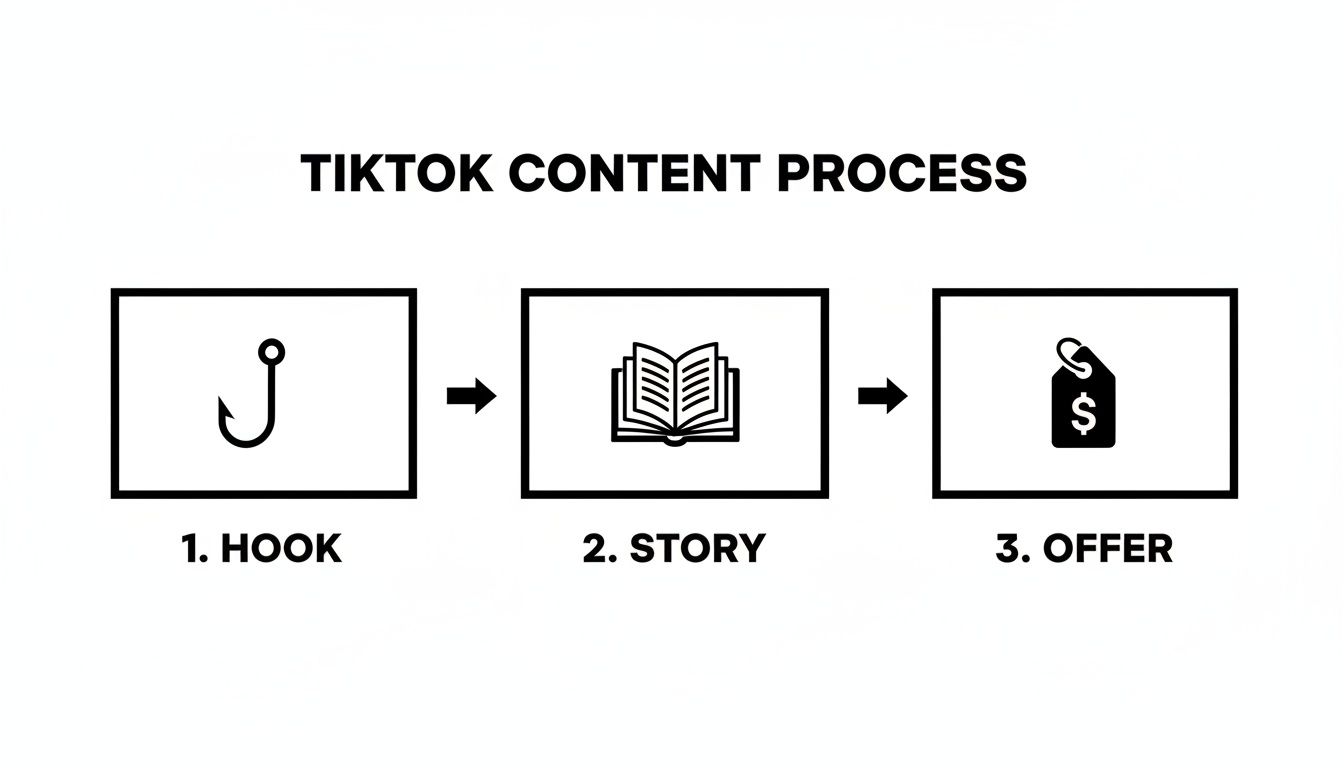
The Hook, Story, Offer framework is gold. It forces every video you make to grab attention, deliver real value, and then gently guide the viewer toward taking an action. This is how you turn casual views into real engagement and, eventually, customers.
Building a Sample Content Schedule
A smart content mix is all about balance. You want to keep your audience hooked without making them feel like they're just watching one long ad. A little bit of planning goes a long way here.
Here's a sample schedule that shows how you can blend different content pillars throughout the week to keep things fresh.
Sample 1 Week Content Schedule for a Small Business
| Day | Content Pillar | Example Video Idea (for a Local Coffee Shop) |
|---|---|---|
| Monday | Educational | "3 ways to make better coffee at home (that we use in our shop)." |
| Tuesday | Behind-the-Scenes | A satisfying time-lapse of baking fresh morning pastries. |
| Wednesday | Trend-Based | Using a trending sound to create a funny skit about morning customers before they've had coffee. |
| Thursday | Promotional | Announcing a new seasonal drink with beautiful shots of it being made. |
| Friday | User-Generated Content | Stitching a video from a customer who tagged the shop in their post. |
| Saturday | Community/Local | "Come with us to the local farmer's market to pick up fresh ingredients." |
| Sunday | Relaxing/Aesthetic | A simple, calming video of latte art being poured with relaxing music. |
A schedule like this gives you a roadmap, but it also leaves room to be spontaneous if a great idea strikes.
To make this whole process even easier, you can grab a pre-built plan from our free TikTok content calendar template and tweak it to fit your business perfectly. Having a solid workflow is what finally makes consistency feel achievable, not overwhelming.
Turning Views Into Revenue with TikTok Shop and Ads
Making great content is one thing, but let's be honest—the real goal is turning those views into sales. This is where you close the loop between discovery and purchase, and thankfully, TikTok has built some powerful tools to help you do just that.
The platform’s magic is how it has woven e-commerce right into the app experience. A potential customer can see your product in a video and buy it without ever leaving their feed. That seamless path is a huge win for converting casual viewers into paying customers.
Setting Up Your TikTok Shop
If you sell physical products, TikTok Shop is a non-negotiable. It's the platform’s all-in-one e-commerce solution that basically turns your profile into a storefront. You can tag products directly in your videos and livestreams, so when someone sees an item they love, they just tap the little shopping bag icon, see the details, and check out. It’s that simple.
Getting started is pretty straightforward:
- Register as a seller: Head to the TikTok Shop Seller Center and set up an account with your business info.
- Upload your products: Add your inventory with good photos, descriptions, and pricing, just like you would on Shopify or Etsy.
- Link your accounts: Connect your new Shop to your main TikTok Business account.
Once you’re connected, a video of you packing an order for your handmade candles can now have a direct link to purchase that exact candle. The numbers prove this works. TikTok Shop pulled in an insane $26.2 billion globally in the first half of this year, and over 500,000 U.S. merchants are already on board. Even more telling, 58% of users say they’ve bought something directly through the app. You can dig into more of these explosive TikTok Shop statistics if you're curious.
A Smart Approach to TikTok Ads
While your organic content is the bedrock of your strategy, TikTok Ads let you strategically pour some fuel on the fire. The thought of paid ads can be intimidating, but you don't need a Hollywood budget to see results.
For most small businesses, In-Feed Ads are the way to go. These are the ads that show up right in a user's "For You" page, looking and feeling just like a regular TikTok. The best ones don’t even register as ads at first glance.
My best advice? Don't reinvent the wheel. The most effective TikTok ads are usually your best-performing organic videos with a bit of budget behind them. Find a video that's already getting traction, then use the "Promote" button or Spark Ads to push it out to a wider, more targeted audience.
When you set up a campaign in TikTok’s Ads Manager, you can get incredibly specific. Target users based on their age, location, interests, and even their behavior on the platform—like who they follow or what videos they engage with. This means your ad for artisan dog treats can be shown directly to people who follow other pet accounts. It’s that precise.
Partnering with Nano and Micro-Influencers
Here’s a budget-friendly tactic that punches way above its weight: collaborating with nano-influencers (1k-10k followers) and micro-influencers (10k-50k followers). These creators typically have smaller but fiercely loyal communities that truly trust their recommendations.
An endorsement from them feels less like a paid ad and more like a genuine tip from a friend. This approach is perfect for tiktok marketing for small business because it’s authentic and cost-effective. Instead of a huge upfront fee, you might offer free products or a commission on sales. The content they create for you is gold—it provides social proof and can be repurposed across your own channels for months to come.
How to Measure Your TikTok Performance
So, you’re creating content. That’s great, but it's only half the job. If you want to build a real TikTok marketing for small business strategy that gets results, you have to know what's actually working and what's falling flat. This means diving into your TikTok Analytics isn't just a "nice-to-have"—it's how you stop guessing and start building a repeatable formula for growth.
It’s easy to get caught up chasing vanity metrics like likes. They feel good, sure, but they don't paint the full picture. Instead, your focus should be on the Key Performance Indicators (KPIs) that truly signal how your audience is engaging and, more importantly, how that engagement impacts your business. This is where the real gold is hidden.
Key Metrics to Actually Watch
Opening your analytics dashboard for the first time can feel like a lot. There's data everywhere. To cut through the noise, you really only need to zero in on a few critical numbers that tell you how your content is truly connecting with people.
These are the metrics I always start with:
- Video Views: This is your entry point. It tells you how many eyeballs saw your video. A high number is a good sign, but what happens after the view is what really counts.
- Average Watch Time: Honestly, this might be the most important metric on the platform. A longer watch time tells the TikTok algorithm your content is sticky and engaging, which means it's more likely to get pushed out to more "For You" pages.
- Profile Visits: This number shows how many people saw a video and were curious enough to tap through to your profile. It's a fantastic indicator that you've sparked genuine interest in your brand.
- Website Clicks: For most small businesses, this is the money metric. Tracking clicks on the link in your bio shows you're successfully turning viewers into potential customers by moving them off the app and into your world.
When you start analyzing your top-performing videos, you'll see patterns emerge. Maybe they all started with a killer hook in the first 3 seconds. Or perhaps they all solved one specific, nagging problem for your audience. This data is your roadmap.
This is what a data-driven approach looks like. It helps you understand not just what worked, but why it worked. And if you really want to level up, you can see how you're stacking up against the competition. Our guide on conducting a thorough TikTok competitor analysis is a great place to start digging into that.
Got Questions? We've Got Answers
If you're a small business owner thinking about TikTok, you're probably wrestling with the same questions I hear all the time. Let's clear up some of the biggest hurdles so you can jump in with confidence.
One of the first things everyone asks is about money. What's the real cost of TikTok marketing for a small business? The beauty of TikTok is that your budget can literally be zero. The platform’s magic is in its organic reach. Success isn't about big, expensive productions; it's about clever, relatable content you can shoot right on your phone.
So, Do I Have to Dance on Camera?
Let's get this one out of the way: absolutely not. It’s a huge myth that you have to jump on every single trend to succeed.
While hopping on a trend can give you a nice visibility boost, the smartest businesses on the platform adapt them to their own voice. Does a viral dance challenge make sense for your accounting firm? Probably not. Instead, focus on what feels authentic to you.
Your content should provide real value, whether you're:
- Teaching your audience something new
- Giving them a laugh
- Showing them what happens behind the scenes
The goal is to connect with people, not just chase trends.
Another big worry is time. How on earth can you add another social media platform to your plate? The secret is building a smart, efficient workflow. Try batch-creating your content—set aside a couple of hours once a week to film everything you need. This approach stops the daily scramble and keeps you consistent without pulling you away from actually running your business.
The most important thing to remember is that TikTok rewards authenticity above all else. Your audience wants to see the real people and stories behind your brand, not a perfectly polished corporate ad.
Finally, I always get asked, "Is it too late for me to start?" The answer is a hard no. TikTok's algorithm is constantly looking for fresh, engaging content, which gives brand-new accounts a genuine shot at getting discovered.
Stop wondering what to post and start creating content that works. Viral.new delivers daily, trend-aligned TikTok ideas directly to your inbox. Get your next viral video idea at https://viral.new.
