
Think of a small business social media strategy as your game plan. It’s a clear, written-down document that lays out exactly what you want to achieve, who you’re talking to, what you’ll post, and how you’ll know if it’s actually working. This isn't just about posting pretty pictures; it's about turning random activity into a focused effort that builds brand awareness, connects with customers, and drives real business growth. This plan is your roadmap, making sure every single post has a purpose.
Why a Documented Strategy Is Non-Negotiable
Posting on social media without a plan is like shouting into a void. Sure, you might get a random "like," but you aren't building a reliable way for new customers to find you. As a small business owner, your time and money are stretched thin. Making up your content on the fly isn't just inefficient—it’s a huge missed opportunity.
Having your strategy written down is your best defense against wasted effort. It shifts your social media from a time-sucking chore into a predictable engine for growth.
The True Cost of "Winging It"
When you improvise, every post is a shot in the dark. You're guessing what your audience cares about, when they're online, and what message might actually stick. This leads to wildly inconsistent results and makes it impossible to figure out what’s working and what’s not.
Without a strategy, you have no filter for making decisions. For example, should you jump on that new TikTok trend? A documented plan helps you answer that question by checking it against your brand voice and goals. If it’s a good fit, go for it. If not, you can confidently skip it and stick to what you know works, saving yourself a ton of time.
A smart strategy isn't about posting more; it’s about working smarter to get the biggest impact from every post, turning your social channels into a genuine business asset.
Gaining a Competitive Edge
Here’s a little secret: many of your competitors are probably winging it, too. This is where having a structured approach gives you a massive advantage. A clear plan keeps your messaging consistent, your content purposeful, and your efforts measurable.
Over time, that consistency builds brand recognition and trust. When people see your content, they get a clear picture of who you are and what you stand for. That clarity is what turns casual scrollers into loyal followers and, ultimately, paying customers.
In the end, a documented strategy gives you:
- Clarity and Focus: Everyone on your team knows the goals and how they contribute.
- Efficient Resource Allocation: You put time and money only into activities that get you closer to your goals.
- Measurable ROI: You can actually track what’s working and fine-tune your approach for even better results.
It’s the first, most important step to ensure your social media efforts are actually helping your bottom line, not just adding to the noise online.
Defining Your Goals and Finding Your Audience

Before you ever hit "post," you need a destination. What does winning on social media actually look like for your business? A real small business social media strategy begins with clear, written-down goals that reach far beyond feel-good numbers like follower counts or likes. Those surface-level stats are nice, but they don't keep the lights on.
Your goals have to connect directly to your bottom line. Seriously, what do you want your social media time and money to accomplish? Are you trying to get more people to your website? Generate solid leads for your service? Or build a die-hard community that comes back to buy again and again? The answer to that question becomes the "why" behind every single post.
This clarity acts as a filter for everything you do. When your primary goal is to boost online sales by 15% this quarter, you suddenly have a powerful lens to view every content idea, trend, or platform through. It keeps you focused and stops you from chasing shiny objects that don’t actually move the needle for your business.
Moving Beyond Vanity Metrics
This is where you need to get obsessed with the right Key Performance Indicators (KPIs). If your goal is more website traffic, your most important metric isn't how many followers you have—it's your click-through rate (CTR) from social to your site. If you're hunting for leads, you should be tracking how many people actually fill out your contact form after seeing a video.
Here are a few examples of what meaningful, business-focused goals look like:
- Increase website traffic from social platforms by 20% in the next three months.
- Generate 50 qualified leads per month specifically through TikTok and Instagram.
- Boost online sales for a specific product by 10% using a targeted content series.
- Grow a highly engaged community, measured by a 25% jump in comments and shares.
See how each one is specific, measurable, and tied to a real business outcome? That’s the foundation of a strategy that delivers an actual return on your effort.
A documented set of goals and a robust audience profile will act as your North Star. They provide the direction needed to ensure every piece of content you produce is purposeful and effective.
Who Are You Actually Talking To?
Once your goals are set, the next question is brutally simple: who are you trying to reach? "Everyone" is the fastest way to reach no one. To create content that people genuinely connect with, you need a deep, almost personal understanding of your ideal customer, especially how they act on fast-moving platforms like TikTok.
Think about your absolute best customers. What are their real-world challenges, their secret motivations, their daily frustrations? What kind of content do they scroll through for fun or to learn something new? Answering these questions helps you build out a detailed audience persona—basically, a character sketch of your perfect customer.
Let's imagine a local coffee shop. Their persona might be "Stressed Student Sarah."
- Demographics: 19-24 years old, a university student who lives within a 2-mile radius of the shop.
- Pain Points: Desperately needs a quiet spot to study with good Wi-Fi, feels buried by exams, and is always looking for an affordable pick-me-up.
- Content Habits: Follows local food bloggers and "study with me" TikTok accounts. She loves funny, relatable memes about the chaos of student life.
Armed with this persona, the coffee shop can now create TikToks showing off its quiet study nooks, advertising a student discount, or making a hilarious video about surviving finals week. This kind of targeted content will land so much better than a generic post just showing a cup of coffee. For a deeper dive, you can learn more about how to identify your target audience in our detailed guide.
Of course, goals and an audience profile are just the beginning. Understanding effective social media engagement strategies is what helps you turn that profile into an active, thriving conversation. With a clear picture of what you want to achieve and who you're talking to, you're ready to build a social media presence that doesn't just get attention—it gets results.
Building a TikTok-First Content Plan
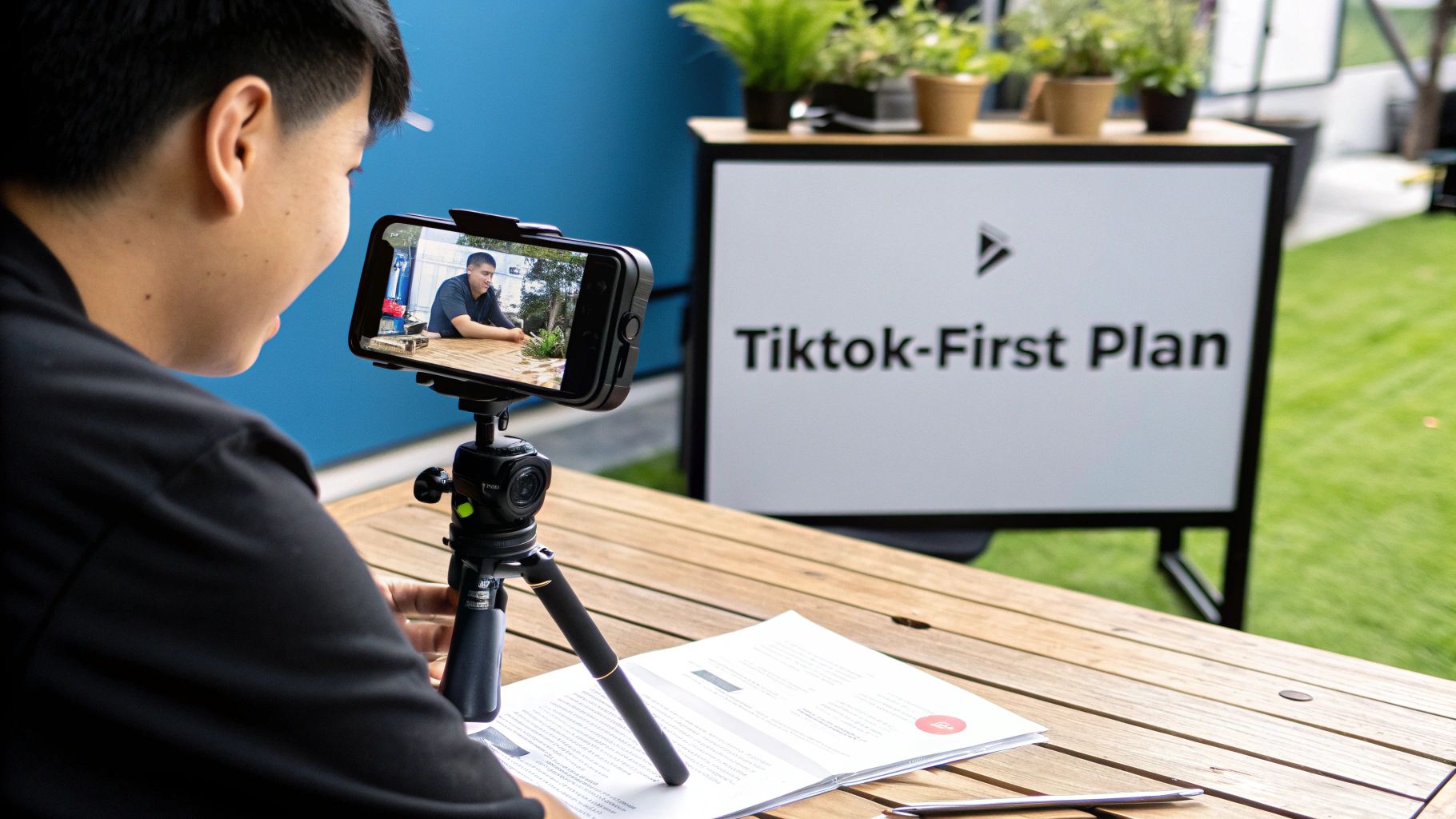
This is where the rubber meets the road—turning your big-picture strategy into something you can actually do every day. For any small business social media strategy to work today, it has to be built around short-form video. That means thinking TikTok-first.
Now, this doesn't mean you should ditch Instagram or Facebook. It simply means you create your core video content for the platform with the highest ceiling for organic reach (that’s TikTok) and then adapt it for everywhere else.
The days of painstakingly building a rigid, month-long content calendar are long gone. On TikTok, a trend can be born, go viral, and die in less than a week. Your plan needs to be fluid, giving you the freedom to jump on what’s hot right now without losing sight of your brand's core message.
This approach is so effective because short-form video is dominating social media, giving small businesses a real shot at standing out without a Hollywood-sized budget. By 2026, platforms like TikTok, Instagram Reels, and YouTube Shorts will only become more central to how people consume content. We're already seeing a huge shift: one in three consumers now start their search on social media instead of Google. For younger audiences, TikTok is the new phone book.
The Power of Content Pillars
To keep your content focused and consistent—but not boring—you need to build it on three core content pillars. These are the major themes you’ll circle back to again and again. It ensures every video has a purpose. Ideally, you’ll want a pretty even split, with each pillar making up about a third of what you post.
Here’s a simple breakdown:
- Educational Content: This is your "how-to" and "did-you-know" content. You're solving problems for your audience, sharing tips, and offering insights that position you as an expert. If you run a coffee shop, this might be a quick video on brewing the perfect pour-over. For a B2B consultant, it could be a 30-second clip busting a common industry myth.
- Entertaining Content: Here’s where your brand's personality shines. You're connecting with your audience through humor, relatable moments, and trending sounds. This is your chance to try a viral challenge or create a funny skit that resonates with your customers' experiences.
- Promotional Content: Yes, you can talk about what you sell, but you have to do it the TikTok way—no hard sells. Instead of a "buy now!" ad, show your product in action. Feature a glowing customer testimonial. Announce a special offer in a creative, engaging way.
Balancing these three pillars is what separates a brand that just sells things from a brand people genuinely want to follow. You provide value, build a real relationship, and naturally guide people toward becoming customers.
Your Daily TikTok Workflow, Simplified
The best part of a TikTok-first plan is how fast it can be. You’re not trying to create a cinematic masterpiece. The goal is to get relevant, engaging content out there quickly and consistently. Here’s a daily workflow that turns content creation from a dreaded chore into a task you can knock out in under an hour.
This is exactly where Viral.new comes in, dropping ready-to-shoot ideas straight into your inbox every day.
It takes the guesswork out of the equation. The dashboard gives you a simple, direct prompt tied to a current trend, so you’re never staring at a blank screen wondering what to post.
A structured workflow like this makes posting daily feel totally achievable.
Putting It All Into Practice
Let's see how this works for two completely different businesses.
Example 1: A Local Coffee Shop ("The Daily Grind")
- The Idea: Viral.new sends a prompt: "Use this trending audio to show 'a day in the life' of your business."
- Brainstorm (10 mins): The owner decides to shoot quick, aesthetic clips: fresh beans grinding, latte art being poured, a customer’s happy reaction, and the final wipe-down at closing time.
- Execution (30 mins): They grab the shots during quiet moments throughout the day. Later, they stitch them together in the TikTok app and add the trending sound.
- Pillar: Entertaining (with a behind-the-scenes feel).
Example 2: A B2B Marketing Consultant
- The Idea: The prompt is: "Use the 'green screen' effect to react to a common myth in your industry."
- Brainstorm (10 mins): The consultant finds a popular (but wrong) article about SEO and plans to debunk three key points.
- Execution (40 mins): They record themselves in front of a screenshot of the article, delivering sharp, valuable counters. They add text overlays to highlight the takeaways.
- Pillar: Educational.
In both cases, the content is relevant, fast to produce, and neatly fits into a content pillar. This system ensures you’re not just posting to post—you’re strategically building a library of content that serves your audience and your business. For more inspiration, check out our guide on TikTok content ideas for business. This repeatable process is the engine of a winning social media strategy.
Making Your Content Creation Workflow Actually Work
A brilliant strategy is just a piece of paper if you don't have the time or energy to bring it to life. For most small businesses, the real enemy of a great social media plan isn't a lack of ideas—it's burnout. That's why building a smart, repeatable workflow is the backbone of any small business social media strategy that gets results.
The goal here is to make content creation feel less like a massive, overwhelming project and more like a simple daily habit. A good system removes the "what should I post today?" headache and helps you consistently publish great videos without dedicating your entire day to it. Think of it as building a well-oiled machine that runs smoothly, even when you're swamped.
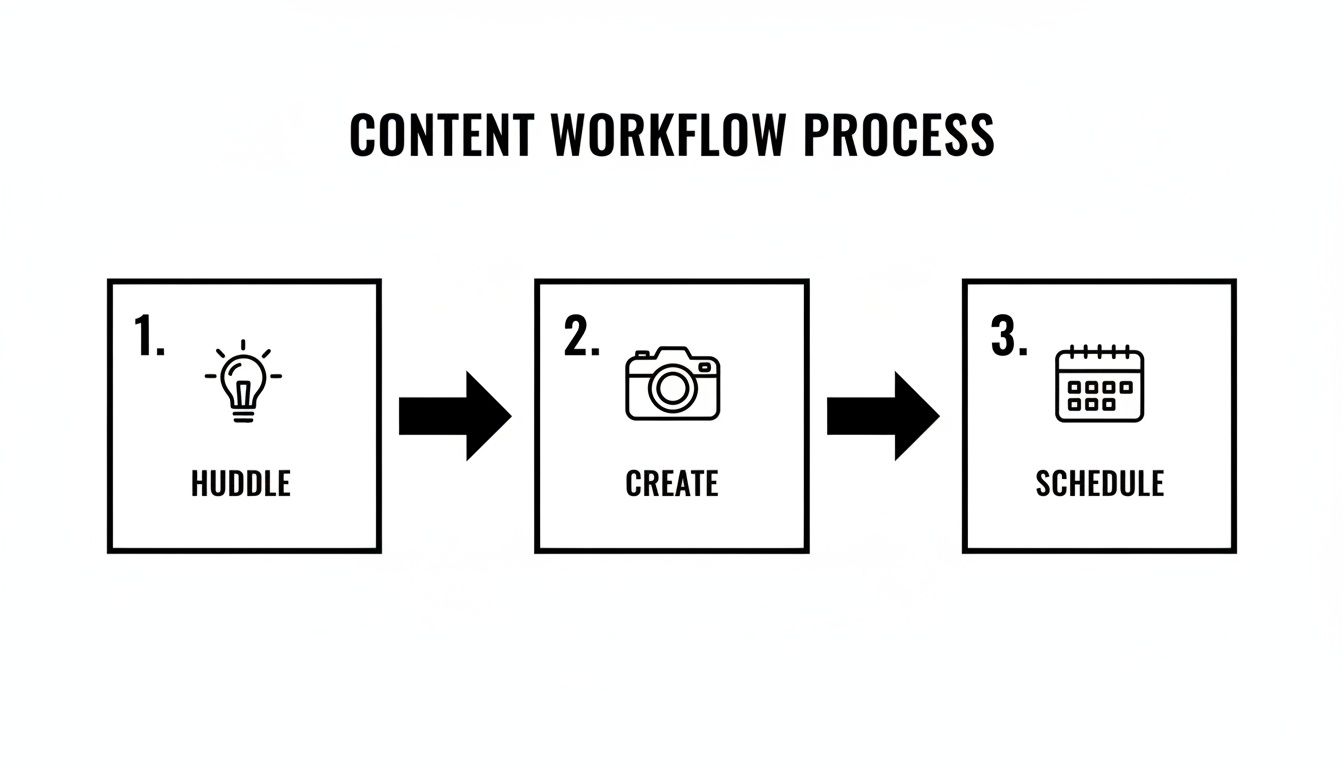
The 15-Minute Morning Huddle
Kick off each day with a quick, focused check-in. This isn't some long, drawn-out meeting; it’s a 15-minute sprint to lock in your content direction for the day. And when you're using a service like Viral.new, the hardest part—finding a relevant idea—is already handled.
Here’s what your morning huddle looks like in practice:
- Check the Idea: Open your daily email from Viral.new. Get a feel for the trend, the audio, and the core concept they’ve sent over.
- Find Your Angle: Ask yourself, "How can my business make this our own?" This is where you connect the idea back to your content pillars. Is this an educational moment, something entertaining, or a direct promotion?
- Map Out Your Shots: Quickly jot down 3-5 simple shots you'll need to film. For example, if the idea is a "day in the life" video, your list might be: 1) unlocking the shop, 2) making the first coffee, 3) a shot of a happy customer, 4) a quick behind-the-scenes moment.
This simple process takes an abstract idea and turns it into a concrete, actionable plan. You walk away knowing exactly what you need to create, which is the best way to kill the procrastination that comes from feeling overwhelmed.
Batch Your Filming and Edit on the Go
Efficiency is your new best friend. Instead of getting stuck in a cycle of filming, editing, and posting one video at a time, you need to embrace batch creation. All this means is setting aside a dedicated block of time to create multiple pieces of content at once. Maybe you film three different TikToks in a single hour on a Monday afternoon.
This approach saves a huge amount of setup and teardown time. Once you have your footage, keep the editing process just as simple. Today’s mobile editing apps are incredibly powerful, and you absolutely do not need complex desktop software to create a video that connects with people.
Your phone is a production studio in your pocket. Focus on clean cuts, clear text overlays, and perfectly synced audio—all of which can be done directly within the TikTok or Instagram apps.
Of course, if you want to level up, there are plenty of options. You can find some of the best tools for content creators in our detailed breakdown.
Schedule and Repurpose Everything
Once a video is edited and ready, don't just post it and move on. Use a scheduling tool to plan your posts in advance. This ensures a consistent flow of content even on your busiest days and helps you maintain momentum with both the algorithm and your audience.
Beyond that, a great TikTok video shouldn't just live on TikTok. Maximize the reach of every single piece of content you create by repurposing it for other platforms. A successful video can easily be adapted for:
- Instagram Reels: You can often post the exact same video. Just remember to remove the TikTok watermark first.
- YouTube Shorts: This is another perfect home for your vertical videos, helping you tap into a whole new audience on the world's second-largest search engine.
This "create once, publish everywhere" mentality is the secret to scaling your efforts without multiplying your workload. To really tighten up your process, it's worth looking into an efficient workflow for YouTube content creation with AI, as many of the same principles apply. By building a system around a daily huddle, batch creation, and smart repurposing, you're not just posting content—you're running a powerful content machine that consistently delivers for your business.
How to Measure Success and Optimize Your Approach
A strategy without measurement is just wishful thinking. To turn your social media efforts into a real asset for your business, you have to track the right numbers and let that data guide your next move. It’s all about focusing on the Key Performance Indicators (KPIs) that actually signal growth, not just vanity metrics.
Honestly, creating the content is only half the job. Your small business social media strategy needs a feedback loop—a way to see what’s hitting the mark, what’s falling flat, and why. This is how you stop throwing content at the wall and start making smart decisions that actually improve your results.
Choosing Metrics That Matter
It's so easy to get obsessed with follower counts, but that number rarely tells the whole story. A huge audience that never engages, clicks, or buys is far less valuable than a smaller, dedicated community that hangs on your every word.
Instead, let’s pivot to metrics that reveal how your content is really doing.
- Average Watch Time: On platforms like TikTok, this is gold. A high average watch time signals to the algorithm that your content is genuinely interesting, which can seriously boost your reach.
- Click-Through Rate (CTR): If your goal is to get people to your website, this is the number to watch. It tells you the percentage of viewers who saw your post and actually clicked the link in your bio.
- Conversion Events: This is where the rubber meets the road. This tracks how many people took a valuable action after clicking through, like signing up for your newsletter or buying a product. It connects your social efforts directly to business results.
A consistent content workflow is the engine that feeds your measurement process. Without a steady stream of new posts to analyze, your data won't be very reliable.
Here's a breakdown of the metrics that provide the clearest picture of your social media health, moving from broad awareness to direct business impact.
Key Social Media Metrics for Small Business Growth
| Metric Category | Key Performance Indicator (KPI) | What It Tells You | Platform Example (TikTok) |
|---|---|---|---|
| Awareness | Video Views & Reach | How many unique people are seeing your content. This is your top-of-funnel exposure. | Total video views in the last 28 days. |
| Engagement | Likes, Comments, Shares, Saves | How much your audience is interacting with your content. It shows resonance and community health. | Total shares on a specific video. |
| Interest | Average Watch Time | How captivating your content is. Higher watch times tell algorithms to show your video to more people. | A video's average watch time compared to its total length. |
| Consideration | Profile Visits & Link Clicks | How many people are interested enough to learn more about your brand or visit your website. | Clicks on the link in your bio. |
| Conversion | Leads, Sign-ups, Sales | The ultimate goal: how many users are taking a specific, valuable action for your business. | Tracking sales or sign-ups that originated from a TikTok ad. |
By tracking a mix of these KPIs, you get a holistic view of your performance and can identify exactly where your strategy needs a tune-up.
Creating a Simple Review Cadence
You don’t need a fancy, expensive analytics dashboard to find powerful insights. A simple weekly and monthly review is more than enough to keep your strategy sharp and effective.
Your weekly review can be a quick, 20-minute check-in. Just pull up your analytics and look at your top-performing videos from the last seven days. What did they have in common? Was it the hook? The format? The topic? Jot down those patterns.
Once a month, it’s time for a deeper dive. This is where you zoom out and look for the bigger trends.
Use your data to answer these key questions: Which of my content pillars drove the most engagement? Which video hooks resulted in the highest watch time? Are there specific days or times my audience is consistently more active?
This data-driven mindset is non-negotiable for small businesses today. A staggering 96% of small business owners are already on social media for marketing. That level of competition means you have to be strategic to stand out, especially when you realize that 93% of all internet users are on social platforms. You can find more data on why social media is a must-have for small businesses in this report.
This cycle of creating, measuring, and optimizing is what separates a social media presence that just exists from one that actually grows and delivers a return. It turns your content from a daily chore into a strategic investment that pays dividends.
Pouring Some Gas on the Fire: Scaling Your Reach with Ads
Organic reach is a fantastic starting point, but every business eventually hits a plateau. When your growth starts to level off, it's time to step on the gas. A smart, strategic ad spend can take what's working and show it to thousands of potential new customers, amplifying your results in a big way.
If you're like most small business owners, the thought of paid ads probably sounds complicated and expensive. But here’s the thing: you don't need a massive budget to get real results. You can actually make a significant difference starting with just $5-$10 per day, especially if you're smart about it instead of just hitting the "boost post" button and hoping for the best.
So, where do you start? With your winners. Go find an organic video that’s already doing well—one with great watch time, a lively comment section, and a decent number of shares. Putting a small budget behind that specific post is like pouring fuel on an already burning fire. Your audience has already told you they love it, which dramatically increases the odds that a new, colder audience will love it too.
Kicking Off Your First TikTok Ad Campaign
Diving into paid ads on a platform like TikTok is a lot less intimidating than it seems. The trick is to keep it simple at first. Pick one clear goal, like getting more people to your website or getting more eyeballs on a specific video.
To get started, you'll just need to think through a few core pieces:
- Your Goal: What, exactly, do you want this ad to do? For most small businesses, good starting points are Reach (showing your ad to as many people as possible) or Traffic (sending people directly to your website).
- Your Audience: Who are you trying to talk to? You can get pretty specific here, targeting people based on their interests, online behaviors, and even how they've interacted with your content before. A local coffee shop, for instance, could target users aged 18-35 within a 5-mile radius who have shown an interest in #latteart or #coffeeshopvibes.
- Your Budget: You’re in complete control here. Set a daily or lifetime budget that feels comfortable. Starting small is the best way to test the waters and figure out what works without a big financial risk.
One of the most powerful—and affordable—tactics you can use is retargeting. This just means showing your ads to people who have already engaged with you in some way, whether they liked a post, visited your profile, or watched one of your videos. These are warm leads, and they're way more likely to take the next step because they already know who you are.
How to Know if Your Ads Are Actually Working
Once your campaign is running, you need to figure out if your money is doing its job. Don't let yourself get overwhelmed by all the data. Just focus on a couple of key numbers that tell you what you really need to know.
- Cost Per Click (CPC): This is simply how much you pay every time someone clicks on your ad. A lower CPC is what you're aiming for—it means you're getting more visitors for less money.
- Return On Ad Spend (ROAS): This is the ultimate report card for your ad. It shows you exactly how much money you made for every dollar you spent. If you have a ROAS of 4:1, that means you brought in $4 in revenue for every $1 you spent on that ad. A clear win.
This kind of smart spending is quickly becoming a must-do, not a nice-to-have. Global social media ad spend is expected to reach $317.33 billion by 2026, and it's not just big brands getting in on the action. In fact, 55% of small business owners in the US are already running ads on social media, and 84% of them say their campaigns are a success.
If you're curious, you can discover more insights about social ad spending and its impact on businesses like yours. By starting small and doubling down on what's proven to work, paid ads can become one of the most predictable and powerful tools you have for growing your business.
Questions We Hear All the Time
Even with a solid plan, you're going to have questions. That's a good thing! It means you're in the trenches, doing the work. Here are some of the most common hurdles small business owners run into when they first get serious about social media.
What's the "Magic Number" for Posting on TikTok?
Everyone wants a magic number, but the real answer is all about consistency, not just raw frequency.
While a great target to work towards is 1-3 high-quality posts per day, don't burn yourself out trying to get there on day one. Start with one fantastic video a day. Nail that process. More importantly, make time to actually engage with the comments you get.
Once you feel like you have a rhythm and aren't scrambling, then you can experiment with adding a second or third post. This is how you build real momentum without your quality tanking.
I Hate Being on Camera—Am I Doomed?
Not at all! This is a huge misconception. Some of the most viral content on TikTok doesn't feature a single face. Your authenticity comes from the value and story you share, not from being a talking head.
You've got a ton of other creative options:
- Screen Recordings: A lifesaver for showing off software, an app, or a digital product.
- Product-as-the-Star: Let what you sell be the main character. Think aesthetic shots, close-ups, or showing the product being used.
- Text & Sound Stories: Use a trending audio track and tell a compelling story just with text on the screen. It's incredibly effective.
- Simple Voiceovers: Record your voice over B-roll footage of your workspace, your process, or stock clips that help tell your story.
Seriously, How Long Until I See Results?
This is the big one, right? While every account is different, you can expect to see early signs of life—like a noticeable uptick in views and comments—within 2-4 weeks of consistent posting. You have to give the algorithm time to figure out who your people are.
As for the results that really move the needle, like a steady stream of website traffic or genuine leads, you should plan for that to take 3-6 months to build. Think of it as building a foundation. You can often speed this up by putting a small, strategic ad spend behind your top-performing videos to get them in front of fresh eyes.
Stop guessing and start growing. Get daily, trend-aligned TikTok ideas delivered to your inbox with Viral.new and turn your content creation into a simple, repeatable system. Start getting your daily ideas now.
