
You post a video that feels just as strong as your last one, then watch it stall while your previous upload keeps collecting views. Followers stop responding, For You traffic appears to vanish, and every new post seems to confirm the same fear: why is TikTok shadow banning me?
That reaction is understandable, but the “shadowban” label often sends creators toward the wrong fix. TikTok doesn't publish a formal policy category called a shadowban. A reach drop can come from ordinary video-by-video ranking, recommendation filters, content eligibility issues, or account enforcement. The practical task is to identify which signal changed, then correct it without making your account look even more erratic.
What Is Actually Happening When Your TikTok Reach Drops
A sudden reach drop can look like a hidden penalty. Your profile still works, uploads go through, and no warning appears, yet a video that once attracted new viewers now stalls. That pattern feels personal, but it can result from video-level ranking, recommendation eligibility, or automated safety checks.
TikTok does not use “shadowban” as an official policy term, and platform explainers note that TikTok has not acknowledged a formal shadow-ban system. A 2026 summary cited research and a 2022 Center for Democracy and Technology report estimating that 3.2% to 21% of social media creators believe they have been shadow-banned (Hootsuite's explanation of shadowbanning). The range shows why the label is difficult to verify. Creators can see reduced distribution, but they generally cannot tell from view counts alone whether the cause was enforcement, weak early response, or ordinary ranking volatility.
Reduced distribution is still real
Rejecting the label should not dismiss the outcome. TikTok's moderation and recommendation systems may reduce a video's exposure before any account suspension appears. TikTok said that in Q3 2021 it removed over 91 million violative videos, about 1% of all videos uploaded during that period. 95.1% of those removals happened before a user report, 88.8% before the video received any views, and 93.9% within 24 hours of posting (Hootsuite's summary of TikTok's enforcement data).
Those figures concern removed videos, not a hidden account penalty. They still show how early automated systems can act. TikTok also says it tries not to recommend certain content categories that may be inappropriate for a general audience. A video can therefore remain available while receiving less exposure through For You, search, or other discovery surfaces.
Practical rule: Treat “shadowban” as a description of an outcome, not a diagnosis.
Check each affected video separately. Ask whether it lost recommendation eligibility, failed its initial audience test, or triggered an account-level restriction. Compare retention, skips, traffic sources, and notices in account status before changing your entire strategy. That process replaces algorithmic speculation with checks you can perform.
How TikTok's Recommendation System Evaluates Your Content
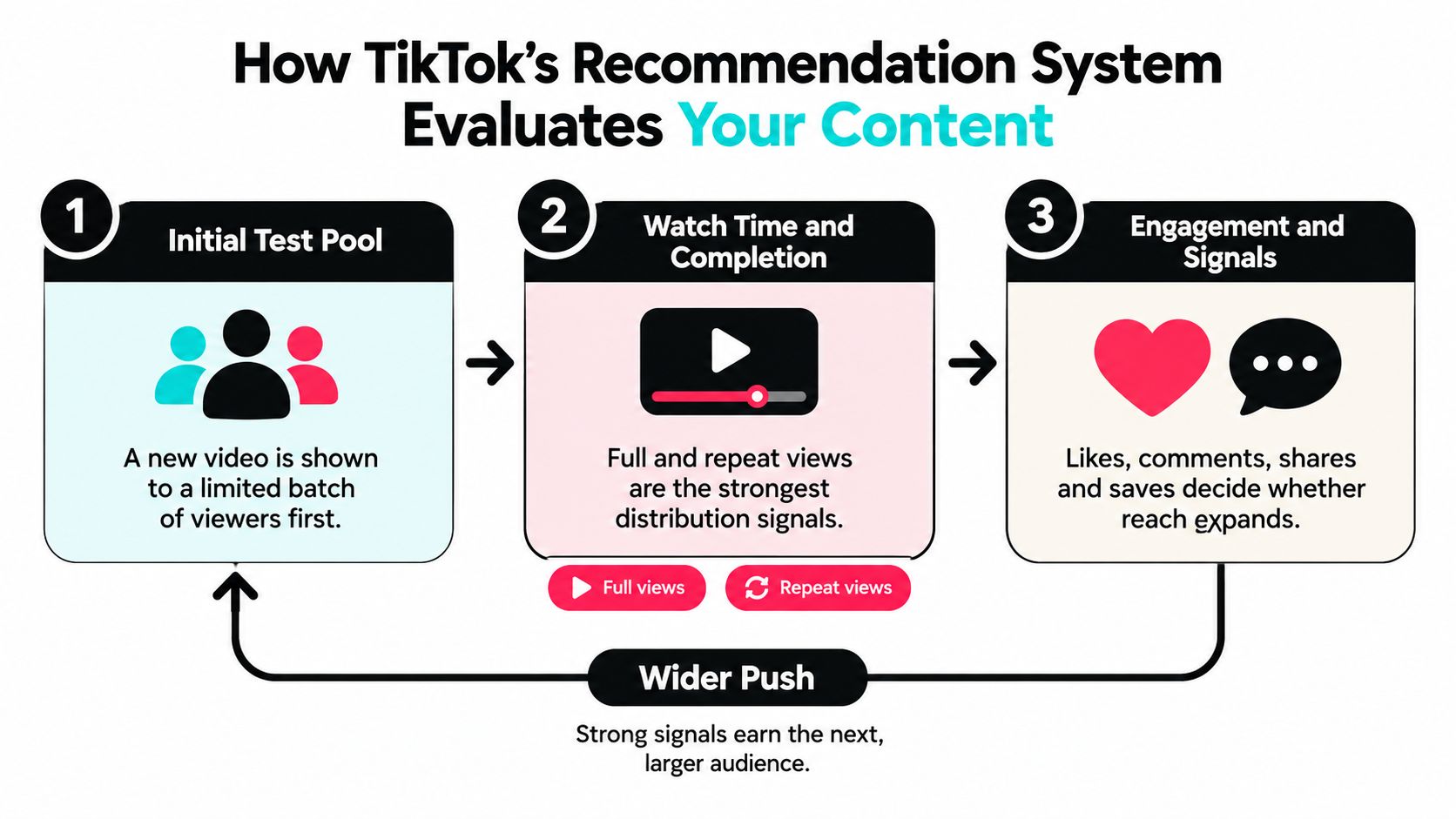
TikTok's public explanation identifies three main inputs for recommendation: user interactions, content information, and user information (TikTok's recommendation system guide). These inputs help the platform decide which viewers are likely to find a video relevant, then whether the video deserves broader distribution.
User interactions
The first signal is what viewers do with the video. Watching, skipping, liking, commenting, sharing, and saving all help TikTok interpret interest. Watch time and completion matter because a viewer who stays through the ending gives the system stronger evidence than someone who leaves immediately.
A weak opening can therefore look like a distribution problem even when the topic is sound. If viewers need several seconds to understand the promise, many may swipe before the video establishes its value. The system then has less reason to expand the audience.
Content information
TikTok also reads the video itself. Captions, hashtags, sounds, spoken language, and on-screen text help classify the topic and match it with potential viewers. Metadata that describes one subject while the footage delivers another can create a poor audience fit.
For example, broad trend tags may attract viewers who don't care about a niche tutorial. Their quick exits can weaken the video's early signals. Relevant wording usually gives the recommendation system a clearer route to an interested audience.
User information
User information provides context around language, location, device settings, and viewing behavior. It doesn't mean the platform shows every creator to the same audience in the same way. Distribution depends on the relationship between the video, the people seeing it, and how those people respond.
Use your analytics to compare videos with similar topics rather than comparing every upload with your biggest outlier. For a broader framework for interpreting performance across channels, the multi-platform ad metrics guide can help separate reach, engagement, and conversion signals instead of treating views as the only measure of success.
The result is a clip-by-clip ranking process. One weak post doesn't prove your account is suppressed. A repeated pattern across several relevant uploads deserves investigation.
Common Triggers That Suppress Video Distribution
Distribution problems usually begin with a mismatch between what you publish and what TikTok can safely or confidently recommend. Review recent uploads, captions, editing workflows, and account activity together. Don't inspect only the video with the lowest views.
Run this audit
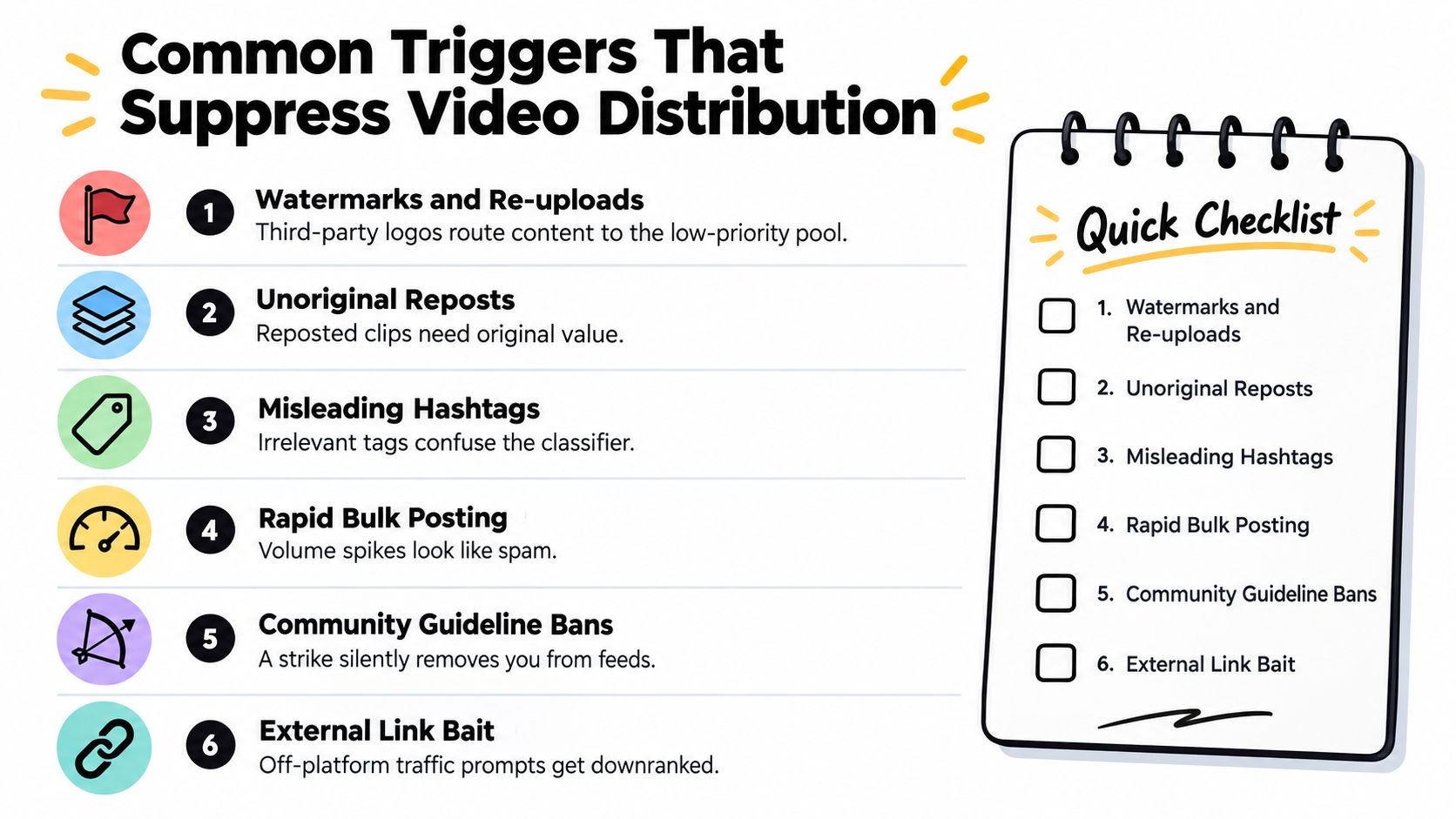
- Recycled footage: Reuploads and lightly edited clips can look repetitive or unoriginal. Add a clear original contribution, such as commentary, analysis, demonstrations, or a new narrative.
- Misleading metadata: Hashtags that don't match the spoken topic can confuse classification and attract the wrong viewers. Relevance is more useful than attaching every popular tag.
- Watermarks and third-party branding: A visible logo from another platform can make a post look repurposed rather than native. Export clean footage and build platform-specific edits.
- Rapid bulk activity: A sudden burst of near-identical uploads, repetitive comments, or automated actions can resemble spam. Publishing more often doesn't repair weak content signals.
- Borderline policy material: Sexualized framing, dangerous acts, graphic scenes, harassment, and misleading claims may receive limited recommendation even when the post isn't removed.
- Intellectual-property problems: Repeated copyright complaints or multiple intellectual-property strikes can affect account standing. Check that footage, audio, and branded material are yours or properly licensed.
- Ban-evasion behavior: TikTok says an account can be limited for creating another account to avoid restrictions, reaching a strike threshold, or existing mainly to violate rules (TikTok's content violations and bans guidance).
A common mistake is deleting everything in a panic. Remove or appeal content when you can identify a genuine issue, but preserve your analytics notes first. You need to know whether the problem followed a specific format, topic, sound, or behavior.
For a closer review of what content can create eligibility problems, use this practical guide to TikTok content guidelines. It's more useful to make a targeted correction than to wipe your entire library without understanding the trigger.
Diagnosing Your Account Versus Normal Algorithmic Volatility
A single flop is weak evidence. TikTok can rank two videos from the same account very differently because their hooks, subjects, viewer fit, or early responses differ. The more reliable signal is a repeated pattern across several uploads, especially when those uploads use different hooks but serve the same audience.
Start with TikTok's native analytics. Check whether new videos still receive any For You traffic, whether followers can see them, and whether search contributes views when your caption and spoken topic are tightly aligned. Look for changes in audience behavior, not just the headline view count.
Compare the symptoms
| Observation | More consistent with video-level volatility | More concerning for account-level enforcement |
|---|---|---|
| One post underperforms | Common and inconclusive | Not enough evidence |
| Similar posts repeatedly lose discovery | Possible topic or retention mismatch | Worth checking account status and violations |
| Followers still engage | The account remains reachable | Doesn't rule out content limits |
| Videos show policy or review notices | Content eligibility issue | Escalate through TikTok's tools |
| New posts lose multiple discovery surfaces | Could be a classification problem | Investigate repeated policy or integrity signals |
This distinction matters because creators often try to “fix the account” when the problem sits inside the video. TikTok-facing guidance emphasizes that content can be re-ranked per video because of weak early signals, rather than an account being globally suppressed (TikTok Shop's creator guidance).
Don't make a permanent strategy change because of one underperforming upload.
Use a controlled test. Keep the audience and topic stable, then change one variable at a time: the first sentence, opening visual, duration, caption, or edit structure. If a clearer hook restores retention while the account and topic remain the same, you've learned more than a third-party “shadowban checker” could tell you.
You can also follow this focused guide to checking whether you're shadowbanned on TikTok. The goal isn't to prove a conspiracy. It's to determine whether the issue is eligibility, account standing, or ordinary ranking variance.
A Step-by-Step Recovery Plan to Rebuild Your Reach
Recovery works best as a controlled reset, not a burst of desperate activity. Creators often respond to low reach by posting repeatedly, changing niches overnight, buying engagement, or stuffing captions with broad tags. Those actions make diagnosis harder and can introduce new trust and relevance problems.
1. Check account standing first
Review TikTok's account and content notifications. Look for removed posts, recommendation eligibility messages, intellectual-property complaints, or restrictions that match the date your reach changed. Save screenshots and note the affected videos before editing or deleting anything.
If TikTok offers an appeal and you believe the decision is wrong, use the platform's own process. A calm, specific appeal is more useful than accusing the system of censorship.
2. Stop repeating the suspected trigger
Pause the format or behavior that may have caused the issue. That could mean removing a misleading hashtag set, replacing reused footage, stopping rapid automated actions, or avoiding a borderline visual style. A short publishing pause can be sensible when your activity itself looks chaotic, but it isn't a guaranteed reset button.
During the pause, audit your last successful posts and recent failures. Compare the first few seconds, viewer promise, topic specificity, and payoff. The purpose is to return with a clearer video, not merely to wait and repost the same problem.
3. Rebuild around retention
Your first shot and sentence should tell the intended viewer why the video deserves attention. Cut greetings, long introductions, and context that can wait until after the promise. Deliver the payoff, then give viewers a reason to comment, save, or share because the content helped them, not because you demanded engagement.
A practical relaunch sequence might include:
- One clearly original video in a proven content pillar.
- A caption that accurately describes the subject.
- A clean edit without recycled platform branding.
- A direct response to a real audience question.
- An analytics review before you change the next variable.
4. Fill the idea gap deliberately
Reach slumps often create creative paralysis. You second-guess every topic, then publish whatever is quickest, which can produce the same weak signals that started the problem. An idea tool such as Viral.new can deliver trend-aligned, niche-specific prompts based on a creator's business or offer, giving you more concepts to test while you focus on hooks, execution, and audience fit.
Use this recovery guide for getting out of a TikTok shadow ban as a checklist, not a promise of instant restoration. The recovery signal you want is consistent eligibility and stronger viewer response across multiple original posts.
Building a Sustainable Content Strategy for Long-Term Growth
A recovery plan is temporary. A durable strategy reduces the number of reasons you need one by making every upload easier to classify, safer to recommend, and more useful to a defined audience.
Choose a small group of content pillars that connect to the same audience need. A local business might rotate between demonstrations, customer questions, behind-the-scenes explanations, and product use cases. A personal brand might combine tutorials, opinions grounded in experience, responses to audience comments, and evidence of the work itself. The formats can vary, but the audience promise should remain recognizable.
Build a feedback loop
Review performance by pattern:
- Hook quality: Does the opening make the subject clear immediately?
- Retention: Do viewers stay long enough to reach the useful part?
- Topic fit: Are the people seeing the video the people you want to attract?
- Conversation value: Does the post answer a question or invite a meaningful response?
- Eligibility: Have any policy, copyright, or recommendation notices appeared?
Don't chase every trend. A trend that attracts the wrong viewers can produce fast exits and weak downstream signals. Adapt a format only when it gives your audience a natural way to understand your subject.
Keep your publishing cadence consistent enough to learn from, but avoid repetitive bulk behavior. Maintain clean source files, write accurate captions, and document which variables changed between uploads. That discipline turns TikTok from a slot machine into a testing environment.
The core mindset is simple: stop asking whether TikTok is secretly punishing you, and start asking which signal your latest video failed to earn. You can't control every ranking decision, but you can control originality, clarity, retention, relevance, and policy compliance.
Viral.new turns your niche, offer, and audience into fresh TikTok video prompts aligned with current formats and practical hooks. Visit Viral.new to keep your testing pipeline full and return to publishing with clearer ideas instead of repeating the same reach problem.
