

Are you really looking for a list of viral sounds, or do you need to know which repeatable video structures keep working after a sound fades? On TikTok, fast-moving ideas usually combine an adaptable format with timely audio, visual language, and a clear audience payoff. A sound can create an opening, but the format determines whether viewers watch, search, comment, save, share, or consider an offer.
This guide classifies 10 formats behind trending TikTok videos by their underlying growth mechanism: watch time, search intent, proof, participation, community, and conversion. You'll find behind-the-scenes stories, tutorials, remixes, transformations, hot takes, niche in-jokes, educational series, unboxings, customer content, and participation challenges. Each one works across industries because you can change the hook and evidence without rebuilding the format from scratch.
Evaluate an idea against four practical questions: Does it fit the audience? Can you produce it quickly? What should make viewers stay? What business action should follow? A useful workflow is simple: identify the format, adapt the opening to your niche, choose an available sound that supports the idea, publish promptly, then review the audience response. This approach is more durable than comparing TikTok and Instagram for clippers by surface-level virality alone. When you need a steady source of niche-specific prompts, Viral.new can also help turn current trend signals into ready-to-shoot concepts.
1. Day-in-the-Life and Behind-the-Scenes Content
A polished product tells viewers what you sell. A working process shows them who makes it, how it's made, and what standards guide the result. That distinction makes day-in-the-life and behind-the-scenes content useful for brands that need trust before a purchase.
A coffee shop owner could film the first espresso calibration, milk steaming, and a failed latte-art attempt before serving the finished drink. An e-commerce team might show order picking, packaging, and the handoff to the courier. A fitness coach can document a morning routine and meal preparation, while a jewelry maker can move from raw materials to a finished piece.
The underlying mechanism is human connection supported by watchable progression. Viewers want to see what happens next, especially when a process includes a small problem, a decision, or a satisfying finish. Unfiltered process also fits the current movement toward real stories, work-in-progress moments, and behind-the-scenes access described in TikTok trend analysis from Hootsuite.
Build a compact narrative
Film several short clips during the day instead of trying to record one continuous take. Edit them into a sequence with a beginning, a task, a complication, and an outcome. Text overlays can add context through timestamps, production details, or a surprising fact about the work.
Use a currently available sound when it complements the pace, but don't let the audio replace the story. Show imperfections when they clarify the process, rather than staging mistakes for attention. For more ideas, see this guide to behind-the-scenes content.
Practical rule: The process should reveal something a customer couldn't learn from a product photo.
For a local business, end with an invitation to visit or book. For a product brand, show the finished item in use. For a personal brand, ask viewers which part of the workflow they'd like to see next.

2. Quick Tutorials and Problem-Solution Videos
Tutorials are among the clearest answers to what videos are trending on TikTok because they align entertainment with search intent and immediate utility. The audience arrives with a question, watches for the solution, and may save the video for later.
A skincare creator can demonstrate a simple evening routine. A clothing brand can show three ways to style one item. A productivity software company can explain one feature that removes a repetitive task. A local repair business can answer a common maintenance question with a close-up demonstration.
The evidence supports this format strongly. A 2026 social-media summary citing Adobe Express reports that 62% of TikTok users prefer tutorials, compared with 39% for product or service reviews and 38% for personal stories. The same summary reports that 60% of users interact with short-form videos shorter than 60 seconds, so a focused lesson can fit the platform's preference for quick comprehension. See the TikTok statistics summary from Buffer for the cited figures.

Give the viewer one solvable problem
Put the outcome in the first frame. “How to stop your screen protector bubbling” is stronger than “A few tips for your phone.” Use captions for every step, since viewers may watch without sound, and cut pauses between actions.
A useful tutorial sequence looks like this:
- Name the problem: State the question in the opening frame.
- Show the method: Demonstrate each action rather than describing it abstractly.
- Reveal the payoff: Let viewers see the corrected result.
- Offer the next step: Invite a follow, product trial, consultation, or visit.
After the main explanation, use a short product-in-context shot or a second angle to make the process easier to copy. That visual reinforcement matters more than adding extra tips that dilute the central answer. Brands developing product-led tutorials can also explore this resource on an AI video generator for clothing brands, while creators can find production guidance in how to create tutorial videos.
3. Trend Remixes and Sound Jacking
Using a popular sound isn't a strategy by itself. The stronger format is recognizable audio plus a niche-specific visual interpretation. That combination lets a creator borrow existing attention while giving viewers a reason to watch this version.
A fashion account might pair a familiar transition sound with an outfit change for a specific occasion. A coach could match a motivational audio clip to a client lesson. A product business might sync the beat to an unboxing, feature demonstration, or rapid comparison. The audio supplies cultural context, while the visual supplies relevance.
TikTok's scale explains why this format moves quickly. Recent industry summaries estimate roughly 1.9 billion monthly active users globally in 2026, and benchmark reporting cited by multiple social sources says users upload about 16,000 videos every minute, or roughly 23 million videos per day. The same TikTok statistics source from Sprout Social reports median engagement around 4.56% to 4.86% in 2025 and 2026. In such a crowded stream, creators need a format they can recognize and adapt before the audience has moved on.
Add context instead of copying
Monitor TikTok's Discover and Sounds areas, then ask whether the sound can express a customer tension, transformation, or point of view. Film multiple variations with different openings, but change the visual idea rather than posting the same clip repeatedly.
For a restaurant, the sound could frame a customer's reaction to an unexpected menu item. For a software company, it could dramatize a common workflow mistake and its fix. For a personal brand, it could contrast an old assumption with a more useful approach.
The audio earns the stop. Your niche-specific context earns the watch.
Trend lifespan is the central trade-off. Research cited by Marketing-Interactive indicates that nearly half of TikTok trends disappear within five days, while only a small minority last beyond two weeks. That means production speed and format flexibility matter more than elaborate editing. Use this guide to find trending sounds, then publish only when the audio supports a clear audience idea.
4. Transformation and Results-Focused Content
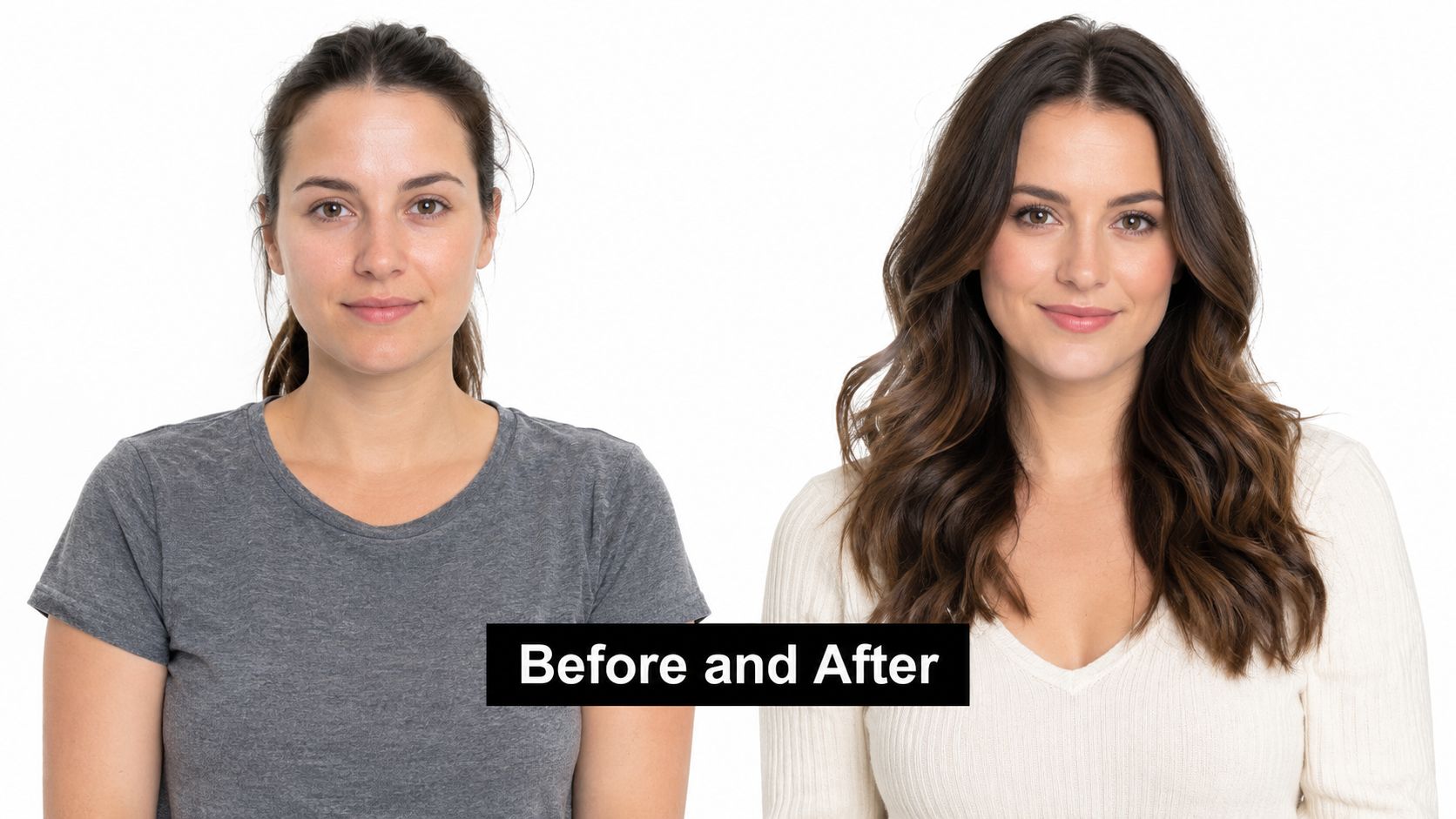
Transformation videos turn an abstract promise into a visible sequence. They work through proof, anticipation, and emotional payoff, whether the change involves a room, a skill, a routine, or a product experience.
A home organizer can begin with a crowded cupboard and end with a labeled system. A language teacher can compare a beginner's first recording with a later speaking sample. A fitness creator can document sustainable habit changes. A beauty brand can show how a product is applied and what the user notices over time. The format is adaptable because the “before” and “after” can represent a process, not just appearance.
The strongest execution makes the path credible. Use consistent framing and lighting where comparison matters, explain the actions that produced the result, and distinguish your own experience from a guarantee. A transformation without context can attract views but leave the audience uncertain about what caused the change.
Make progress understandable
Use a narrative arc rather than a rapid slideshow. Open with the starting problem, introduce the intervention, show intermediate evidence, and finish with the result. If you have legitimate progress measures, display them clearly, but don't add precision to make the video sound scientific.
A creator could structure a decluttering video around three decisions: what stays, what leaves, and how the new system works. An e-commerce brand could show a product before use, the application process, and the finished result in a real setting. A coach can explain the habit behind the visible improvement.
Ask a specific question at the end, such as which stage was most useful or what viewers want to see tested next. That converts passive validation into comments and gives you material for a follow-up. Keep claims realistic, especially in health, finance, and appearance categories, where an impressive edit must not imply a universal outcome.
5. Controversy and Opinion-Driven Hot Takes
Hot takes earn attention by creating a decision point. Viewers agree, challenge the premise, or contribute an example. The format therefore grows through comment and conversation, while its conversion value depends on whether the opinion attracts people with a relevant problem.
Start with a defensible tension, not an insult. A business coach might argue that adding channels can weaken a small team's marketing. A fitness creator could question whether a popular routine suits beginners. A marketing consultant might explain why attention without a relevant offer does not automatically create sales. A product founder can challenge a category convention without naming a competitor.
The creative pattern is simple: make the disagreement specific enough to discuss and narrow enough to support. Use an observation, demonstration, or documented experience as evidence. If the opposing approach works in certain conditions, name those conditions. This boundary makes the argument more credible and gives viewers a useful reason to respond.
For execution, build the video around four questions:
- What is the claim? State the opinion in the opening.
- Why might it be true? Explain the mechanism or show an example.
- Where does it fail? Identify the audience or situation that needs a different approach.
- What should viewers test? Ask for a counterexample, experience, or result.
Keep criticism aimed at ideas, systems, or common habits rather than individuals. Humor can lower defensiveness, but it should not hide the evidence. Review comments after publishing if the topic involves health, money, politics, or regulated products.
Match the next step to the argument. A consultant can invite viewers to audit their process. A product company can demonstrate the alternative it recommends. The goal is qualified participation, not maximum conflict. A strong opinion filters for people who share the problem and value the reasoning behind your solution.
6. Niche Community and In-Jokes Content
Broad entertainment can reach many people, but specific recognition creates belonging. Niche community videos use shared vocabulary, familiar frustrations, and references that make a viewer think, “This account understands my world.”
A game master can joke about players ignoring the planned storyline. An indie hacker can show the emotional swing between a product launch and a quiet dashboard. A gardener can dramatize a problem that only balcony growers face. A sustainability creator can use an everyday household moment to speak to people trying to reduce waste.
This format works through identity and participation, not just information. The viewer may comment with a shared phrase, tag someone from the same community, or follow because the account consistently reflects their interests. TikTok's trend coverage also emphasizes the value of communities, emotionally resonant stories, and content that makes people feel seen, rather than content built only for broad reach. The relevant discussion appears in Sprout Social's 2026 social media trends overview.
Keep the door open
Insider language should feel natural, not like a brand copying a subculture. Spend time watching how community members describe their problems, then use those expressions only when you understand their meaning. Celebrate other creators, respond to community references, and avoid presenting yourself as an outsider with borrowed slang.
A niche video can have two layers. The first rewards existing members with a precise reference. The second gives newcomers enough context to understand why it matters. For example, a woodworking joke can show the specific mistake, then explain the lesson in the caption.
Ask a community question that invites stories rather than a generic “Who agrees?” A gardening brand might ask what plant repeatedly fails in a particular climate. A software founder might ask which part of building in public feels hardest. Those responses can become the next series of videos, creating a feedback loop between community language and content planning.
7. Educational Series and Mini-Courses
One useful video answers a question. A series builds a return habit and a structured funnel. Educational sequences work especially well when the topic has several decisions, stages, or mistakes that can't fit into one clip.
A social media manager can publish a content creation challenge. An e-commerce founder can document a product launch from positioning to promotion. A writing coach can teach one copywriting principle per episode. A fitness creator can build a progressive routine, provided the advice stays appropriate and responsible for the audience.
The series mechanism combines watch time, saves, follows, and continuity. Viewers know what the account teaches and why another episode may be worth watching. TikTok benchmark data also shows that longer videos can produce the most median views even when shorter videos generate stronger engagement. In the cited analysis of more than 6 million TikTok videos, the 15 to 30 second band reached 6.00% engagement, compared with a 2.60% overall average across 69 million videos, while videos between 120 and 180 seconds generated median views of about 11,136. These figures come from Fastlane's short-form video benchmarks.
Design each episode to stand alone
Label episodes clearly, but don't force viewers to watch every previous part before they receive value. “Day 3 of 7, write the offer before the headline” is more useful than a cliffhanger that withholds the answer.
Use a consistent release rhythm that your team can sustain. Introduce the full promise in the first episode, give every part a specific outcome, and reserve a deeper resource or paid offer for viewers who want implementation support. A final lesson can invite an email signup, consultation, course purchase, or product trial, but the free sequence should still solve meaningful problems.
Choose the length based on the lesson, not a fixed rule. A concise definition may suit the shorter engagement band, while a demonstration or case explanation may need more time. Review completion, saves, comments, and follows by episode to find where the series earns attention or loses it.
8. Unboxing and Product Showcase Videos
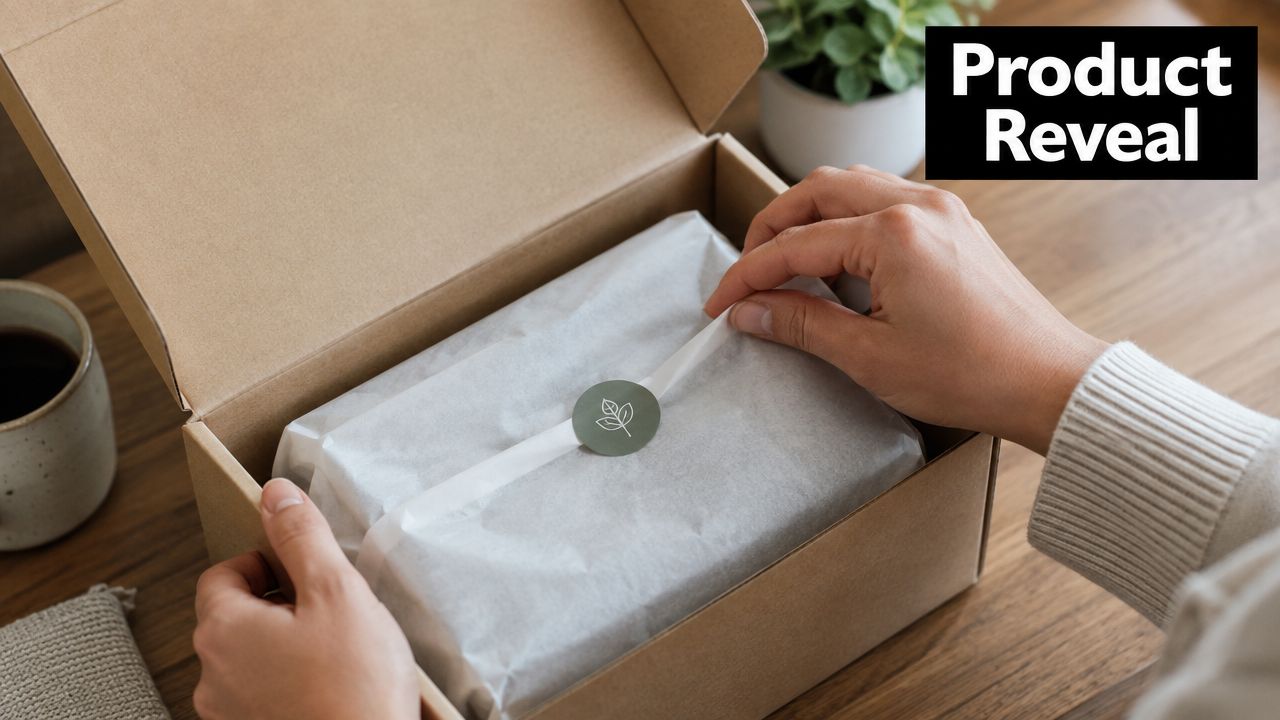
A sealed package creates a simple attention sequence: viewers anticipate the reveal, inspect what arrives, then assess whether the product fits their needs. That makes unboxing a proof and conversion format rather than a packaging exercise. The creative pattern works best when each visual answers a buying question.
Use the niche to shape the reveal:
- A coffee roaster can open a limited bean selection, then explain the roast profile.
- A beauty brand can show the first application and the product's finish.
- A technology company can move from box contents to a first feature tour.
- A fashion brand can reveal a collection while showing fabric, fit, and styling.
Packaging supplies the sensory hook. Tissue, inserts, textures, and opening sounds create natural edit points, while close-ups establish what the camera cannot assume. Show the contents, scale, materials, and appearance outside controlled studio lighting. Those details reduce uncertainty, which gives the video a clearer path from attention to consideration.
Build the purchase case after the reveal
The box opening earns curiosity. Demonstration earns intent. Move the product into the setting where a customer would use it: place coffee beside a grinder or brewing setup, fit a phone accessory onto a device, or show clothing through movement and a styling choice.
A stronger structure follows the viewer's decision process:
- Expectation: Show the sealed package and identify the product.
- Reveal: Open it at a pace that lets viewers register key details.
- Inspection: Point out materials, components, and included items.
- Application: Demonstrate one practical use in context.
- Decision: State who the product suits and identify the next action.
ASMR can support watch time through texture and sound, yet it cannot replace product information. Add readable on-screen details, then direct viewers to the relevant purchase path. A discount code can measure conversion, but the video still needs to explain the product's value and fit. The resulting format combines sensory retention with evidence that helps viewers decide.
9. UGC, Testimonials and Micro-Influencer Collaborations
A customer's experience can provide proof that branded content cannot reproduce. UGC, testimonials, duets, and stitches connect social proof with audience transfer: the creator demonstrates the product in a real context, while their community supplies initial relevance and attention.
The format works through three signals: a recognizable problem, observable use, and a specific outcome. A fitness company might reshare a customer's routine, a software business could show a user completing a changed workflow, and an e-commerce brand might publish styling clips. A local business can work with a nearby creator whose audience already understands the category.
The creative pattern is simple. Give the contributor a situation and an angle, then let them tell the story in their own voice. Ask what happened before purchase, what they did with the product, what they noticed afterward, and who they believe it suits. These prompts produce usable evidence without forcing a scripted endorsement.
Turn creator contributions into decision-stage proof
The strongest submissions answer a question a potential buyer is already asking. A SaaS screen recording with customer narration can clarify how a workflow operates. A beauty first-impression video can show uncertainty, application, and final assessment. Viewers can evaluate the product through someone else's experience rather than relying on polished claims.
Use a clear operating model:
- Specify the proof point: Request one problem solved, not a broad recommendation.
- Match the audience: Choose creators whose viewers share the relevant use case.
- Protect interpretation: Set the required context while preserving the contributor's style.
- Close the response loop: Credit the creator, obtain usage permission, answer comments, and explain how feedback informs future content.
This approach supports both reach and conversion. Creator familiarity can earn the first view, while concrete demonstrations help viewers judge fit. A branded hashtag may collect submissions, but active replies and regular features give participation a visible purpose. Avoid universal promises when the evidence comes from one person's experience.
10. Trending Audio Challenges and Participation-Based Formats
Participation formats turn viewers into potential distributors. A dance, lip-sync, caption prompt, reaction structure, or product challenge gives people a simple action to repeat, which can generate many variations around one idea.
A clothing brand might ask customers to show a product styled for their own setting. A beauty creator can invite viewers to try a specific look. A restaurant can ask customers to caption an unusual menu item. A personality-based prompt can work when the participation mechanic is obvious and the joke doesn't require extensive explanation.
The central constraint is friction. If participants need special equipment, advanced editing, or a complicated explanation, fewer people will join. The brand should demonstrate the exact action in one short example, publish a memorable phrase or hashtag, and make recognition visible by featuring strong submissions.
Seed the loop deliberately
A challenge needs participants before it can look active. Ask collaborators or existing customers to publish early examples, then respond to each participant so the format feels social rather than abandoned. The prompt should also accommodate different skill levels. A viewer who can't dance may still be able to answer a caption question or show a product in use.
Use audio while it still supports discovery, but don't build the entire idea around a sound that has already peaked. The format should remain understandable if the sound loses momentum. A local business can keep the participation concept alive by featuring customers from its area. A personal brand can turn responses into a recurring reaction series.
TikTok's Ads Manager includes an Industry Benchmark feature, and cited platform guidance reports an average engagement rate by views of 3.85%. Use TikTok's video insights guidance to compare performance with relevant category peers rather than judging a challenge only by raw views. Track participation, comments, profile visits, and the action connected to your offer.
Top 10 Trending TikTok Video Formats, Quick Comparison
| Format | 🔄 Implementation complexity | ⚡ Resource requirements | 📊 Expected outcomes | Ideal use cases | ⭐ Key advantages |
|---|---|---|---|---|---|
| Day-in-the-Life & Behind-the-Scenes Content | Low, simple phone shoots but needs consistency | Low, phone, natural light, basic editing | Builds trust & relatability; good watch-time | Small businesses, creator branding, product process showcases | Authenticity, repurposable content, steady engagement |
| Quick Tutorials & Problem-Solution Videos | Medium, concise scripting and tight edits | Moderate, demo tools, captions, clear framing | High intent traffic; strong conversions and follow-through | How-tos, product demos, quick skill wins | Actionable value, authority building, high watch-through |
| Trend Remixes & Sound Jacking | Low‑Medium, rapid turnaround and trend monitoring | Low, trending audio + quick edits | Short-term high visibility and discovery (time-sensitive) | New creators, reach growth, timely content hooks | Instant algorithm boost, low production overhead |
| Transformation & Results-Focused Content | High, sustained production and consistent documentation | Moderate‑High, time, storage, ongoing assets | High shareability; strong proof-driven conversions | Fitness, skincare, long-term product efficacy stories | Tangible proof, aspirational impact, series potential |
| Controversy & Opinion-Driven Hot Takes | Medium, research, careful messaging, risk management | Low, simple production; high moderation & PR effort | Spike engagement and comments; potential reputation risk | Thought leadership, bold positioning, debate topics | Differentiation, memorable engagement, thought leadership |
| Niche Community & In-Jokes Content | Medium, requires deep community fluency | Low, minimal gear; time to engage and research | High loyalty and engagement but limited reach | Micro-niches, subcultures, community retention | Strong belonging, high conversion within niche |
| Educational Series & Mini-Courses | High, curriculum planning and episode discipline | Moderate‑High, production across episodes, lead magnets | Sustained engagement, saves, follows and lead gen | Skill-building, lead funnels, authority-building series | Habit formation, funnel to paid offers, bingeability |
| Unboxing & Product Showcase Videos | Low, straightforward filming; aesthetic focus | Moderate, product supply, quality packaging, staging | Drives product interest and conversions; ASMR appeal | E-commerce launches, packaging highlights, demos | Shows product tangibly; strong conversion path |
| UGC, Testimonials & Micro-Influencer Collaborations | Medium, coordination, rights/permissions management | Moderate, incentives, outreach, curation workflow | High trust and credibility; scalable content & reach | Social proof campaigns, launches, community amplification | Highest trust factor, cost-effective scaling, authentic endorsements |
| Trending Audio Challenges & Participation-Based Formats | Medium, challenge design + seeding strategy | Moderate, creator partnerships, hashtag management, prizes | Potential exponential reach if adopted; often short-lived | Brand awareness, viral growth, community participation | Participant-driven amplification, viral loop potential |
Turn a Trend Into Your Next Repeatable Series
The most useful answer to “what videos are trending on TikTok” isn't a permanent ranking of sounds. It's a decision system for matching a format to an audience need and a business outcome.
Choose tutorials when viewers seek an answer or aim to complete a task. Their value comes from clarity, captions, and a visible solution. Choose behind-the-scenes and niche community content when trust and belonging matter more than immediate product explanation. These formats let viewers see the people, processes, and shared references behind the account.
Choose transformations and testimonials when the audience needs proof. Show the starting problem, the relevant action, and the result without implying that one example guarantees the same outcome for everyone. Choose unboxings when packaging, first impressions, and product details can reduce uncertainty before purchase.
Use remixes and participation challenges for timely reach, but treat them as fast experiments rather than the foundation of your entire strategy. A trend can provide an entry point, while your niche angle determines whether the audience remembers the account. Educational series sit between reach and conversion because they can build a return habit, demonstrate expertise, and lead naturally to a deeper offer.
Use this adaptation sequence for the next idea:
- Define the audience problem: Write the question, frustration, desire, or identity your viewer already recognizes.
- Write the first-frame hook: Promise the answer, reveal the tension, or show the result immediately.
- Choose the visual sequence: Match the footage to the format, such as steps for tutorials, evidence for transformations, or a reveal followed by use.
- Add the niche angle: Replace a broad example with the product, customer, location, profession, or community you serve.
- Select available audio carefully: Use a current sound when it strengthens the idea, but make the video understandable without it.
- Finish with one measurable CTA: Ask for a save, comment, follow, profile visit, trial, booking, or purchase, not all of them at once.
Short videos between 15 and 30 seconds reached the strongest engagement in the cited benchmark, while longer videos between 120 and 180 seconds generated the highest median views in that analysis. That contrast means you shouldn't force every idea into the same duration. Use a compact edit for a single payoff and a longer narrative when the process itself supplies the reason to stay.
Test several formats instead of chasing every visible trend. Review retention, comments, saves, shares, profile actions, and offer-related results by format. Viral.new can support that testing process by delivering trend-aligned prompts customized for a creator's business or offer, so each day's idea starts with a format and niche angle rather than an empty content calendar.
Viral.new offers an AI-powered TikTok content idea generator that sends fresh, trend-aligned prompts to your inbox every morning and adapts them to your niche, audience intent, and offer. Use it to build a consistent pipeline of ready-to-shoot concepts across tutorials, remixes, product videos, and repeatable series, then visit Viral.new to start planning your next TikTok test.
