
So, what exactly is TikTok social listening? It’s the process of digging into all the conversations happening on the platform—from comments and hashtags to those earworm sounds—to figure out what people are really saying. It’s less about just watching and more about understanding the patterns in user behavior, sentiment, and the cultural moments that can shape your brand's next move.
Why You Can’t Afford to Ignore TikTok Social Listening
Let's be blunt: ignoring TikTok today is a huge business risk. The platform has grown up. It's no longer just about viral dances; it's a massive engine for brand discovery, a source for brutally honest product reviews, and a direct line to unfiltered consumer opinions. Think of it less as another social channel and more as a live, always-on focus group giving you a constant stream of intel.
The magic of TikTok is in its algorithm and unique content formats, which create a goldmine of insights you just won't find anywhere else. Conversations here are sparked by sounds, video remixes, and incredibly specific subcultures like #BookTok or #CleanTok. These organic interactions show you what your audience truly cares about, often in their own unfiltered words and visual language.
The Real Cost of Looking the Other Way
When you’re not listening, you're not just quiet—you're absent. That absence has real consequences. You could miss a viral trend that could have defined your entire marketing quarter. You might let negative feedback snowball into a crisis. Or you could completely overlook a brilliant new use case for your product that your own customers discovered.
This is where proactive TikTok social listening comes in. It helps you shift from being reactive to predictive.
Here’s what that looks like in practice:
- Product Innovation: A snack brand notices comment after comment asking for a spicier version of their chips. They listen and launch a limited-edition flavor that sells out instantly.
- Message Tuning: A skincare company realizes users are raving about a product's silky texture, not its anti-aging claims. They pivot their ad copy to focus on the sensory experience, and engagement skyrockets.
- Reputation Management: You spot a sudden spike in negative comments about a product flaw. This early warning lets you get ahead of the problem before it dominates the conversation.
The real power of TikTok social listening is its ability to translate messy, unstructured conversations into a strategic advantage. It's about getting a feel for the culture of your audience and figuring out how your brand can genuinely fit in.
This isn’t just a hunch; the data backs it up. There's been a massive 71% increase in people using TikTok to follow or find out about brands since late 2021. Even more telling, 92% of users take some kind of action after watching a video, whether it's sharing, commenting, or hitting that "buy" button. If you're curious, you can dig into more social media statistics and see just how central brand discovery has become on the platform.
Here’s a quick breakdown of what you should be tracking to build a solid listening strategy.
Key Focus Areas for Your TikTok Listening Strategy
This table breaks down the core components of a TikTok listening strategy, providing a clear roadmap for what your brand should actively monitor.
| Focus Area | What to Track | Business Value |
|---|---|---|
| Brand Health | Mentions of your brand, products, and key people. Monitor sentiment (positive, negative, neutral). | Quickly spot and address customer service issues, manage reputation, and measure brand perception over time. |
| Industry Trends | Keywords, hashtags, and sounds relevant to your niche. Track what’s gaining traction and what’s fading. | Stay ahead of the curve, inform your content calendar, and identify new opportunities for engagement. |
| Competitor Intel | Mentions of competitors, their campaigns, and how users are reacting to their content. | Benchmark your performance, identify gaps in their strategy you can exploit, and learn from their successes. |
| Audience Voice | How your target audience talks about their pain points, desires, and needs—even when not mentioning brands. | Gain deep consumer insights to inform product development, refine marketing messages, and build community. |
| Campaign ROI | Mentions and sentiment tied to specific campaigns, hashtags, or influencer collaborations. | Measure the true impact and reception of your marketing efforts beyond simple vanity metrics. |
Viewing TikTok social listening as just another marketing task is a mistake. It’s a core business function that fuels competitive intelligence, product development, and proactive brand management—all of which deliver a real, measurable return.
Building Your TikTok Monitoring Dashboard
Alright, let's get into the nitty-gritty. Theory is one thing, but setting up a killer TikTok monitoring system is where the real work—and the real wins—happen. We're not just talking about catching a few brand mentions. A truly powerful setup is about creating a dashboard that tracks the full spectrum of conversation: branded hashtags, unbranded industry chatter, what your competitors are up to, and which creators are making waves.
The goal here is to build a listening post that's tuned into TikTok’s unique frequency. Think trending sounds, specific audio clips, and those quirky video formats that signal a trend long before it hits the mainstream. This is how you turn a chaotic, endless feed into an organized source of real intelligence.
To do this right, you need a system. The workflow I’ve found most effective follows a simple but potent cycle: Discover, Analyze, and Act.
This is the core loop of effective TikTok social listening.
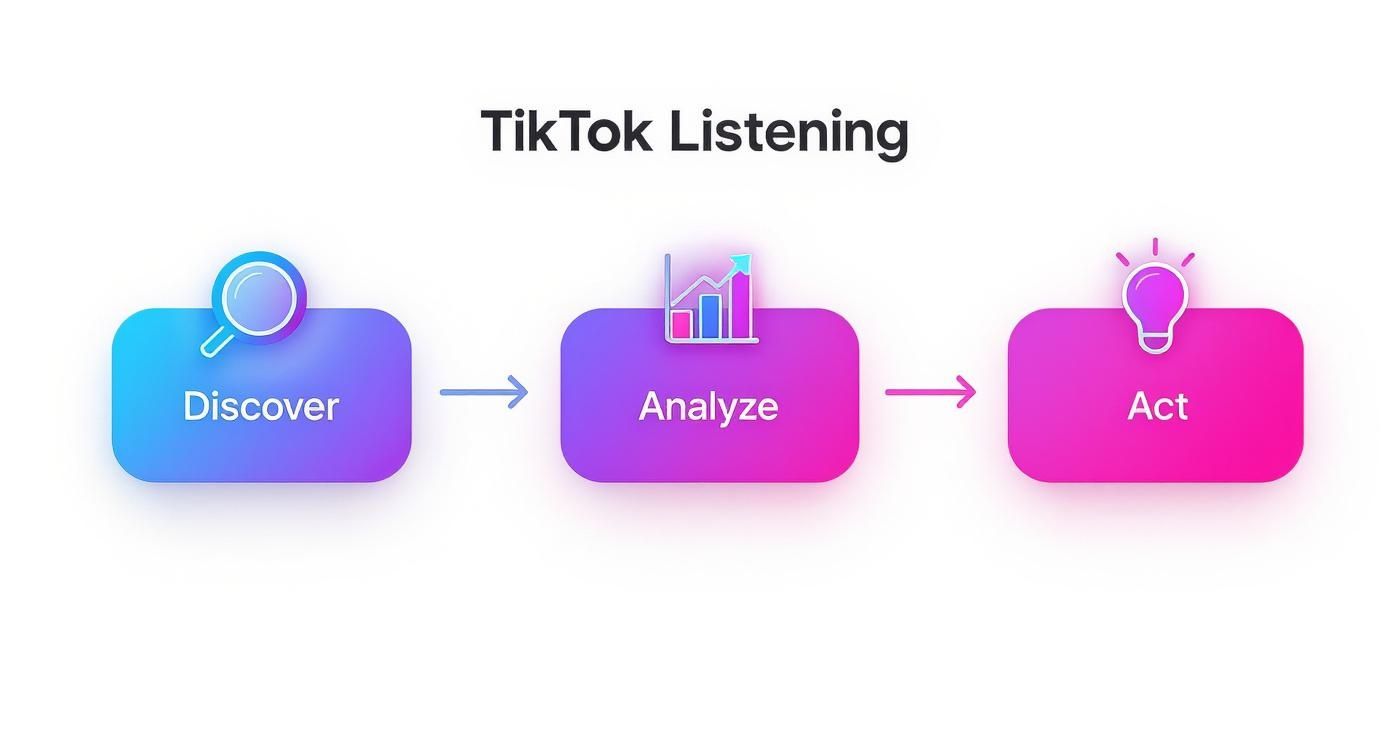
The key takeaway is that listening isn't passive. It's an active, cyclical process where what you discover fuels your analysis, and that analysis tells you exactly what to do next.
Defining Your Core Monitoring Pillars
Your dashboard, whether you're using a slick social listening tool or a souped-up spreadsheet, needs structure. Without it, you'll drown in irrelevant mentions. I like to organize everything around a few core pillars.
Think of it like setting up different channels on a radio—each one is tuned to a specific signal you absolutely need to hear.
Brand Health: This is your home turf. You’ll track direct mentions of your brand handle (@YourBrand), specific product names, and all your branded hashtags (#YourProductLaunch). This pillar tells you what people are saying directly to and about you.
Competitor Activity: You've got to keep an eye on the competition. Monitor their brand names, campaign hashtags, and even the creators they’re partnering with. This is how you benchmark your performance and spot opportunities where they might be dropping the ball.
Industry Conversations: This is where you find those golden, unbranded opportunities. If you're a beauty brand, you're not just tracking your products; you're listening for terms like "glass skin," "dupe culture," or "GRWM" (Get Ready With Me). This gives you a pulse on the wider market.
Emerging Trends: This pillar is all about TikTok's native signals. Here, you'll track trending sounds, popular filters or effects, and recurring video formats in your niche. This is your early warning system for what's about to blow up.
Constructing Sophisticated Listening Queries
Once you have your pillars, it’s time to build the search queries that will actually pull in the data. On a platform as dynamic as TikTok, just tracking a few simple keywords won't cut it.
For instance, a food company could get way ahead of the next big culinary trend by monitoring viral recipe sounds. Instead of just tracking a generic hashtag like #easyrecipes, they might track specific audio clips that keep popping up in cooking videos. That repetition often signals a new format or ingredient combo that's gaining serious traction.
A well-built query is the difference between collecting noise and capturing intelligence. You want to be specific enough to filter out the junk but broad enough to catch conversations you weren't expecting.
This kind of detailed listening is crucial for understanding what customers actually want, especially as the platform's user base grows up. The largest demographic on TikTok is now 25 to 34-year-olds, making up 34% of the audience. These aren't just kids; they're consumers with real purchasing power.
And their behavior is telling. 1 in 4 people bought a product after seeing it in a beauty-related TikTok. Even more importantly, 67% of users said the platform introduced them to brands and products they’d never even heard of. If you want to dig deeper, these TikTok statistics and consumer behaviors paint a pretty clear picture of the opportunity.
Organizing Your Dashboard for Action
How you lay out your dashboard is just as important as the data it contains. Whether you're in a third-party tool or a spreadsheet, organization is everything. I recommend using columns or tabs to separate each of your monitoring pillars.
Here’s a practical layout you can steal and adapt:
| Pillar | Primary Queries | Signals to Watch For | Potential Action |
|---|---|---|---|
| Brand Health | @YourBrand, #YourBrandSlogan | Spikes in negative/positive sentiment | Address customer service issues, amplify UGC |
| Competitor Intel | @Competitor, #CompetitorCampaign | Low engagement on their new ads | Identify a messaging gap you can exploit |
| Industry Trends | "dupe alert," "life hack" | High-velocity hashtag growth | Create content that joins the conversation |
| Emerging Sounds | Specific trending audio clips | Cross-niche adoption of a sound | Jump on the sound with a new video concept |
A setup like this gives you a clear framework for action. When you spot a signal—like a sudden surge in videos using a particular sound—you’ll know exactly what to do next. It turns raw observation into a repeatable process for creating timely, relevant content that actually works.
Choosing the Right Tools for TikTok Listening
Picking the right tool for TikTok listening can feel a bit overwhelming. The market is flooded with options, all promising a firehose of data. But the best tool isn't about having the most bells and whistles—it’s about finding the one that actually fits your goals, your team, and your budget.
Your choices really boil down to three camps: the native features TikTok gives you, dedicated social listening platforms, and more specialized analytics tools. Each plays a different role, and knowing their strengths and weaknesses is the first step to making a smart choice.
Starting with Native TikTok Tools
Before you start swiping the company card, it’s always a good idea to see what you can get for free. TikTok's own tools are surprisingly effective for getting a quick pulse on what's happening, and they're the perfect way to get started without any financial commitment.
Your first stop should be the TikTok Creative Center. Think of it as your command center for what's currently working on the platform. It's a goldmine where you can easily find:
- Trending Hashtags: See what tags are picking up speed in your area and industry.
- Popular Songs: Pinpoint the sounds that are the engine behind today's viral videos.
- Top Ads: Break down successful ad campaigns to figure out what makes them tick.
These built-in features are fantastic for fast, directional insights. A solo creator or a small team can use them to stay nimble and jump on trends as they pop. The catch? You'll hit a ceiling pretty quickly when you need to dig deeper. They don’t offer historical data, sentiment analysis, or a way to track brand conversations at scale.
Upgrading to Dedicated Social Listening Platforms
When you've outgrown what TikTok offers natively, it's time to bring in the heavy hitters: third-party platforms. These are the tools built from the ground up for TikTok social listening, designed to capture and make sense of massive volumes of conversation with real precision.
The technology behind this has come a long way. Specialized tools are now available that give brands much deeper, more contextual insights. For instance, advanced platforms like Exolyt provide serious TikTok analytics, letting you track accounts, hashtags, and videos while flagging the trending sounds that should be on your radar. Others like All Ears use AI to monitor millions of videos for brand mentions, even transcribing what’s said in a video and giving you metrics like reach and sentiment. Onclusive Social was actually the first big listening player to add TikTok monitoring, which shows just how crucial the platform has become. To get a better sense of their impact, you can explore more about how these platforms are shaping TikTok marketing.
When you're shopping around, you need to look for features that understand the unique DNA of TikTok.
A generic social listening tool just won't cut it here. TikTok is built on video and sound, so you need tools with specialized capabilities. If your tool can't analyze what's being said in a video, you're missing more than half the conversation.
Here are a few non-negotiables to look for in a third-party tool:
- Audio Transcription: The ability to turn spoken words into searchable text is essential. Countless brand mentions are spoken, not typed.
- Sentiment Analysis for Spoken Content: This goes beyond just words to understand the feeling behind them. Is a creator genuinely recommending your product or sarcastically trashing it?
- Sound Usage Tracking: The best tools can show you how a specific sound is spreading across the platform, who's using it, and in what context.
- Visual Analytics: Some of the most advanced platforms can even spot your logo or product in a video, even if your brand is never mentioned by name.
These platforms are the right fit for mid-to-large businesses that need to manage brand reputation, conduct serious competitor analysis, and actually measure the ROI of their TikTok campaigns. They provide the structure needed to turn raw chatter into real business intelligence.
Comparing TikTok Social Listening Tool Types
To help you decide which path is right for your brand, here's a quick comparison of the different types of tools available. This overview should help clarify which option best aligns with your needs, budget, and overall strategy.
| Tool Type | Primary Use Case | Key Features | Best For |
|---|---|---|---|
| Native TikTok Tools | Quick trend-spotting and initial content inspiration. | Trending hashtags, sounds, and top ads. | Solo creators, small teams, and those just starting with TikTok listening. |
| Dedicated Listening Platforms | In-depth brand monitoring, competitor analysis, and campaign measurement. | Audio transcription, sentiment analysis, visual analytics, historical data. | Mid-to-large businesses with a dedicated social media or marketing team. |
| Specialized Analytics Tools | Optimizing your own account's performance and content strategy. | Best posting times, engagement rates, follower growth tracking, content-specific analytics. | Creators and brands focused on maximizing their own channel's performance. |
Each tool type offers a unique lens through which to view TikTok. Your choice depends on whether you're looking for broad market trends, deep brand insights, or specific performance metrics to guide your content.
Using Specialized Analytics Tools for Performance Tracking
Finally, there’s a third category of tools that are less about broad "listening" and more about deep-diving into performance metrics. These are fantastic for creators and brands who are laser-focused on optimizing their own content.
They’re built to answer very specific questions, like:
- When is the absolute best time for my account to post?
- Which of my videos got the highest engagement rate last month?
- What does my follower growth look like over the last quarter?
- Which hashtags are actually driving views to my content?
While not traditional listening tools, they are the perfect complement to your broader efforts. Once you use a social listening platform to identify a hot trend, an analytics tool helps you measure just how well your content capitalized on it.
Ultimately, the right tool often comes down to maturity. Start with the native tools to build the habit of spotting trends. Graduate to a dedicated listening platform when you need to understand brand health and what your competitors are up to. Then, layer in specialized analytics to fine-tune your execution. Many of the most successful brands end up using a hybrid approach, giving them the most complete view of the entire TikTok universe.
From Raw Data to Actionable Insights
You’ve set up your queries, and the data is pouring in. That’s the easy part. The real work—and where the magic happens—is turning that firehose of mentions, metrics, and memes into actual business intelligence. It’s about finding the story hidden in the noise.
Without a solid plan for analysis, you're just hoarding data. A good framework helps you make sense of what you've found, understand the "why" behind the numbers, and share it in a way that actually helps your team make smarter moves. This is how you turn observation into opportunity.

A Framework for Thematic Analysis
First things first: stop looking at every mention individually. You need to start grouping them into meaningful themes to see the bigger picture. Think of it as sorting your mail—instead of letting it all pile up, you’re immediately putting bills, personal letters, and junk mail into their own stacks.
Every piece of data you collect should be sorted into a bucket that lines up with a specific part of your business.
Here are the themes I always start with:
- Product Feedback: This is your direct line to the R&D team. Are people raving about a specific feature? Complaining about a packaging flaw? Begging for a new flavor? This stuff is gold.
- Customer Experience Gaps: Look for patterns in complaints. Are there dozens of videos showing customers struggling with your assembly instructions? Are comment sections filled with mentions of slow shipping?
- Competitor Strengths & Weaknesses: What's the word on the street about your rivals? Maybe everyone loves a competitor's customer service but thinks their products are overpriced. That's an opening for you.
- Nascent Content Trends: This is your idea factory. It's where you stash emerging sounds, video formats, and challenges that are just starting to bubble up in your niche.
Organizing your data this way creates targeted streams of insight. The "Product Feedback" bucket goes straight to your product managers, while the "Customer Experience" findings get routed to your support and ops leaders.
Digging into the Qualitative Nuances
With your data sorted, it’s time to look closer at the qualitative details—the sentiment, tone, and intent that raw numbers can’t capture. On TikTok, context is everything. A comment can be sincere, sarcastic, hilarious, or scathing, and your analysis has to tell the difference.
For instance, a sudden spike in brand mentions isn't always good news. You have to ask deeper questions:
- What's the sentiment? Are people celebrating your brand, or is a wave of negative reviews crashing in? Sentiment analysis tools give a quick overview, but you need a human eye to catch sarcasm and irony.
- Who is driving the conversation? Is it a handful of big creators or a groundswell of everyday users? This tells you how widespread the feeling really is.
- What's the underlying intent? Are people asking questions before they buy, looking for customer support, or just showing off their new purchase in a UGC video?
The goal is to move beyond what is being said and get to why. A user sarcastically complimenting your "unbreakable" packaging while showing it shattered is a powerful piece of feedback that raw numbers would completely miss.
Distinguishing Memes from Movements
One of the trickiest parts of TikTok social listening is knowing the difference between a fleeting meme and a real cultural shift. Jumping on every single trend is exhausting and can water down your brand message. You need a way to figure out if a trend has legs—and more importantly, if it even makes sense for your brand.
Here’s a quick checklist I use to evaluate a trend:
- Velocity and Volume: How fast is it growing, and how many people are jumping on board? A trend with explosive but short-lived growth is almost certainly a meme.
- Cross-Niche Adoption: Is the trend stuck in one small community, or are different subcultures on TikTok picking it up? Broader adoption is a sign of a bigger cultural moment.
- Brand Alignment: Does the trend's tone and topic actually fit your brand's values? Forcing your brand into an irrelevant or off-key conversation can backfire spectacularly.
Ultimately, your analysis should result in a tight, clear insights report. It should spotlight the top 3-5 key takeaways, backed up with concrete examples like links to pivotal videos or screenshots of impactful comments. This is the kind of distilled intelligence that empowers your marketing, product, and leadership teams to make decisions that are truly in tune with your audience.
So, your social listening has surfaced a hot new trend on TikTok. Great. Now what? The clock is ticking, and that window of opportunity is smaller than you think. TikTok moves at lightspeed, and a trend that’s everywhere today could be ancient history by next week.
The real challenge is jumping from that data point to a piece of content that actually feels like it belongs on the platform—not some clunky corporate ad desperately trying to be cool. This is where you have to be a creator, not just a marketer. It's about breaking down what makes a trend work and then rebuilding it in a way that’s true to your brand. You have to join the conversation, not just broadcast over it.
Deconstructing the Trend Anatomy
Before you even think about filming, you need to play detective. Every viral TikTok trend is really just a mix of a few core elements. By taking a minute to dissect the trend, you’ll understand why people are connecting with it, which is the key to making it work for you.
Pull up a few examples of the trend and ask yourself these questions:
- The Sound: What’s the audio doing? Is it a trending song clip? A funny line from a TV show? An original sound from another creator? The audio almost always sets the pace and structure of the video.
- The Format: What’s the visual formula here? Is it a lip-sync video, a dance, a skit, or one of those "point-to-text-on-screen" explainers? The format is the skeleton of your story.
- The Text and Caption: How is text being used? On-screen text might deliver the setup, while the caption provides the punchline. The tone of the caption—whether it's self-deprecating, sarcastic, or sincere—is a massive part of the trend's personality.
Once you’ve broken it down, you have a blueprint. You're no longer just seeing a viral video; you’re seeing a specific sound that dictates a 5-second pace, a visual format that tells a story, and a caption style that seals the deal.
Brainstorming with Brand Authenticity
Okay, you have the blueprint. Now, how do you make it yours? The single biggest mistake brands make on TikTok is forcing their message into a trend where it just doesn’t fit. People can smell an inauthentic, "how do you do, fellow kids?" attempt from a mile away.
Your job is to find the sweet spot where the trend's theme and your brand’s world genuinely overlap.
The best brand content on TikTok never feels like an ad. It feels like a smart, funny, or helpful contribution to a conversation that’s already happening. You’re not borrowing from the trend; you’re adding to it.
Let's say a skincare brand spots a trending sound where people share their "unpopular opinion."
- Forced Idea: A video with text saying, "Unpopular opinion: Our moisturizer is the best." This is just an ad. It’s lazy and adds nothing.
- Authentic Idea: A video featuring one of their on-staff dermatologists sharing a genuinely counterintuitive skincare tip. The caption could be something like, "Our lead derm's unpopular opinion might just save your skin barrier 👀 #SkincareMyths."
See the difference? The second idea plays by the rules of the trend (sharing a surprising take) while reinforcing the brand's expertise. It gives the viewer something valuable and makes the brand look like an insider.
Establishing a Rapid-Response Workflow
On TikTok, speed is everything. A trend can blow up and die out in less than 48 hours. If your internal approval process takes a week, you've already lost. To consistently win with insights from your TikTok social listening, you need a workflow built for speed.
This isn’t about being sloppy; it’s about being nimble and cutting out the red tape.
- Empower a Small Team: Give a small, trusted team (or even just one person) the autonomy to act fast. They need to know the brand voice and the guardrails so well that they don't need five different sign-offs for a 15-second video.
- Create Simple Templates: Have pre-approved assets ready to go—things like text overlay styles, caption formats, and your logo placement. This lets your team focus on being creative instead of reinventing the wheel every single time.
- Use Agile Tools: This is where you can get a serious edge. A tool like Viral.new can be a game-changer by feeding you daily trend-aligned ideas. It essentially does the first brainstorming session for you, translating what's trending into ready-to-shoot concepts that fit your niche, massively shortening the gap between spotting a trend and posting your take on it.
By building a system that prioritizes speed, you turn social listening from a passive reporting task into an active engine for creating content that connects with people right now.
Answering Your Top TikTok Social Listening Questions
Even with a solid game plan, it's totally normal to have questions when you first start digging into TikTok social listening. You're trying to decode a whole new world of trends, sounds, and subcultures. Let's walk through some of the most common questions and sticking points brands run into.
Getting these basics down will help you feel more confident and make sure your listening efforts actually lead to real insights, not just a mountain of data.
How Much Time Does This Really Take?
This is the big one, isn't it? The honest answer is: it depends entirely on your goals and what tools you're using. If you're just dipping your toes in, you can get a lot of value from just 30-60 minutes a day spent manually checking the TikTok Creative Center and your core hashtags. It's a fantastic way to build a daily listening habit.
For teams with bigger ambitions (or bigger budgets), a dedicated social listening tool will do the heavy lifting of data collection for you. When that’s the case, your time shifts from hunting for mentions to analyzing what they mean. A social media manager using a tool might spend 2-3 hours per week digging through dashboards, spotting the most important trends, and pulling together an insights report for the rest of the team.
It's not about the total hours logged; it’s about consistency. Ten focused minutes every single day will give you more actionable insights than a four-hour deep dive at the end of the month, long after the trends have peaked and faded.
Can I Only Track Hashtags and Mentions?
No way. If that’s all you’re doing, you’re missing out on where the real conversations are happening. While hashtags and @mentions are the obvious starting points, the gold in TikTok is often found in the signals hiding just below the surface.
A truly effective listening strategy goes much deeper:
- Audio Tracking: Keeping an ear on trending sounds and music is non-negotiable. You can see how different communities interpret a sound, which is often the first sign of a new content format bubbling up.
- Spoken Mentions: This is a huge one. Using a tool with audio transcription lets you catch every time someone says your brand name in a video, even if they don't tag your account.
- Competitor Campaign Analysis: Don't just watch your competitors' videos—read the comments. You can learn just as much from their flops as you can from their viral hits.
- Niche Community Keywords: Track unbranded terms that are hyper-relevant to your audience. A beauty brand, for instance, should be all over terms like "#skincaredupes" to understand what shoppers are really looking for.
How Do I Know if a Trend Is Safe for My Brand?
This is such a critical question. Jumping on the wrong trend can backfire spectacularly, and not every viral moment is right for every brand. Before you even think about hitting record, run the trend through a quick brand safety gut-check.
- Find the Origin Story: Where did this trend actually come from? A quick search can tell you if it has problematic roots or a controversial history you want no part of.
- Get the Vibe Right: Is the tone sarcastic, wholesome, or a little unhinged? Make sure it genuinely matches your brand’s personality. If you're a serious B2B company, a chaotic meme might feel awkward.
- Does it Actually Make Sense? Can you connect the trend back to your product or message in a way that feels natural? If it's a stretch, your audience will smell it a mile away.
Think about it: a law firm probably has no business participating in a silly prank meme, but it could be a perfect fit for a snack brand. When in doubt, it's always smarter to sit one out. Listening is just as much about knowing when to stay quiet as it is about knowing when to join in.
Ready to stop guessing what's trending and start getting daily, ready-to-shoot TikTok ideas tailored to your brand? Viral.new analyzes what's working in your niche and delivers fresh concepts to your inbox every morning, so you can spend less time brainstorming and more time creating content that connects. Discover your next viral video at Viral.new.
