
What makes a TikTok viewer continue, rather than merely pause for a dramatic opening? A strong hook isn't just a loud first line. It's a compact promise that tells the right viewer why the next moment deserves attention.
The best TikTok hooks examples usually activate one of a few viewer motivations: curiosity, surprise, relevance, aspiration, trust, authority, or timely participation. That distinction matters because attention isn't the same as qualified retention. A pattern interrupt may stop a scroll, but the video still needs to deliver a payoff that matches the viewer's reason for staying.
TikTok for Business benchmarks provide a useful warning about the opening frame. 63% of the highest-click-through TikTok videos hook viewers within the first three seconds, according to the benchmark summarized by this analysis of TikTok hook examples. Independent analysis of 34,635 clips also found that the top-performing hook category averaged 6,037 views per clip, roughly twice the lowest-ranked category, showing that structure can affect distribution.
Use the eight examples below as a working system. Identify the audience problem, make the promise specific, connect the opening to the payoff, and test one variable at a time. If you need a steady supply of trend-aligned starting points, Viral.new can provide daily prompts, but trends won't rescue a vague promise. A useful three-second hook framework starts with the same discipline: earn the next second before trying to earn the sale.
1. The Question Hook
What problem does your viewer already want answered? A question earns attention when it makes the viewer assess their own situation. “Would you quit your job for $100K/month?” speaks to an entrepreneurial fantasy. “Have you been using your phone wrong this whole time?” creates a technology knowledge gap. “Could this $5 product change my business?” frames a product reveal as a question the video must resolve.
The trade-off is audience quality. A broad question can attract more curiosity, but it may also bring viewers with no interest in the offer. A narrower prompt, such as “Why does your Shopify product page lose buyers after the first scroll?” reaches fewer casual viewers while speaking directly to a commercial problem.
Practical rule: Ask a question the video can answer clearly. Suspense without a relevant payoff weakens trust.
Match the question to the payoff
Begin with the viewer's situation and make the promised answer visible in the video. For a local bakery, “Why do people walk past your best-selling pastry?” leads into a visual merchandising lesson. For a fitness creator, “Why does your squat feel unstable even when your stance looks right?” sets up a demonstration.
Adapt the template by replacing the generic problem with a specific symptom, audience, or outcome. Keep the overlay short enough to read immediately, while spoken audio supplies context. The question should remain understandable with the sound muted, since a trending sound can support pacing but should not carry the message.
Protect credibility and test intent
Avoid wording that implies a result you cannot support. “Can this landing-page change improve your sign-up flow?” leaves room for conditions and limitations. Show the answer early, then explain the mechanism, test setup, or situation where it may not apply.
Use the same footage for three versions: a problem question, a contrarian question, and a result-oriented question. Compare two-second view rate, average watch time, and three-second retention, metrics recommended in short-form hook testing guidance. Keep the strongest opening only when the viewers who stay also fit your target audience. If retention rises but qualified viewers fall, narrow the wording rather than choosing the higher raw count.
2. The Pattern Interrupt Hook
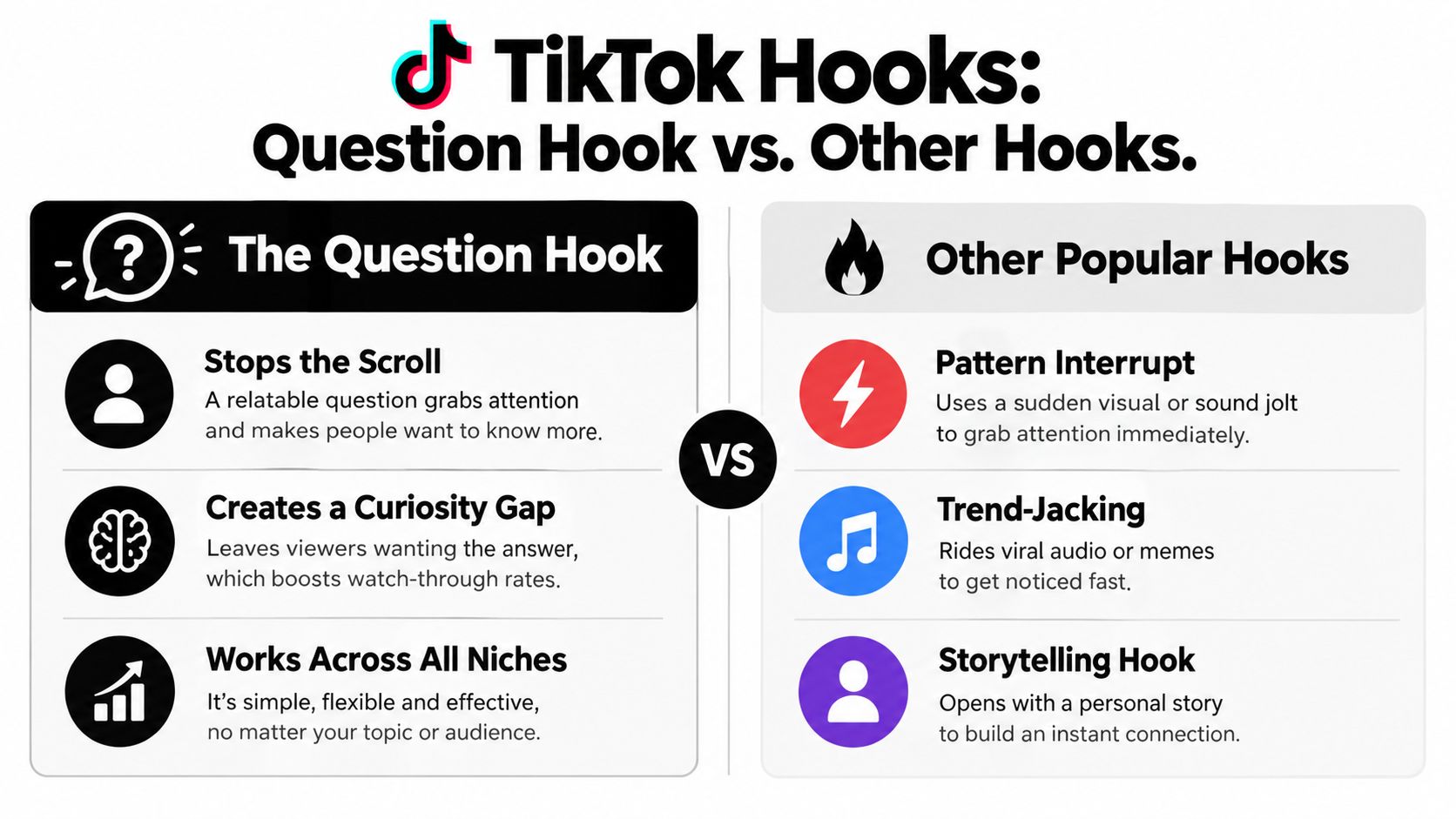
A pattern interrupt breaks the rhythm of passive scrolling with an unexpected visual, sound, movement, or statement. A freeze-frame can appear before a product demonstration. A creator might cut from a quiet talking-head shot to an abrupt close-up of a damaged item. Bold text such as “Your homepage has one expensive problem” can create tension before the explanation begins.
The interruption earns attention through surprise, not necessarily relevance. That's its strength and its weakness. It can make an ordinary topic feel immediate, but a disconnected jump cut or loud sound may produce short-lived views from people who leave as soon as the actual subject appears.
Make the interruption carry meaning
A useful interrupt previews the content. A chef can drop a failed cake onto the counter, then explain the baking mistake. A software consultant can open with a screen recording of a cluttered dashboard before showing the cleaner workflow. A fashion creator can begin with an outfit reversed, then reveal the styling correction.
Keep the visual language consistent with the brand. A children's education account may use a fast object reveal, while a financial educator may rely on a bold statement and a document close-up. High contrast helps readability, but excessive motion, flashing text, or audio spikes can make the video feel like an advertisement before the viewer understands its value.
For more ways to build a stronger opening, see these TikTok video intro ideas.
The video below demonstrates how an opening can combine movement, framing, and a clear premise without leaving the viewer to guess what follows.
Test the interruption, not the whole concept
Shoot one body section and create separate openings using visual motion, text contrast, and an audio change. Keep the wording and payoff stable. If the visual interrupt lifts early retention but lowers average watch time, it may be attracting curiosity without delivering a satisfying continuation. Choose the version that brings both attention and relevant viewing behavior.
3. The Trend-Jacking Hook
Trend-jacking uses a familiar sound, meme, text format, or recurring point of view, then redirects it toward a specific niche. A skincare brand can use a current reaction format to show a common product mistake. A realtor can adapt a “POV” structure to depict what buyers notice during a home tour. A creator teaching bookkeeping can pair a recognizable sound with on-screen text about a business expense that gets misclassified.
The advantage is cultural familiarity. The viewer understands the format before understanding your message, which reduces the effort required to enter the video. The risk is dependence on the trend. If the sound carries more identity than the idea, your content may feel interchangeable, and the audience may remember the meme rather than your business.
Add a niche-specific turn
Use the trend as packaging, not as the entire hook. The first visual should reveal your subject quickly. A florist shouldn't spend the opening beat performing a generic meme and wait until the end to show flowers. Show the arrangement, the customer problem, or the unexpected result immediately, then let the trend provide tone.
Viral.new delivers daily trend-aligned prompts that can help creators find formats relevant to a niche. Its trend analysis guide can also support a more deliberate process, where you examine why a format fits an audience instead of copying it mechanically.
Use a credibility safeguard
Don't imply that a trend is still culturally relevant unless you've checked it on the platform. Sounds and formats change quickly. Also, avoid stuffing the caption with irrelevant hashtags. Combine the trend label with terms that describe your audience, product, or location, so the content remains intelligible after the trend fades.
Test the same niche idea in two versions, one using the trend and one using original audio. If the trend version earns attention but the original version produces stronger qualified comments, profile visits, or inquiries, the trend may be useful for reach but weaker for business intent. Keep both roles separate.
For broader social media video tips, focus on the connection between format, audience, and message rather than treating trend participation as a complete strategy.
4. The Controversial or Contrarian Hook
Contrarian hooks challenge a belief the audience already recognizes. “Stop hustling 24/7, it's killing your business.” “This product is overrated, and here's why.” “You don't need more followers, you need a clearer offer.” Each line creates tension because viewers expect evidence, context, or a rebuttal.
The format can establish authority quickly, but it also creates a credibility debt. If the claim is stronger than the explanation, viewers may read it as engagement bait. Anger without useful insight can weaken trust, particularly for consultants, healthcare-adjacent brands, and financial creators.
Make the disagreement precise
Challenge a specific habit rather than attacking an entire industry. “Posting more won't fix a weak product page” gives you a practical path: show the page, identify the friction, and offer a revision. “Content is useless” creates attention but gives viewers little they can apply.
The hook should also state its condition. If you say, “You don't need more followers,” explain that the business may need qualified attention rather than an arbitrary follower target. Address the strongest counterargument inside the video when the topic affects spending, health, employment, or reputation.
Controversy should open the conversation. The explanation has to earn the authority.
Test the claim against a neutral version
Write a bold version, a balanced version, and a question-led version of the same idea. Keep the evidence and body identical. Compare retention, comment quality, saves, and whether viewers repeat the intended point in their responses.
Use proof carefully. Present any outside finding as context for the hook type, not as a forecast for your account. The audience, category, offer, and strength of the supporting explanation can change the result.
Choose the winner based on the business goal. If the bold version attracts attention but produces hostile or irrelevant comments, keep the neutral version. If the question-led version brings fewer views but more qualified questions, use it for topics where trust matters more than reach. Before publishing, remove any wording you cannot demonstrate in the video.
5. The Transformation or Before and After Hook
Show the problem state and the resolved state before explaining the process. A cluttered desk can cut to an organized workspace. An e-commerce creator can open with an unopened package, then show the product in use. A business educator can present a confusing customer journey, followed by a cleaner process map.
This hook works because the viewer immediately understands the destination and wants to know what changed. It's especially effective when the transformation is visible. The trade-off is that an overly polished before-and-after can look staged, filtered, or impossible to reproduce.

Show enough of the middle
The opening should reveal the outcome, but the body must explain the bridge. A cleaning product demo needs to show the surface, the application, and the result. A productivity creator should identify which change created the improvement, rather than implying that the entire transformation came from a single vague habit.
Use labels such as “before,” “after,” or “the step that changed it” only when they accurately describe the footage. If the process took substantial time, don't imply an instant result. A viewer may accept a gradual transformation when the video states the conditions clearly. They're less forgiving when the edit compresses effort into an unrealistic promise.
Decide what the viewer should learn
Test three opening orders: before then after, after then before, and a close-up of the key change. Keep the body consistent. Choose the sequence that produces the clearest continuation, not just the most dramatic first frame.
A practical benchmark summarized by Highstyle's short-form framework treats approximately 55% retention at three seconds as a structurally sound hold rate and recommends keeping the actual hook within one to three seconds, with the setup around five seconds or less. Use that as a diagnostic reference, then judge the result against your own audience and content category.
6. The Storytelling or Narrative Hook
A narrative hook begins at the moment something changes. “I was about to file bankruptcy, then I discovered…” establishes stakes. “My followers were gone overnight, and here's what I learned” creates an unresolved problem. “This customer almost left, but then I did this…” gives a service business a human conflict to resolve.
Stories build trust because they let viewers follow decisions, consequences, and context. They also take longer to explain than a product claim or visual reveal. If the opening spends too much time on background, the audience may leave before the useful part begins.
Start at the turning point
Don't open with a biography. Open with the email, call, mistake, failed launch, or customer conversation that changed the situation. A founder can show the rejected proposal before explaining what the rejection revealed. A creator can display the analytics screen before describing the lesson.
The emotional detail should support the business or audience problem. “I felt stressed” is less informative than “I realized our support team was answering the wrong question.” Specificity makes the story believable without requiring melodrama.
For brands building a more credible narrative, authentic brand storytelling guidance can help connect the personal moment to a customer-relevant takeaway.
Close the loop
A narrative hook needs a resolution, even if the resolution is a lesson rather than a perfect outcome. Tell viewers what changed, what failed, or what they can do differently. Don't use “wait for the end” as a substitute for a meaningful sequence.
Test a story opening against a direct lesson opening using the same final takeaway. Storytelling may generate stronger comments and shares from people who identify with the situation, while the direct version may communicate the advice faster. Choose based on the business goal. Trust and identification require a different opening from immediate instruction.
7. The Educational or How-To Hook
Educational hooks promise a practical gain. “Here are three ways to make your product demo clearer.” “This is why your product page isn't converting.” “Follow this process to plan a week of content.” Each opening identifies the task, problem, or result before the explanation begins, so viewers can judge whether the lesson fits their needs.
The trade-off is credibility. A broad promise may attract more viewers but give them little reason to trust the advice. Avoid claims such as “triple your conversions” unless evidence applies to the same audience, offer, and conditions. Specificity can come from naming the task, audience, tool, or mistake instead of promising an exceptional outcome.
Teach before you tease
Show the first useful point quickly. If the hook promises a fix for a slow checkout, display the relevant screen and identify the friction rather than using the opening for a long introduction. Numbered text helps viewers follow a lesson, provided each item gives a distinct action.
A creator teaching CapCut editing might open with the finished transition, then show the exact cut and setting. A local restaurant could explain how to photograph a daily special near a window, then demonstrate the framing. Both examples make the promised knowledge visible before asking viewers to continue watching.
Adapt the template by replacing the subject with one specific task: “Here's how to [action] in [tool]” or “Fix [problem] by checking [step].” Keep the demonstration accurate. If the method depends on a platform setting, industry, or customer type, state that boundary on screen or in the voiceover.
Build a defensible promise
Use screenshots, demonstrations, examples, or clearly labeled personal experience. Explain what the method can address and where it may not apply. That constraint may reduce broad appeal, but it gives viewers a clearer basis for deciding whether to save or try the advice.
Test three openings while keeping the lesson unchanged: problem-led, process-led, and outcome-led. Compare early retention with saves, comments that signal intent, and profile actions. Select the winner according to the business goal. A view spike is less useful if viewers do not understand the lesson or take the intended next action.
8. The Social Proof or Results-Based Hook
Social proof opens with evidence that other people used, trusted, or benefited from something. A brand might show a customer testimonial with permission. A software company can display a real workflow and identify the customer context. A creator can begin with a viewer comment, then explain how the featured product or method addressed the stated problem.
The format reduces uncertainty, especially for purchases and services. It can also create skepticism when the result appears too perfect, lacks context, or relies on anonymous screenshots. Viewers want to know who achieved the result, under what conditions, and whether the claim applies to them.
Make proof inspectable
Show the relevant artifact, not just a claim. A testimonial can include the customer's name and image with permission, the date, the original problem, and the specific experience being described. A metrics screen should make clear which period and outcome it represents. If results vary, explain the range or the conditions rather than presenting one exceptional outcome as typical.
Avoid borrowing credibility from numbers you can't verify. The hook examples in recent research often use exact figures, such as “We analyzed 34,635 TikToks,” because specificity creates curiosity and makes a premise easier to evaluate, as discussed in this review of proof-backed TikTok hooks. Exact figures only help when they describe real analysis or documented results.
Match proof to the buyer's question
A DTC viewer may need to see the product in use. A coaching prospect may care about the starting situation and the work involved. A local service customer may want evidence from a nearby, comparable case. Lead with the proof that addresses the biggest perceived risk, not the most impressive screenshot.
Test testimonial-first, demonstration-first, and problem-first openings while keeping the evidence identical. If testimonial-first gets attention but demonstration-first produces more product questions, the latter may be better for conversion intent. Social proof should clarify value, not just decorate the first frame.
8 TikTok Hook Types Compared
| Hook | Implementation complexity 🔄 | Resource requirements ⚡ | Expected outcomes 📊⭐ | Ideal use cases 💡 | Key advantages ⭐ |
|---|---|---|---|---|---|
| The Question Hook | Low, craft concise, compelling question | Low, phone + text overlay; minimal editing | ⭐⭐⭐⭐, high watch-through & comments from curiosity gap | Educational content, product reveals, solo creators | Stops scroll via curiosity; highly shareable |
| The Pattern Interrupt Hook | Medium, timing, edits and surprise elements required | Medium, sound design, quick cuts, visual assets | ⭐⭐⭐⭐, excellent thumb-stopping; strong early algorithm signals | Small businesses, creators improving baseline watch time | Extremely attention-grabbing; memorable brand signature |
| The Trend-Jacking Hook | Low–Medium, quick pivot to trend with niche spin | Low, uses existing audio; needs trend monitoring | ⭐⭐⭐⭐, fast reach and amplification when timed well; short window | Agencies, DTC brands, trend-reactive creators | Rapid visibility with low production overhead |
| The Controversial / Contrarian Hook | Medium, careful framing and evidence required | Low–Medium, research, supporting data or examples | ⭐⭐⭐, very high comments & debate; risk of polarizing audience | Thought leaders, consultants, personal brands | Sparks discussion; positions creator as opinion leader |
| Transformation / Before–After Hook | Medium, requires authentic before/after assets and editing | Medium, quality visuals, sequencing, possible staging | ⭐⭐⭐⭐, strong retention and persuasive impact if authentic | DTC product demos, fitness, coaching, case studies | Visually communicates clear value and outcome |
| Storytelling / Narrative Hook | Medium–High, needs structured arc and pacing | Medium, time to craft story, capture authentic moments | ⭐⭐⭐⭐, deep emotional connection; high completion rates | Personal brands, coaches, founders, long-form creators | Builds trust and parasocial relationships over time |
| Educational / "How‑To" Hook | Medium, requires clear, actionable structure | Low–Medium, research, on-screen text, examples | ⭐⭐⭐⭐, high completion and shareability; authority-building | Educators, consultants, marketing creators, agencies | Delivers immediate, actionable value; attracts intent-driven viewers |
| Social Proof / Results‑Based Hook | Low, present verification-ready results or testimonials | Medium, gather testimonials, screenshots, permissions | ⭐⭐⭐⭐, builds credibility and conversion potential; persuasive | E‑commerce, agencies, SaaS, coaches selling outcomes | Establishes trust via evidence; leverages FOMO and social validation |
Turn the Hook Into a Testing System
The eight formats are easier to use when you connect each one to a viewer motivation and business goal. Questions and pattern interrupts earn attention. They work well when the audience problem is easy to recognize but the answer or visual outcome isn't obvious. Educational and contrarian openings build authority by promising either a useful explanation or a defensible challenge to conventional thinking.
Transformations and social proof clarify value. They help viewers understand what changes, what the product does, or why another person trusted the offer. Storytelling builds trust when the audience needs context, emotional identification, or a reason to believe the creator understands the problem. Trend-jacking adds timely relevance, but the niche-specific message has to remain clear after the format loses momentum.
The first-second principle is practical: the opening frame should tell the viewer what kind of experience they're entering. Don't show a generic talking head while promising a visual demonstration. Don't lead with a dramatic claim if the body contains only general advice. The opening and payoff are one unit.
Use this workflow for each new video:
- Choose one audience problem: Name the situation in the viewer's language, such as unclear pricing, a messy workflow, weak product presentation, or uncertainty about what to buy.
- Write three first lines: Create one question, one direct promise, and one contrast or contrarian version. Keep the underlying idea constant.
- Match every line with a visual: Show the product, mistake, result, document, screen, or person connected to the promise.
- Define the payoff: Decide what the viewer will see, learn, or understand before the video ends.
- Change one variable: Test wording, visual order, delivery, or sound separately. Changing everything prevents useful diagnosis.
- Review the right signals: Examine early view retention, average watch time, completion behavior, engagement quality, saves, comments, profile visits, or inquiries according to the goal.
A practical hook benchmark cited by short-form practitioners treats a 25% to 35% hook rate as a baseline, 40% or higher as strong, and 50% or higher as exceptional, according to UGC Copilot's hook framework. Treat those thresholds as testing references, not universal promises. A finance tutorial, beauty demonstration, and local restaurant video may attract different viewing patterns.
Viral.new can help when the hardest part is generating enough relevant concepts to test. Use its daily, niche-aligned prompts to find possible formats, then add your own customer language, evidence, product footage, and point of view. Trend alignment may supply the starting context, but your proof and payoff determine whether the viewer has a reason to continue.
For more execution ideas, review these actionable TikTok view tips, then publish a controlled batch instead of waiting for one perfect concept. A repeatable process gives you better creative judgment than guessing from a single result.
Viral.new delivers fresh, trend-aligned TikTok prompts to your inbox every morning, customized to your niche, offer, and audience intent. Visit Viral.new to turn these hook categories into ready-to-shoot ideas and keep your testing pipeline moving.
