
Here’s a simple way to think about the TikTok algorithm: it’s a system designed to give every single video a fair shot. Instead of just pushing content from famous accounts, it starts by showing your video to a small test audience of about 300-500 people to see what they do. If they stick around, watch it again, and share it, the algorithm takes that as a signal to show it to more and more people.
How the TikTok For You Page Actually Works
Think of the TikTok algorithm as the ultimate talent scout. It works on one powerful, democratic idea: great content should win, no matter who made it. This is the magic behind the famous ‘For You Page’ (FYP), that hyper-personalized, never-ending feed of videos that feels like it was made just for you. If you're new to the term, you can learn more about the FYP meaning on TikTok in our other guide.
Unlike older platforms where your follower count was everything, TikTok gives every video a fighting chance. The moment you hit post, your video isn't just thrown into the digital void. It’s immediately pushed to a small, carefully selected test audience. This is your video’s first, and most important, test.
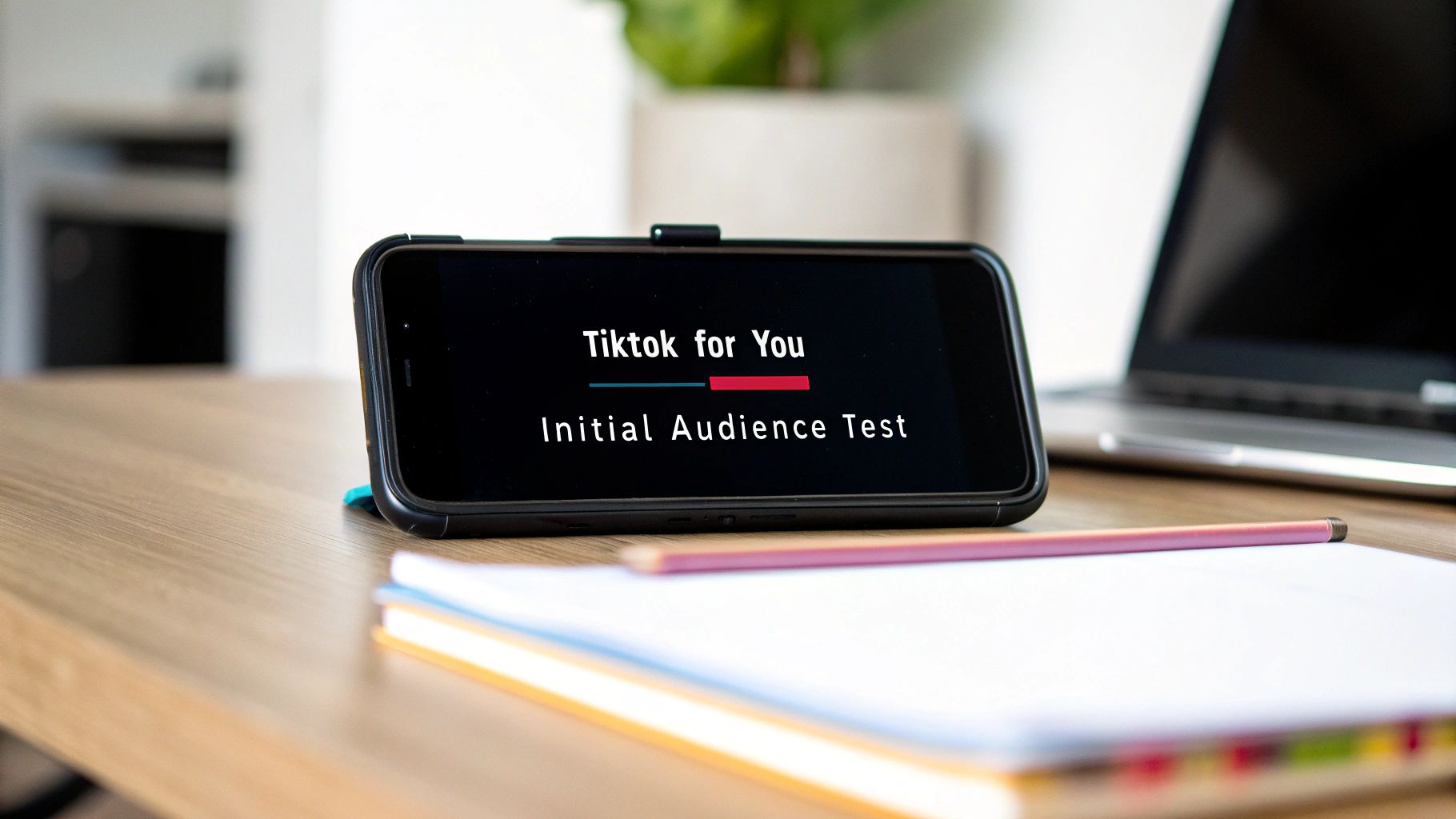
The Initial Audience Test
This first group of 300-500 viewers is basically the algorithm’s focus group. How they behave in the first few minutes and hours is everything. The algorithm is watching a few key signals like a hawk:
- Completion Rate: Are people watching your video all the way to the end?
- Rewatch Rate: Is it good enough that they hit replay?
- Engagement Signals: Are they liking, commenting, sharing, or saving it?
If your video does well with this initial batch of viewers, the algorithm sits up and takes notice. It sees that positive engagement as a sign of quality, which greenlights the next stage of distribution.
The core idea is that the quality of the content should always beat the popularity of the creator. A video's real value—its ability to make someone laugh, teach them something, or just grab their attention—is what powers its journey on the FYP.
This whole process can be broken down into a simple, three-step journey from creation to potential virality.
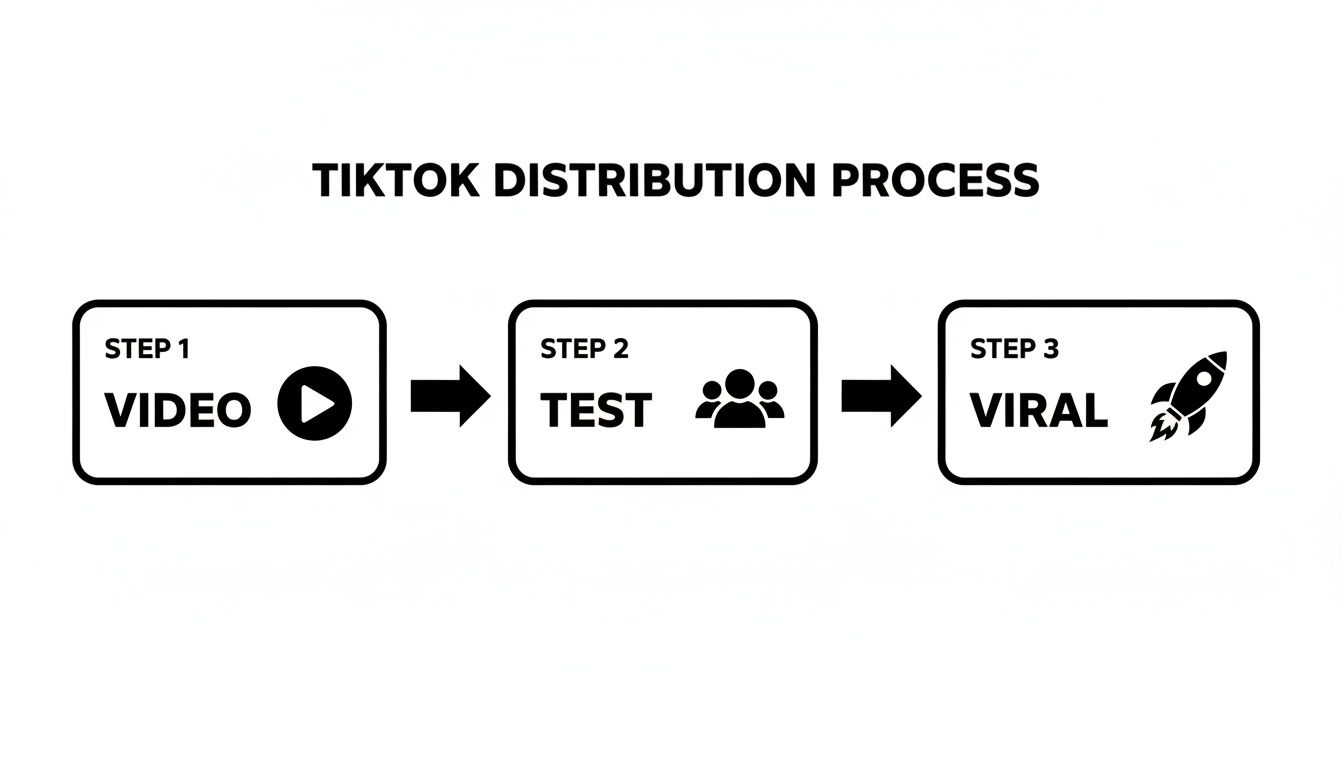
As you can see, every video you post gets the same opportunity. It all comes down to whether you can pass that initial audience test to unlock a much wider reach.
Triggering the Snowball Effect
So, what happens if your video passes that first test with flying colors? Let's say you hit a strong 20-30% completion rate or get a ton of replays. The algorithm then pushes it out to a much bigger audience, usually somewhere between 1,000 and 10,000 viewers. This is what we call the 'snowball effect.'
This second group of viewers acts as another checkpoint. If the engagement stays high, the snowball keeps rolling and growing, and your video gets shown to hundreds of thousands, or even millions, of people. This incredibly effective distribution system is a huge reason why TikTok, with its 1 billion monthly active users, managed to become the world's most-visited website, even surpassing Google.
What this all means for you is that your focus should be 100% on creating content that hooks viewers from the very first frame. The algorithm is built to find an audience for great videos, but it's on you to create something that actually deserves its attention.
The Ranking Signals You Need to Master
Think of the TikTok algorithm as a sophisticated voting system. Every time a user interacts with your video, they’re casting a vote. But here’s the thing: not all votes are created equal. Some actions carry a massive amount of weight, screaming to the algorithm that your content is a winner, while others are just a gentle nudge. If you want to create videos that the algorithm can't help but push, you have to understand what these signals are and which ones matter most.
The undisputed champions at the top of this hierarchy are watch time and video completion rate. These two metrics are the ultimate proof of a video's quality. TikTok's main goal is simple: keep people on the app for as long as possible. Content that successfully grabs and holds a viewer's attention is the most valuable asset in achieving that goal.
Let's say you post two videos. The first is 60 seconds long, but most people swipe away after just 20 seconds. The second is only 15 seconds long, but almost everyone watches it straight through to the end, with many even watching it a second time. In the eyes of the algorithm, that second video is far more powerful. Its sky-high completion rate sends an unmistakable signal of viewer satisfaction.
The Power of Watch Time and Completion
The TikTok algorithm is absolutely obsessed with how long people watch your videos. It treats high watch time and completion rates as the ultimate vote of confidence. I've seen countless creators achieve an average watch time of just 15-60 seconds and see their reach multiply by 10x as the system starts feeding their content to more and more For You Pages.
When TikTok rocketed past 1 billion global monthly users, its secret sauce was prioritizing completion rates over simple likes. It was a game-changer. Videos that are watched all the way to the end can see 50-70% more distribution. You can find more details on these engagement metrics and how they've changed by reading more about social media algorithm updates on stackinfluence.com.
This is precisely why the first few seconds of your video are make-or-break. A strong, compelling hook isn't just a good idea—it's non-negotiable.
Key Takeaway: The algorithm doesn't just care if people watched your video; it cares intensely about how much of it they watched. A high completion rate is the single most powerful positive signal you can send.
A pro tip for this is to create seamless loops—videos that end in a way that flows perfectly back to the beginning. This little trick encourages rewatches, which dramatically inflates your total watch time and tells the algorithm your content is ridiculously captivating.
Secondary Signals That Amplify Reach
While watch time sits on the throne, other engagement signals act as powerful amplifiers. These actions tell the algorithm that your content didn't just hold someone's attention—it actually inspired them to do something.
Here’s a rough breakdown of these secondary signals, ranked by importance:
- Shares: When someone shares your video, they’re putting their own reputation on the line and personally vouching for it. It's an incredibly strong indicator of value.
- Comments: Comments show your video sparked a real conversation. The algorithm loves this, especially if you jump in and reply to keep the discussion alive. It signals deep engagement.
- Saves: A save means your content was so useful or entertaining that a viewer wants to come back to it later. This is a huge win for educational content, tutorials, or anything inspirational.
- Likes: Likes are still a good thing, but they're the most passive form of engagement. It’s easy to double-tap, so they don't carry nearly as much weight as shares, comments, or saves.
On the other hand, the algorithm is also looking for negative signals. The absolute worst is the quick skip. If viewers are consistently swiping away from your video in the first second or two, it’s a death sentence. It tells the algorithm your hook failed and the content isn't worth showing to anyone else, effectively stopping its distribution in its tracks.
Turning Signals into a Content Strategy
Once you understand these signals, you can stop just making videos and start building a content strategy that speaks the algorithm's language. Don't just chase views; aim for specific actions that you know the algorithm values.
- To get comments: End your video with a question or a slightly controversial take that begs for a response.
- To get shares: Create something highly relatable, hilarious, or a "life hack" so good that people feel compelled to send it to their friends.
- To get saves: Provide real, tangible value. Think recipes, workout routines, book recommendations, or step-by-step guides.
- To boost watch time: Use a killer visual hook, add on-screen text to build curiosity, and tell a story that keeps viewers hooked until the very last second.
By focusing your creative energy on triggering these specific signals, you're not just creating content; you're engineering it for distribution. When you combine this approach with a smart hashtag plan, which you can learn about in our guide on trending hashtags for TikTok, you've got a seriously powerful formula for growing your reach.
How the Algorithm Learns About Your Content
Before a single person ever sees your video, the TikTok algorithm is already hard at work. Think of it like a meticulous librarian, carefully scanning every detail you provide to figure out one simple thing: what is this video about? This initial analysis is how it picks the perfect test audience, and getting this right is your first big step toward going viral.
The algorithm isn't just guessing. It’s reading the clues you leave behind. This whole process revolves around analyzing input signals—all the bits of information you embed directly in your post. It’s like putting a clear label on a package; the better the label, the faster it gets delivered to the right person.

Decoding Your Video Information
The algorithm's analysis is surprisingly sophisticated. It uses machine learning and natural language processing to dissect several key elements, all in an effort to categorize your content with pinpoint accuracy. It’s looking for context anywhere it can find it.
Here are the main signals it’s looking for:
- Captions and Descriptions: The algorithm reads your caption for keywords. A caption like "Easy 3-ingredient pasta recipe" is an immediate flag for the algorithm to show your video to users who love cooking content.
- Hashtags: These are powerful signposts. Using #BookTok or #CleanTok tells the algorithm exactly which established community your video belongs to, pushing it directly to enthusiasts of that niche.
- On-Screen Text: Any text you add directly to the video itself gets scanned. If your video has a text overlay that says, “My Top 5 Skincare Tips,” the algorithm instantly understands the topic and ideal audience.
This entire process is really just TikTok SEO in a nutshell. By being clear and intentional with your text, you’re basically spoon-feeding the algorithm the exact information it needs to find your perfect viewers right from the get-go.
Your goal is to leave no room for interpretation. Make it incredibly obvious what your video is about and who it's for. The less the algorithm has to guess, the better your initial audience targeting will be.
But it doesn't stop with text. The algorithm also processes what it sees and hears to gather even more context about your video and who might like it.
The Role of Audio and Visual Cues
The algorithm doesn't just read; it listens and watches, too. A couple of other critical signals give it a much deeper understanding of your content.
First up is the sound you use. When you hop on a trending audio clip, you're doing more than just adding music. You’re tapping into a built-in network of viewers who have already engaged with that specific sound. The algorithm knows that people who liked other videos with that audio are prime candidates to see yours, giving you an instant distribution boost.
Second, the system uses computer vision to identify objects, scenes, and even actions within your video. It can recognize a cat, a beach, or someone dancing. This visual analysis helps it further refine its understanding, matching your video with users who have shown interest in visually similar content. All of these signals—text, sound, and visuals—come together to create a detailed profile of your video before it even meets its first viewer.
You can dig into your video’s performance and see how well the algorithm is categorizing your content by learning how to see TikTok analytics in our guide.
The Ever-Changing TikTok Algorithm
Think of the TikTok algorithm not as a set of rules carved in stone, but as a living, breathing system. It's constantly learning, adapting, and evolving. To really succeed on the platform, you have to accept that what worked six months ago might be totally irrelevant today. This constant change isn't a bug—it’s a core feature designed to keep up with user behavior and global trends.
This evolution is a huge deal for any creator trying to build a real, lasting presence. The algorithm is getting much smarter at figuring out what "genuine value" looks like. It's moving past simply rewarding easy viral bait and getting better at finding and promoting high-quality, niche-specific content for dedicated communities. For creators who focus on depth over breadth, this is a massive opportunity.
From Global Scrutiny to Algorithmic Overhauls
TikTok's history is full of twists and turns, with its algorithm often changing in response to intense global pressure. The platform has faced everything from ban threats to massive operational changes, all of which directly affect how its recommendation engine works. The situation in the United States is a perfect example of how outside forces can completely reshape the algorithm from the ground up.
This constant pressure has kicked off a huge U.S. overhaul with a timeline stretching to September 2025, where operational control is shifting to Oracle. Under this new structure, ByteDance’s stake is now less than 20%, and—this is the important part—it has no access to American user training data. You can dig into how these shifts will affect marketing strategies on Traackr for a deeper dive.
This isn't just a simple backend update; it’s a fundamental rebuild that will send ripples across the entire platform. The timeline points to a code review in Q4 2025, a retraining phase in Q1 2026, and a full rollout in Q2 2026. What this means for you is that you should expect some volatility in your reach and engagement as the new system learns U.S. user behavior from scratch.
To put these shifts into perspective, let's look at how the algorithm's focus has changed over time and what that means for your content strategy.
Key Algorithm Shifts and What They Mean for You
| Era or Event | Algorithmic Focus | Your Actionable Takeaway |
|---|---|---|
| Early Days (2018-2020) | Broad Virality & Trends | Jumping on trending sounds and challenges was the primary growth lever. |
| The "Niche-ification" (2021-2022) | Watch Time & Niche Relevance | The algorithm got better at identifying subcultures. Going deep on a topic started to outperform going broad. |
| The U.S. Overhaul (2023-Present) | Community Signals & Trust | With data segmentation, building a loyal, engaged community that trusts you becomes a key defense against volatility. |
| The Future (Post-2026) | Semantic Search & Creator Authority | The rise of TikTok SEO means the algorithm will likely prioritize creators who are true experts with a library of valuable, searchable content. |
The clear trend here is a move away from fleeting moments and toward lasting authority.
The most resilient long-term strategy isn't about chasing fleeting trends or trying to "hack" the algorithm. It's about building a loyal community by consistently delivering high-value content that resonates deeply with a specific audience.
This focus on community is your best defense against algorithmic weirdness. When you have a strong relationship with your audience, your content's success depends far less on the whims of the For You Page.
How to Future-Proof Your Content Strategy
So, how do you build a strategy that works no matter how the TikTok algorithm changes tomorrow? The key is to stop chasing short-term virality and start building long-term audience value. Instead of asking, "What's trending?" start asking, "What does my audience actually need from me?"
Here are a few principles to guide you:
- Double Down on Your Niche: As the algorithm gets smarter, it gets better at playing matchmaker between niche content and the right viewers. Become the absolute go-to expert in your corner of TikTok, whether it’s 18th-century cooking or advanced spreadsheet tips.
- Prioritize Community Engagement: Don't just post and ghost. Dive into your comments, create videos that answer audience questions, and make people feel like they belong. These interactions send powerful signals of value to the algorithm.
- Focus on Evergreen Value: Trends are great for a quick boost, but your foundation should be a library of content that offers lasting value. Think tutorials, in-depth guides, and foundational explainers that will stay relevant and searchable for months, or even years.
Ultimately, the smartest way to navigate the ever-changing algorithm is to create content so good that its success is inevitable, no matter what system is delivering it. Focus on the human on the other side of the screen, and the algorithm will eventually figure it out.
Common TikTok Algorithm Myths Debunked
Trying to understand TikTok can feel like you're chasing ghosts, especially with all the rumors about the algorithm floating around. These myths don't just confuse creators; they can seriously derail your entire content strategy. Let's bust some of the biggest ones so you can get back to what matters: making great videos.
Getting a handle on what's real and what's not is half the battle. So many creators spin their wheels on tactics that are based on pure fiction, and it's a huge waste of time and creative energy.
Myth 1: "I've Been Shadowbanned!"
This is the number one suspect whenever a video flops. You post something, it gets way fewer views than your last one, and the immediate conclusion is that TikTok has secretly blacklisted your account. The truth is, there’s no evidence of a "shadowban" system that intentionally throttles your reach without telling you.
So what’s really going on? Nearly every time, a sudden dip in views comes down to the content itself. Your video was shown to an initial test group, but it didn't hit the right notes on key signals like watch time or engagement. The algorithm simply did its job and stopped pushing a video that wasn't resonating.
A "shadowban" is almost always a content problem, not an account problem. Instead of blaming some invisible force, take a hard look at your video’s hook, its pacing, and the value it offers. The algorithm isn’t out to get you; the audience just wasn’t hooked.
Myth 2: "You Have to Post Multiple Times a Day."
The "more is always better" mindset is another myth that just won't die. While showing up consistently is definitely part of the game, the idea that you have to churn out three, four, or even five videos a day is a fast track to burnout, not growth. Quality beats quantity every single time.
The algorithm doesn't hand out gold stars for posting a lot. It rewards videos that capture and hold people's attention. Think about it: one killer, well-thought-out video that gets watched all the way through and shared is infinitely more valuable than three rushed videos that people scroll past in a second.
Find a sustainable rhythm that lets you create your best work. For most people, aiming for 3 to 5 high-quality videos per week is a fantastic goal for building momentum without sacrificing the quality that actually gets you noticed.
Myth 3: "Deleting Videos Will Hurt My Account."
So many creators are terrified of the delete button. They believe that removing a video that didn't perform well sends a bad signal to the algorithm and permanently damages their account's standing. That's just not true. TikTok has never said that deleting videos hurts your overall reach.
If a video is off-brand, has a mistake, or is doing so poorly that you'd just rather it not be there, deleting it is completely fine. Every other video on your profile will continue to be judged on its own merit.
Here are a few other common misconceptions to leave behind:
- Myth: You have to jump on every trending sound to go viral.
- Truth: A trending sound can give you an initial boost by plugging you into a conversation, but the video's concept still has to be strong enough to stand on its own.
- Myth: You need a ton of followers to hit the For You Page.
- Truth: The FYP is all about the content, not the creator. Accounts with zero followers go viral every single day.
- Myth: Posting at a specific "magic" time guarantees views.
- Truth: Sure, posting when your audience is most active helps, but a truly great video can find its audience and take off at any hour.
Once you let go of these myths, you can focus on the only "hack" that actually works: creating genuinely valuable and entertaining content that your audience loves.
Let's Clear Up a Few Things: Your Top TikTok Algorithm Questions Answered
Even when you know the nuts and bolts of how the algorithm works, it can still feel like a bit of a mystery. So, let's clear the air and tackle some of the most common questions I hear from creators.
Think of this as your quick-reference guide for making smarter content decisions. We'll get straight to the point on everything from how fast the algorithm really moves to whether your follower count is holding you back.
How Long Does It Take for a Video to Get Pushed by the Algorithm?
The first push is almost immediate. The moment you hit post, your video is served up to a small test audience to start collecting data. If that initial group bites—watching, liking, sharing—you’ll often see a surge in views within the first couple of hours.
But it’s not always a quick burn. I’ve seen countless videos have a “delayed explosion,” where they suddenly take off days, weeks, or even months later. This usually happens when a sound, topic, or hashtag in your video catches a new wave of popularity, breathing new life into your old content. So, while the initial test is fast, the potential for a video to go viral can stick around for a long time.
Does My Follower Count Actually Matter?
Honestly? For the For You Page, not really. TikTok's discovery engine is famously democratic; it’s built to elevate great content, not just big accounts. This is exactly why a video from someone with zero followers can get millions of views. The FYP is the great equalizer.
That said, your followers do give you one small edge: they provide an immediate feedback loop from your "Following" feed. That initial burst of engagement can help your video perform well in those crucial first few hours. But at the end of the day, your success on the FYP comes down to how total strangers react to your video.
Your follower count might get you to the starting line, but your content quality is what gets you across the finish. The algorithm cares a lot more about watch time and shares than how many followers you have.
Should I Post Niche Content or Follow General Trends?
For building a real, sustainable audience, niching down is almost always the best play. When you consistently create content for a specific community—think "vintage camera reviews" or "vegan baking tutorials"—you're teaching the algorithm exactly who to show your videos to. This builds a much more loyal and engaged following over time.
But the most effective strategy isn't choosing one or the other; it’s blending them.
- Jump on a trending sound or format, but apply it to your niche topic.
- Use a popular meme to explain a concept from your area of expertise.
- Do a trending challenge, but give it your own unique, niche-specific twist.
This way, you get to ride the wave of a massive trend while still pulling in the right kind of people who will actually stick around. It’s the best of both worlds.
How Important Are Trending Sounds for the Algorithm?
Using a trending sound is an incredibly powerful signal. It’s like a shortcut that helps the algorithm categorize your video and show it to people who are already engaging with that exact audio. You're basically joining a conversation that's already popular, which gives your video an immediate distribution advantage.
But a trending sound isn’t a magic ticket to virality. Your video still has to be interesting enough to hold attention. The algorithm won't keep pushing a boring video just because it has a popular song attached. The creators who win are the ones who adapt trending audio to their niche in a clever way, adding their own value instead of just copying everyone else.
Ready to stop guessing and start creating TikToks that get seen? Viral.new delivers fresh, AI-powered video ideas tailored to your niche directly to your inbox every morning. We analyze what's working right now and turn those trends into ready-to-shoot concepts, so you can spend less time brainstorming and more time growing. Fill your content calendar with ideas designed for reach at https://viral.new.
