

73% of consumers prefer short-form video when researching products or services, according to Kapwing's 2026 video marketing statistics. That doesn't mean your next clip should chase views. It means buyers are already willing to use this format to make decisions, while many brands still measure it like entertainment.
Short form video marketing works when every creative choice moves a viewer somewhere: from interruption to attention, from attention to understanding, and from understanding to an action your sales team can track. The winning question isn't “How do we go viral?” It's “What must this viewer believe, do, or ask next?”
Why Short Form Video Marketing Is a Revenue Channel, Not a Toy
Short-form video has moved from an experimental social tactic into a core discovery channel. The format combines vertical mobile viewing, rapid delivery, and platform distribution that can place a brand in front of people who weren't actively searching for it. That reach matters, but reach alone doesn't create revenue.
Treat each video as a small funnel. The opening earns attention, the middle establishes relevance and trust, and the close creates a measurable next step. A product demonstration should lead to a product page. An educational clip should lead to a relevant guide or email capture. A customer objection should lead to a conversation, consultation, or comparison asset.
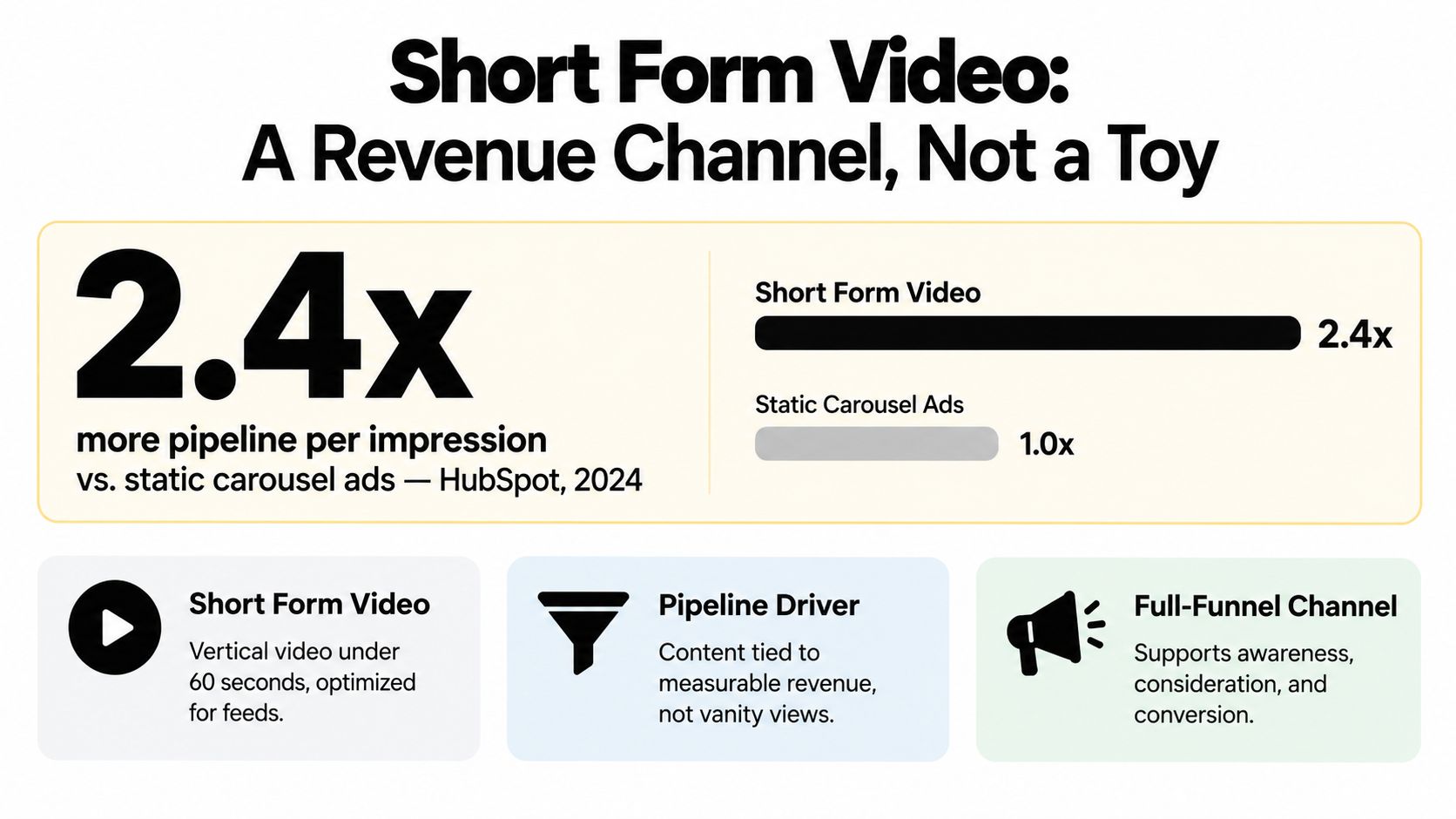
A practical definition helps. For this strategy, short-form video means vertical, feed-native content built around one clear idea, usually consumed in a quick session on TikTok, Instagram Reels, YouTube Shorts, or similar surfaces. The format can entertain, but it should also answer a question, demonstrate a result, resolve doubt, or make the next buying step easier.
Build the channel around three signals
- Three-second retention: Did the opening earn enough attention for the viewer to continue?
- Hold rate: Did the structure maintain interest through the explanation and payoff?
- Assisted pipeline: Did the video influence a qualified action, even if it wasn't the last click?
The first two signals diagnose creative quality. The third protects the business from vanity reporting. A video can generate comments and still attract the wrong audience. A smaller video can influence a sale after a viewer returns through search, email, or direct traffic.
The commercial case is strong because the format meets buyers during research. The strategic mistake is treating it as a cheaper television commercial. Television interrupts a scheduled viewing experience. A feed video competes for the next swipe, so it must earn every second before it asks for anything.
For a broader foundation, review this guide to what video marketing means for a modern funnel. Then write a brief for every clip with one audience, one problem, one promise, and one conversion path.
TikTok, Reels, and Shorts Are Not the Same Channel
Repurposing the same file across platforms is efficient production, not necessarily effective distribution. TikTok, Instagram Reels, and YouTube Shorts each create a different relationship between discovery, identity, search, and conversion.
Current market summaries place TikTok at roughly 40% of the short-form market, with Instagram Reels and YouTube Shorts at about 20% each, as reported by Vidico's short-form video statistics roundup. Those figures describe a broad market view, not a reason to publish identical creative everywhere.
| Dimension | TikTok | Instagram Reels | YouTube Shorts |
|---|---|---|---|
| Primary discovery behavior | Fast discovery, trend participation, and product exploration | Discovery blended with existing relationships and visual identity | Discovery connected to YouTube search, channels, and longer videos |
| Content style | Direct, reactive, personality-led, and native to current formats | Polished enough to fit the account, but still immediate and human | Clear, searchable, educational, or strongly connected to a larger topic |
| Audience relationship | Often starts cold, with limited prior brand context | Frequently includes followers and warm audiences | Can introduce viewers to a broader creator or brand library |
| Commercial role | Demand creation and rapid creative testing | Consideration, social proof, and product familiarity | Education, search discovery, and progression into longer content |
| Best creative adjustment | Use the platform's native language and current viewer expectations | Make the clip fit the account's visual world and buyer context | State the topic clearly and make the video useful without extra context |
| Repurposing risk | A polished advertisement can feel out of place | A raw trend clip can weaken brand coherence | A contextless clip can lose the search and channel connection |
TikTok is usually the strongest environment for testing a new angle with people who don't know the brand. Reels is often better when the account already has trust, a recognizable visual identity, or a product that benefits from warm consideration. Shorts deserves separate treatment when the topic can connect to YouTube search or lead viewers into deeper content.
That doesn't mean you need three separate production teams. It means you should adapt the first frame, caption, pacing, and CTA. A TikTok built around a fast reaction may become a Reels case for a product benefit and a Short that answers a specific question.
Choose a primary battlefield
Pick one platform where your audience, offer, and creative strengths overlap. Establish a repeatable publishing and measurement process there before expanding. Otherwise, your team will mistake distribution volume for learning.
Channel rule: Repurpose the insight, not just the file. Keep the core idea, then rebuild the packaging for the platform.
Hook, Retain, Convert, the Anatomy of a Video That Works
Short-form video earns attention in sequence: the hook wins the first seconds, retention creates room for the message, and the CTA turns interest into a next step. The opening deserves more scrutiny than the logo, soundtrack, or transition pack. Benchmark summaries from Kapwing's short-form retention report indicate that 65% of viewers who reach the first three seconds continue to at least ten seconds. Treat the opening as a conversion constraint, not a branding detail.
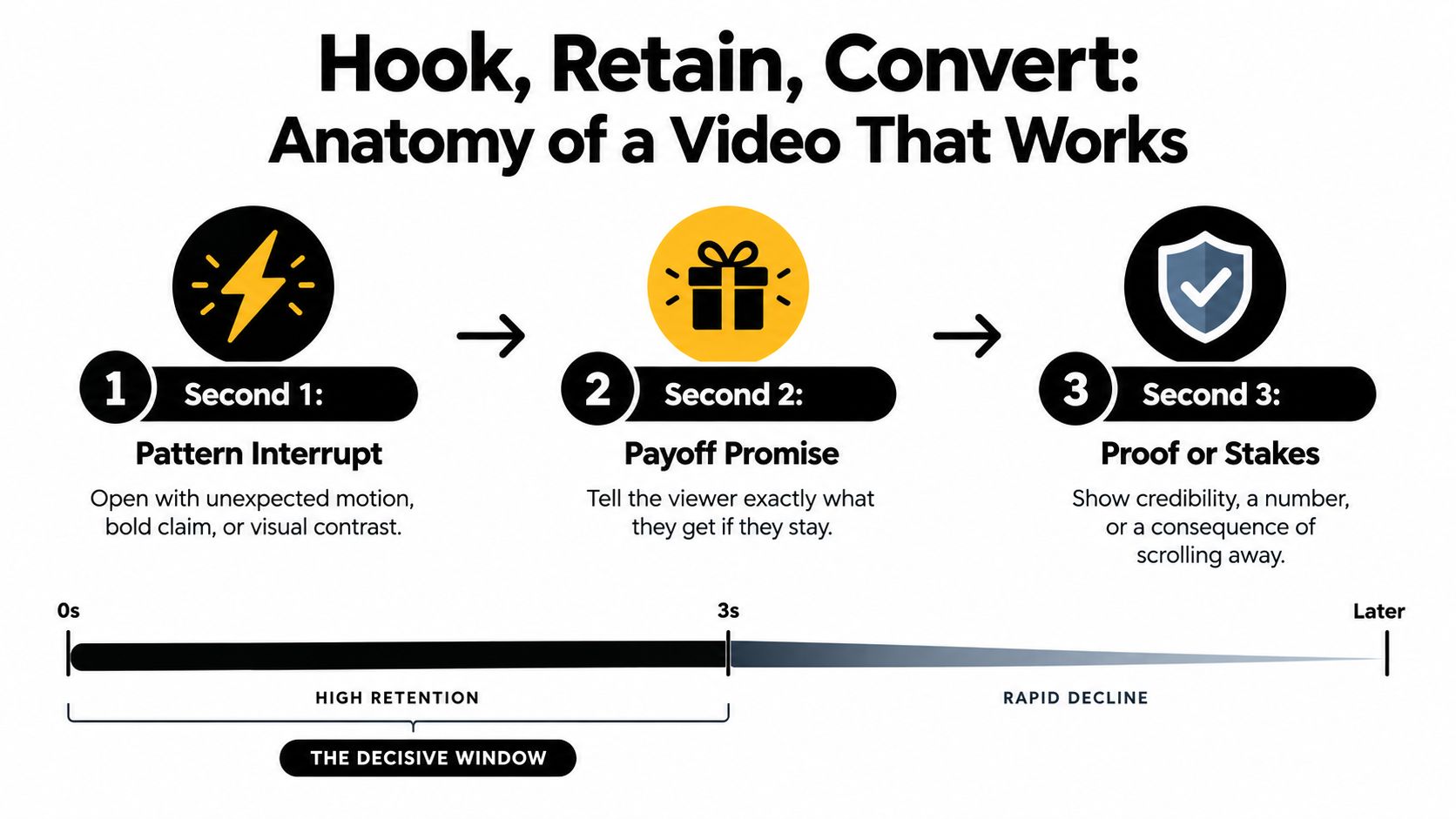
Build the opening in three moves:
- Pattern interrupt: Start with unexpected movement, sharp visual contrast, a direct question, or a problem stated without setup.
- Payoff promise: Tell viewers what they will understand, avoid, compare, or achieve if they keep watching.
- Proof or stakes: Show evidence, a product detail, a process, or the consequence of choosing the wrong approach.
Then move through five beats:
- Hook: Name the tension immediately.
- Context: Explain who faces the problem and why it affects them.
- Tension: Expose the mistake, trade-off, or hidden obstacle.
- Payoff: Deliver the answer with a visible example.
- CTA: Give one next action that matches the viewer's intent.
For clips near the strongest engagement window, roughly 21 to 34 seconds, keep the edit dense and the promise narrow, consistent with the same Kapwing retention benchmarks cited above. Longer videos can work when each extra second earns attention. TikTok benchmark reporting associates well-optimized content with 40% to 60% completion, while retention beyond the 60-second mark can support longer clips, according to WebFX's TikTok benchmarks. Use these figures to set testing ranges, not to chase completion at the expense of qualified clicks or pipeline.
Design the middle for continued attention
Change the visual or informational pattern before viewers have a reason to leave. Cut to a demonstration, introduce a counterexample, show the result early, or ask a question that the next beat answers. Movement must clarify the argument or renew curiosity. Otherwise, remove it.
Skip stock intros, slow greetings, and full-screen logos. Put the brand in the environment, product, voice, or proof. A viewer who waits for the content to begin may never reach the offer.
Use this guide on how to write a short video script for a practical template. Then review the first three seconds as a standalone asset. If the clip still makes sense after everything beyond that point is removed, the opening is carrying its share of the funnel.
The Four Content Pillars That Map to Funnel Stage
Most brands overproduce conversion content because it feels close to revenue. The result is a feed full of product claims and a discovery pipeline that never gets enough useful material to attract new buyers.
Use four pillars, each with a different buyer job:
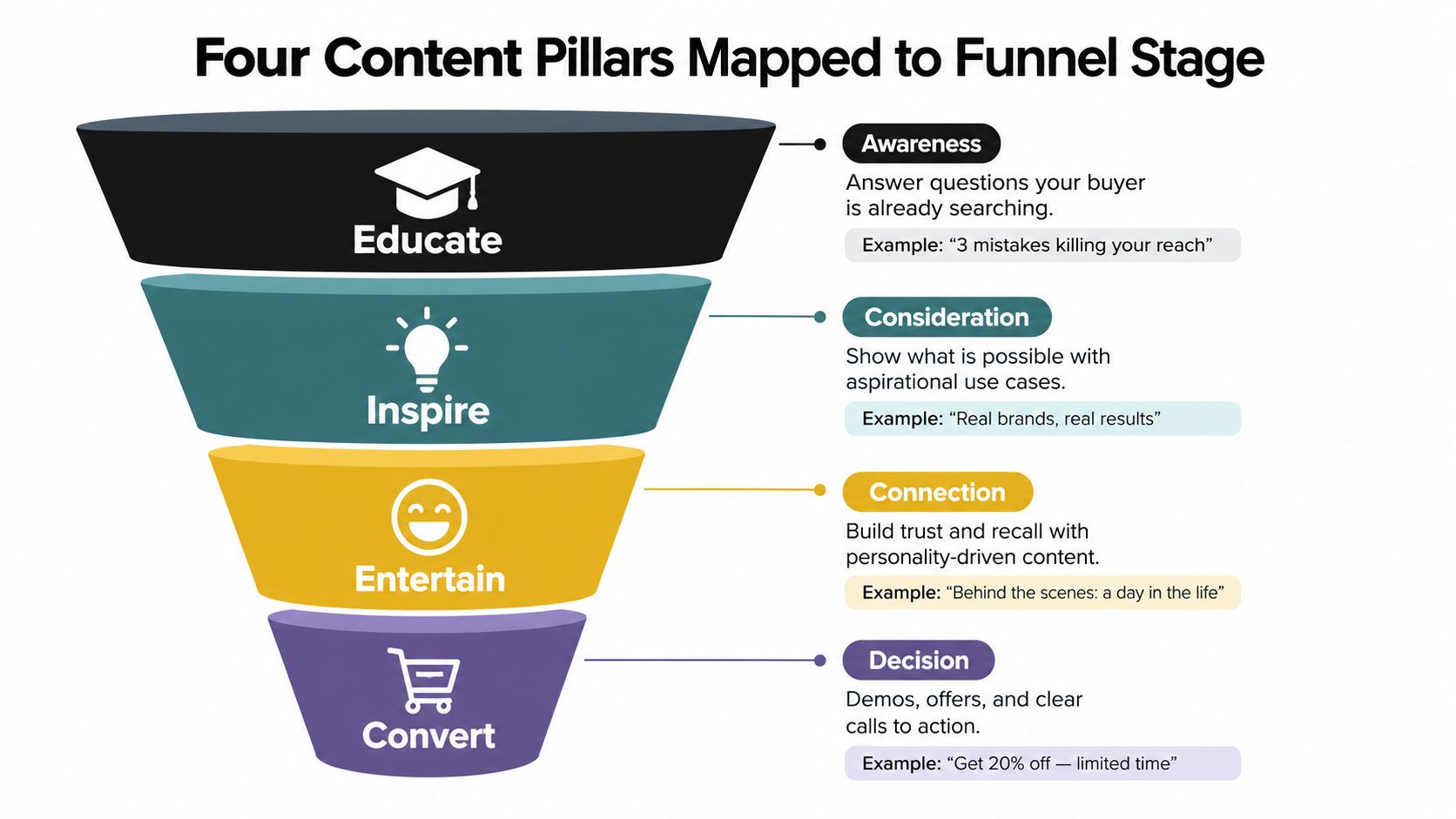
Educate for discovery
Answer questions your buyer already has. A local service business might explain how to identify a failing installation. A software company might show why a common reporting workflow produces misleading results. Use search-led hooks such as “Before you compare these tools, check this.”
The CTA should be low-friction: save the video, follow for the next answer, or visit a deeper guide. Education creates qualified awareness because it attracts people around a problem rather than a slogan.
Inspire for consideration
Show what becomes possible after the problem is solved. Use a before-and-after workflow, a day-in-the-life scenario, or a specific use case. Avoid vague lifestyle imagery. Buyers need to see how the offer changes their situation.
The CTA can invite a comparison, example, or product walkthrough. Aspirational content earns its place here, but it must stay connected to a real customer outcome.
Entertain for connection
Personality, humor, behind-the-scenes footage, and reactions make a brand easier to remember. Entertainment should still reveal something about the people, standards, or point of view behind the business. A joke that attracts an unrelated audience may inflate reach while weakening lead quality.
Use soft CTAs such as commenting with a question or sharing the clip with someone facing the same issue.
Convert at the decision point
Demonstrations, objection handling, testimonials, pricing context, and offers belong here. The strongest conversion videos don't shout “buy now” without preparation. They resolve the final uncertainty that prevents action.
For a useful explanation of how content supports buyer progression, read Carti's awareness consideration conversion funnel guide. Then map every video to one stage before filming.
A practical allocation is to let Educate carry the largest share, followed by Inspire, Entertain, and Convert. The exact mix depends on brand maturity and sales cycle, but the principle is fixed: discovery content must outnumber direct offers until the account has enough qualified attention to support conversion content.
Don't assign revenue to a pillar merely because a viewer clicked from it. Track assisted pipeline by topic, audience, and CTA. That will show whether entertaining content creates useful familiarity, whether educational clips attract qualified prospects, and whether conversion videos close the gap.
A Production Workflow That Scales Without Burning Out
Consistency doesn't come from demanding more ideas from the same tired person. It comes from separating planning, filming, editing, and measurement so each task has a defined output.
Start with a weekly theme sprint. Pick one customer problem, then create several angles around it: a mistake, a demonstration, an objection, a myth, and a direct recommendation. Keep a swipe file of hooks, opening shots, structures, and CTAs. Adapt proven patterns to your offer instead of inventing a new format every morning.
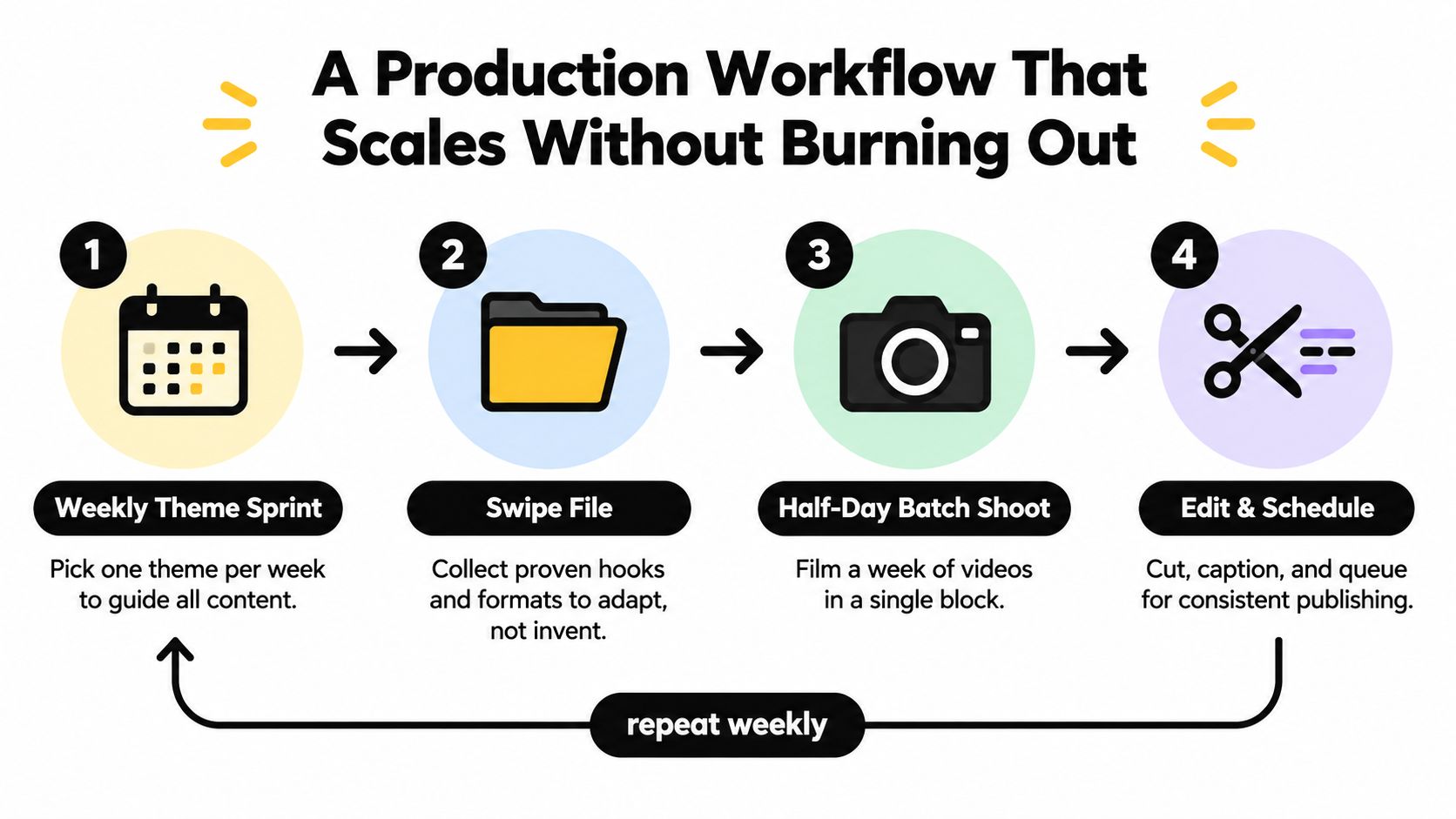
Batch the work in the right order
- Plan: Write short beat sheets, not polished scripts. Each sheet needs the hook, promise, proof, and CTA.
- Shoot: Film multiple openings and endings while the camera, lighting, and set are ready.
- Edit: Make separate passes for story, pacing, captions, sound, and platform packaging.
- Repurpose: Create the native versions only after the core idea works. Change the opening and CTA when the platform intent changes.
- Review: Log retention, clicks, comments that reveal objections, and qualified actions.
AI ideation tools can surface trend-aligned hooks and formats, then feed a swipe file with usable prompts. That removes blank-page work, but it doesn't remove judgment. A human still needs to reject ideas that attract the wrong buyer, make unsupported promises, or disconnect the trend from the product.
A solo creator should automate idea collection, transcription, caption drafts, file naming, and scheduling where possible. Keep positioning, filming, claims, final editing, and performance interpretation human. A small team can split those responsibilities, with one person owning the brief, one owning production, and one owning distribution and learning.
For a more detailed operating model, use this resource on how to scale content creation. The objective isn't maximum output. It's a dependable loop from buyer question to published test to commercial learning.
Organic Distribution and Paid Ads Working Together
Organic and paid distribution solve different problems. Organic content reveals which message earns attention without forcing reach. Paid media gives you control over audience, delivery, budget, and testing. Use organic performance as evidence, not as a permanent substitute for media buying.
| Surface | Intent signal | Recommended weight |
|---|---|---|
| Organic feed | Unfiltered response to the idea, hook, and creator | Primary testing layer |
| Paid reuse of organic winners | Proven creative with controlled audience delivery | Largest scaling layer |
| Whitelisted creator content | Third-party voice with permission for paid distribution | Focused trust and creative diversification |
| Cold paid tests | Unproven hooks, offers, or audiences | Small experimental layer |
Boosting a post is convenient, but it can limit your control over audience construction and creative comparison. Spark Ads and similar paid reuse formats are more useful when you want to preserve the original post's social context while adding campaign-level targeting and measurement. Whitelisting requires clear creator permissions, usage terms, and a process for approving edits.
Run organic tests first when the objective is message discovery. When a clip shows strong retention and meaningful downstream actions, adapt it into paid creative quickly. Don't wait for a perfect winner. A good ad still needs variants for the hook, proof, CTA, and audience.
Build a clean measurement layer
Use platform pixels where appropriate, consistent UTMs, and a CRM field that records the first meaningful video touch. Compare last-click results with assisted pipeline. Short-form often creates demand before the prospect returns through branded search, direct traffic, email, or a sales conversation, so last-click reporting will understate its contribution.
Keep audience layers distinct. Cold viewers need a problem-led message. Engaged viewers can receive proof or education. Site visitors and qualified leads need objection handling, demonstrations, or a direct offer. Rotating creative prevents the same message from carrying every stage.
Don't scale a clip because its view count looks impressive. Scale it when retention, click quality, lead quality, and sales feedback agree.
The KPIs That Actually Predict Pipeline
Views are useful for diagnosing distribution, but they aren't a revenue metric. Likes and follower counts can show audience response, yet they rarely tell you whether the audience has a problem your business can solve.
Use a KPI hierarchy that gives the team a weekly decision:
- Three-second retention: If this is weak, rewrite the opening before changing the offer.
- Hold rate: If viewers leave during the explanation, remove setup and sharpen the proof.
- Profile visits: If retention is strong but profile visits are weak, connect the topic more clearly to the brand.
- Link clicks: If profile visits don't become clicks, fix the CTA, destination, or offer match.
- Opt-in rate: If clicks don't become leads, inspect message continuity and landing-page friction.
- Assisted pipeline: If leads don't become qualified opportunities, audit topic quality and audience fit.
- Cost per qualified lead: If paid distribution increases volume but worsens lead quality, change the audience or creative angle.
The systematic review summarized by Scientiva Press identifies a real research gap: transaction-level and longitudinal evidence is still needed to establish how views, likes, and comments translate into purchases across markets and formats. That should make marketers more rigorous, not more dismissive of video.
Read patterns instead of celebrating spikes
A view spike with no qualified action is a creative or targeting audit. A video with modest reach but strong click quality may deserve a paid test, a follow-up series, or a landing-page improvement. A high completion rate with no profile activity may indicate that the content is satisfying but commercially disconnected.
Measurement rule: If a metric can't be tied to pipeline within two degrees of separation, treat it as diagnostic decoration, not a board-level result.
Track the path from retention to action in the same reporting view. That keeps creative teams focused on what they can change and gives growth leaders a defensible link between content decisions and commercial outcomes.
Your First 30 Days and the Mistakes to Skip
A short-form program doesn't need a dedicated studio to start. It needs a clear audience, a defined offer, a repeatable script, and enough discipline to learn from weak results.
Week one, establish the system
Audit competitors and adjacent creators. Record their opening patterns, topics, proof styles, and CTAs. Choose three content pillars that match real buyer questions, then install the hook, context, tension, payoff, and CTA template.
Week two, produce controlled tests
Batch-shoot around one weekly theme. Create multiple openings for the same idea and publish native versions for your primary platform. Review three-second retention and hold rate before deciding whether the topic deserves another iteration.
Week three, add paid distribution
Select the organic clips that combine attention with meaningful actions. Test them through paid reuse, creator permissions where relevant, and a small cold audience layer. Keep UTMs and CRM attribution consistent so sales feedback can reach the creative team.
Week four, cut and compound
Remove formats that attract views without useful actions. Expand the pillar and angle that generated qualified engagement or pipeline. Turn recurring objections from comments and sales calls into the next sprint's scripts.
Avoid five common failures:
- Chasing virality before product fit: A broad audience can't repair an unclear offer.
- Posting without a CTA: Attention without direction creates no measurable next step.
- Treating platforms as identical: The same idea needs different packaging for TikTok, Reels, and Shorts.
- Ignoring opening retention: A weak first frame makes later production quality irrelevant.
- Using a brand-manager content model: Polished approval cycles often remove the specificity and immediacy that feed audiences respond to.
The commercial standard is simple. Every clip should earn attention, deliver a useful change in understanding, and create a next action that your analytics and sales systems can recognize. When a video fails, identify which stage broke instead of labeling the entire channel a failure.
Viral.new provides daily, trend-aligned short-form video ideas suited to a creator's niche, including prompts and angles for TikTok, Reels, and Shorts. Use Viral.new to keep your swipe file supplied, turn buyer questions into shootable concepts, and maintain a repeatable testing rhythm without starting every content session from a blank page.
