
A discount isn't a strategy. Neither is a flash sale, a bundle, or a creator shouting a promo code into a camera. Those are sales promotion methods, and each one can work, but only when it appears at the right stage of the customer journey, reaches the right audience, and supports a clear business objective.
Short-form video makes this distinction more important. A TikTok can create curiosity, explain a product, demonstrate value, trigger a purchase, or bring an existing customer back. The promotion has to match the job of the video. The strongest sales promotion concepts, methods, and strategies treat content, offer design, timing, and measurement as one operating system rather than a list of disconnected tricks.
Why Most Sales Promotion Guides Miss the Point
Most promotion advice starts with a menu. Pick a discount, add free shipping, launch a bundle, ask an influencer to post, and create urgency with a countdown. That approach sounds practical, but it leaves out the decision that usually determines performance: when should each promotion appear?
A viewer who has never heard of a brand may need proof, education, or a credible demonstration. Showing that person a hard-sell flash sale can create attention without enough trust to convert. A returning customer has a different problem. They may already understand the product and respond better to a loyalty incentive, a complementary bundle, or a useful reason to buy again.
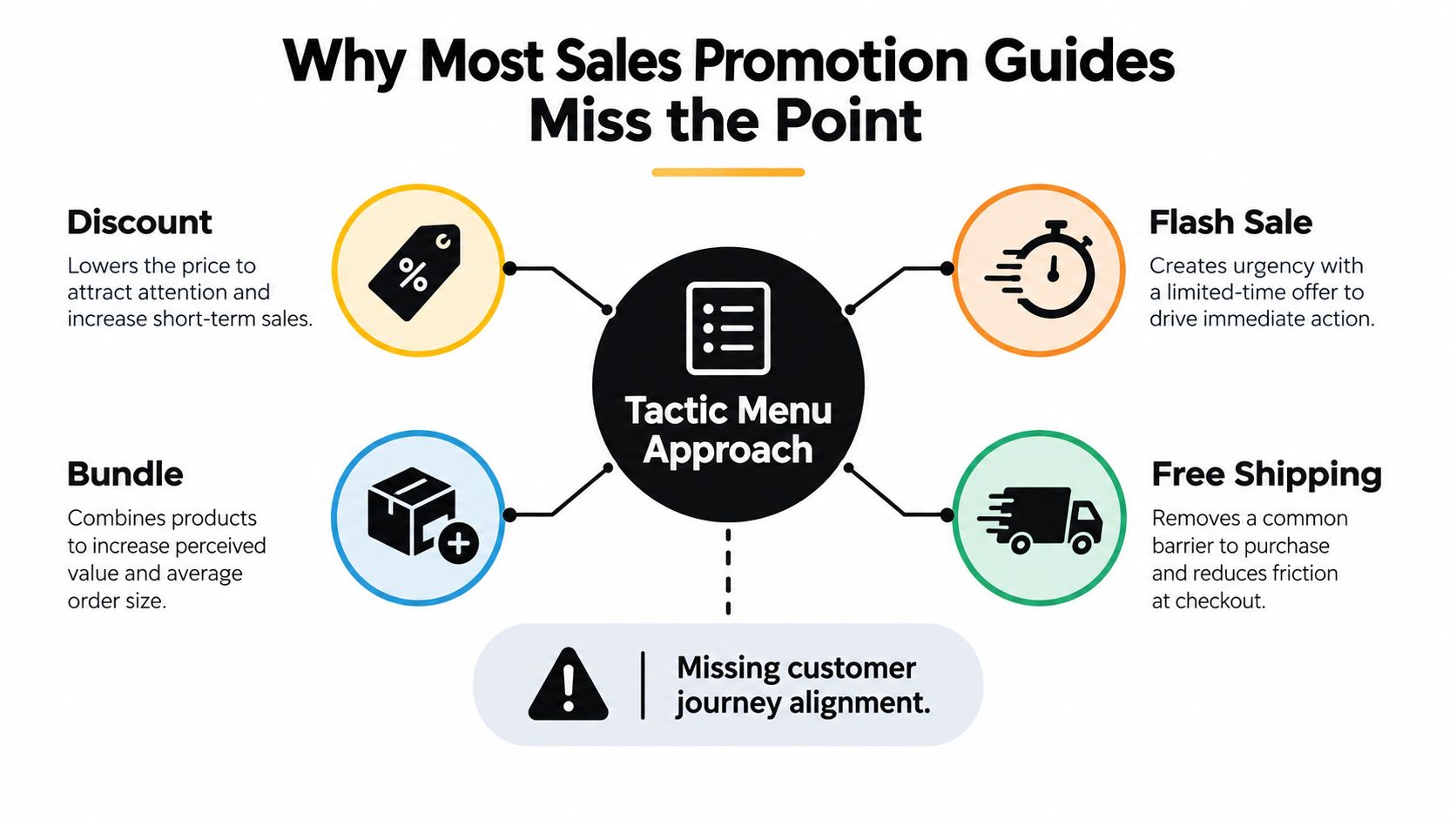
The tactic menu problem
Current promotion coverage often treats discounts, flash sales, bundles, free shipping, loyalty, and referral programs as separate ideas, while giving less attention to sequencing them across the funnel. Brafton's promotion guidance emphasizes the need to align the offer with the goal, audience, channel, and urgency. That alignment becomes more complex when a shopper moves between social video, a product page, email, and a physical store.
A TikTok campaign illustrates the difference. The first video might use a creator-led product demonstration to create demand. A follow-up video can answer objections, show the product in use, or compare options. Only after the audience has enough context should a limited offer appear. The final message can focus on retention, such as a replenishment reminder or a relevant add-on.
Practical rule: Use the promotion to move the viewer to the next stage, not to force the entire customer journey into one video.
Push promotions create attention through paid distribution, creator reach, or broad social exposure. Pull promotions attract people who are already searching, watching educational content, or comparing products. Hybrid promotions combine both, such as an influencer demonstration followed by retargeting with a time-bound offer.
The mistake isn't using any one of these methods. The mistake is asking every tactic to perform every job. A promotion strategy should define the audience state, the next action, the format that communicates the offer clearly, and the evidence needed before the next incentive appears.
Understanding Discount Psychology and Urgency Mechanics
Temporary discounts work because they change the decision context. A viewer who was postponing a purchase now has a reason to act, while a limited window reduces the temptation to keep comparing alternatives. In short-form video, that effect depends on clarity. The audience needs to understand what is changing, who qualifies, and when the offer ends without pausing to decode the message.
Research using weekly scanner data found that temporary price reductions can produce very large short-term sales spikes and strong immediate effects on brand choice. The evidence is summarized in this sales promotion research paper, which also supports treating discounts as time-bound demand-shaping tools rather than permanent pricing policy.
Match the trigger to the format
A countdown hook works when the deadline is real and easy to verify. A limited-stock story works when inventory constrains availability. A price reveal works when the audience needs a simple comparison before deciding. These formats create different kinds of urgency, so don't use scarcity language when the actual offer is always available.
Useful hooks include:
- Deadline-led: “This price is available until midnight, then it returns to the regular offer.”
- Problem-led: “If your current routine keeps creating this problem, here's the lower-friction alternative.”
- Proof-led: “Watch how this product fits into a real morning routine before deciding whether the offer makes sense.”
- Comparison-led: “This is what you receive in the bundle, and why each item belongs together.”
Discount psychology becomes manipulative when the video hides conditions, exaggerates scarcity, or presents a routine price as an exceptional event. It also becomes commercially dangerous when the team measures only orders during the promotion. The immediate lift must be weighed against margin erosion and the sales pattern after the offer ends.
The practical workflow is simple. Define the margin you can protect, state the offer plainly, set a genuine end point, and review what happens after the promotion. If viewers buy only when the price drops, the campaign may be training the audience to wait rather than building durable demand.
Comparing Bundle Deals, Limited-Time Offers, and Influencer Promos
Bundles, limited-time offers, and influencer promotions solve different problems. Treating them as interchangeable creates weak creative and unclear measurement. A bundle changes the composition of the purchase, a limited-time offer changes the timing of the purchase, and an influencer promotion changes who pays attention to the product.
| Promotion Type | Primary Goal | Best Video Format | Key Risk |
|---|---|---|---|
| Bundle deal | Increase perceived value and encourage a broader purchase | Unboxing, side-by-side product routine, “what's included” reveal | Customers may see unnecessary items rather than useful value |
| Limited-time offer | Convert existing demand while the buying reason is strong | Countdown hook, deadline reminder, direct offer video | Urgency can damage trust if the deadline feels artificial |
| Influencer promo | Reach a relevant audience and add social proof | Creator demonstration, review, tutorial, or use-case story | Reach may not translate into qualified purchase intent |
When a bundle makes sense
A bundle should solve a customer problem, not merely place more products in one cart. Skincare products that support the same routine, or a camera paired with a relevant accessory, are easier to justify than unrelated items grouped around an arbitrary price cut. For a deeper look at bundle architecture, Grumspot's product bundling guide offers useful context on complementary products, pricing logic, and customer value.
Short-form video should make the bundle tangible. Show the unboxing, explain the sequence of use, and identify the customer who benefits from buying everything together. A static “save more when you buy more” message usually gives viewers less information than a real demonstration.
When urgency or influence should lead
Use a limited-time offer after the audience has already received enough product context. The video can focus on one objection, one benefit, and one deadline. Don't overload it with features that belong in earlier consideration content.
Influencer promotion works best when the creator's audience has a natural reason to care. A creator should demonstrate the product in a recognizable situation rather than deliver a disconnected endorsement. For planning creator-led formats, the influencer collaboration ideas guide can help turn a partnership into several distinct video concepts instead of one generic sponsored post.
Choose the method by asking what is missing. If the customer needs a fuller solution, use a bundle. If they already understand the offer but keep delaying, use a limited-time incentive. If the product lacks attention or trusted context, use an influencer demonstration.
Sequencing Promotions Across the Customer Funnel
A coherent campaign gives each stage a different responsibility. Awareness should earn attention, consideration should reduce uncertainty, decision content should make the next action obvious, and retention should give customers a reason to return without immediately relying on another deep discount.
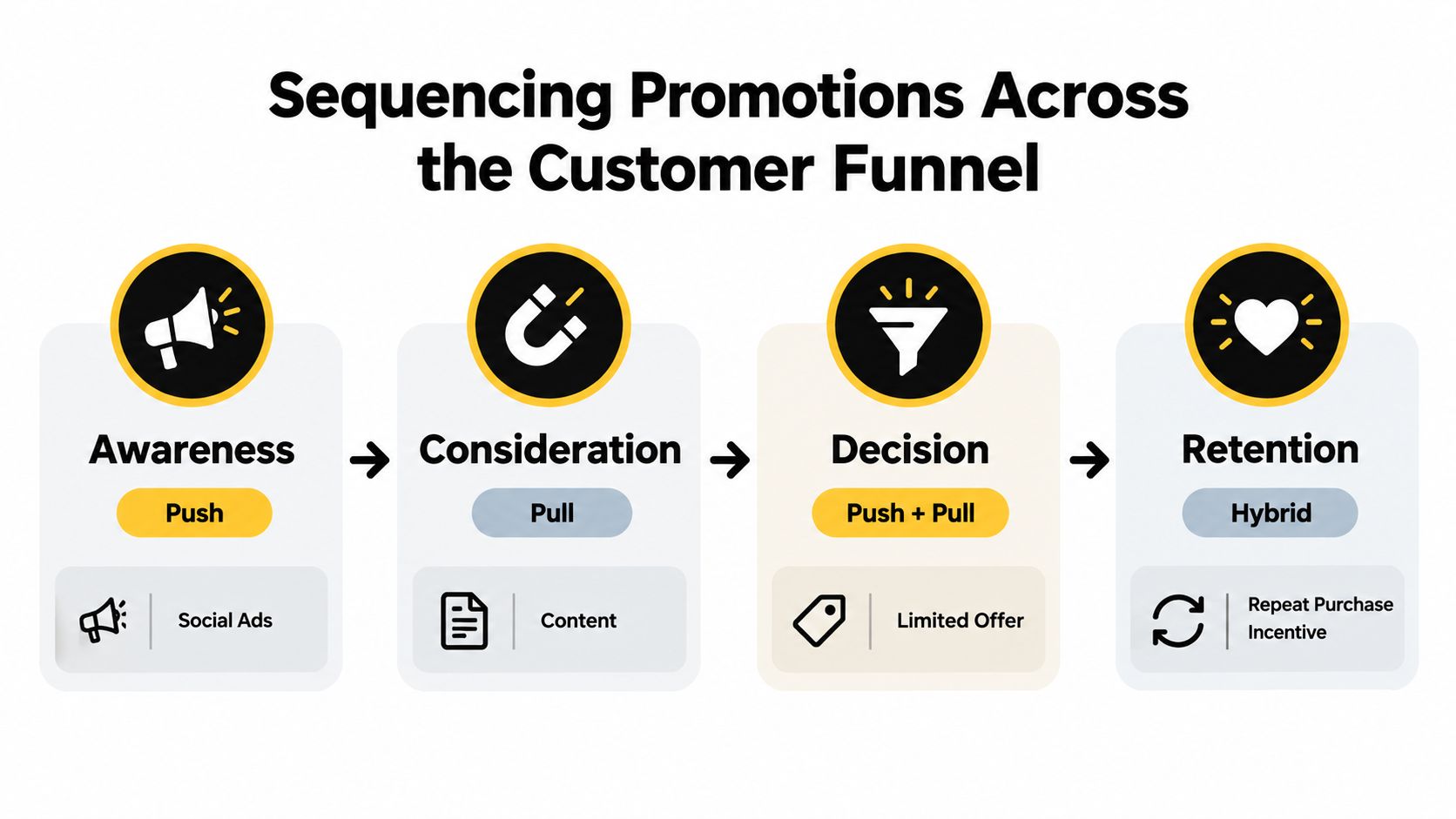
A four-stage video sequence
Awareness uses push. Publish creator content, paid social clips, or broad product demonstrations that introduce the problem and make the brand recognizable. The offer can remain light. The immediate job is to attract a relevant viewer, not close every sale.
Consideration uses pull. Answer questions through tutorials, comparisons, reviews, and behind-the-scenes proof. Invite viewers to explore the product, save the video, or follow for a specific reason. This stage earns permission for stronger conversion messaging.
Decision uses a hybrid approach. Combine organic proof with retargeting, creator reminders, or a limited offer. Keep the message focused. State the product, incentive, qualification, and end point without burying the action under extra claims.
Retention uses a relationship-based incentive. Follow up with usage guidance, complementary product ideas, loyalty access, or a repeat-purchase reminder. The customer should feel that the brand understands their next need, not that every interaction is another attempt to extract a transaction.
Seasonal campaigns need the same sequencing, even when the calendar creates natural urgency. A seasonal promotion guide from Nim provides a useful reference for planning timely creative around events and buying moments.
A promotion calendar should show the audience state beside every post. If the calendar only shows dates and discounts, it isn't yet a funnel plan.
This sequence also prevents creative fatigue. The audience sees different formats and reasons to engage, while the brand can identify whether the problem sits in discovery, product understanding, offer design, or repeat behavior.
Building Short-Form Video Promotion Campaigns Step by Step
Promotion content becomes easier to execute when the team separates strategy from production. Start with the commercial outcome, then choose the audience, offer, format, and publishing rhythm that support it.
Build the campaign in four moves
First, define one primary objective. Decide whether the campaign is meant to attract qualified viewers, generate product-page visits, convert existing intent, or encourage repeat purchases. A single video can support several outcomes, but the script needs one dominant action.
Second, assign the promotion to the audience stage. New viewers may need an educational demonstration. Warm viewers may need objection handling. Customers may need a product-use reminder or a relevant companion offer. This decision prevents a discount from appearing before the audience understands the value.
Third, write the hook before the body. Short-form viewers decide quickly whether a video deserves attention, so open with a specific problem, result, contrast, or use case. “Three products in one routine” is more informative than “You need this.” A creator can then show the product, explain the offer, and close with one clear action.
Fourth, schedule variations instead of repeating one advertisement. Create a sequence with a demonstration, an objection answer, a social-proof format, an offer reminder, and a post-purchase usage video. Align the sequence with seasonal demand and relevant trend cycles, but don't force a trend that makes the product difficult to understand.
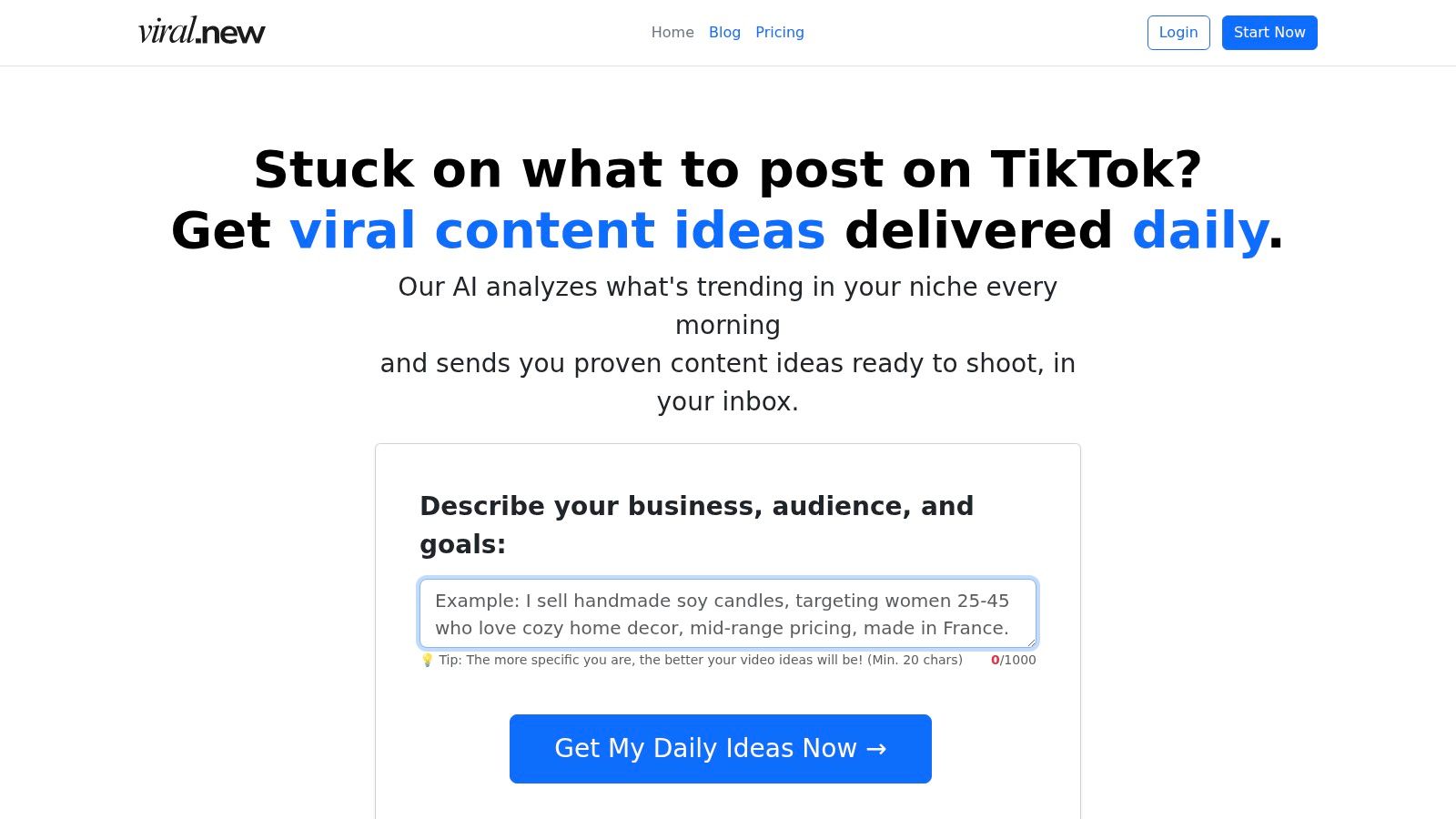
A tool such as Viral.new can generate daily, trend-aligned TikTok concepts from a description of the business, audience, and offer. That makes it useful for maintaining a steady idea pipeline, especially when the campaign needs multiple hooks and formats rather than one polished advertisement.
For broader planning principles, this guide to video marketing for online stores is a useful resource on using video across product discovery and ecommerce conversion.
The production checklist should stay lean:
- Hook: Does the opening identify a relevant tension?
- Demonstration: Can viewers see the product solving the stated problem?
- Offer: Are the terms and timing obvious?
- Proof: Does the video provide a credible reason to believe the claim?
- Action: Is there one next step rather than a collection of competing requests?
The TikTok product promotion guide can help teams turn this structure into platform-specific publishing ideas.
A campaign becomes repeatable when every new concept gets tagged by funnel stage, promotion type, audience, and intended action. That record also makes later measurement much cleaner.
Measuring Promotion Performance and ROI in Video Campaigns
Views can tell you whether a video earned distribution. They can't tell you whether the promotion created profitable demand. A useful measurement system connects attention, intent, transaction, and post-promotion behavior.
Track the audience journey at several levels. At the video level, review hook retention, watch time, saves, comments that indicate purchase intent, profile visits, and clicks. At the offer level, review landing-page conversion, promo-code redemption, average order composition, returns, and contribution after fulfillment costs. At the campaign level, compare the results with the period after the offer ends, when demand may normalize.
Use more than one evidence source
Sales promotion measurement is strongest when it combines aggregate store-level panel data with disaggregate consumer-level panel data. Aggregate data is easier to analyze, while consumer-level data supports finer causal attribution. The sales promotion measurement reference from Springer also recommends using surveys or experiments to isolate which mechanics generate profit rather than merely lift volume.
For a short-form campaign, that principle translates into a practical test design:
- Aggregate view: Compare sales, revenue, margin, and redemption by campaign, channel, product, and promotion window.
- Consumer view: Compare new buyers, returning buyers, exposed viewers, clickers, and customers who used the offer.
- Qualitative view: Ask buyers what persuaded them, what confused them, and whether the incentive changed their timing.
- Control view: Where possible, hold out a comparable audience or market so the team can estimate what might have happened without the promotion.
Don't award the campaign to the video with the most views automatically. A smaller demonstration may generate stronger purchase intent than a broad entertainment clip, while a high-redemption code may still produce weak profit if the offer is too generous.
Teams should also record creative variables. Note the opening hook, creator, format, product, audience stage, offer type, and call to action. Over time, that library reveals whether the business wins through education, social proof, urgency, bundles, or a combination of formats.
For implementation details, this guide to conversion tracking can support cleaner connections between content interactions and downstream actions.
Avoiding the Discount Trap and Protecting Brand Margin
The assumption that a deeper discount will always produce a better campaign is one of the costliest shortcuts in ecommerce. Lower prices can accelerate decisions, but they can also attract customers who are loyal to the deal rather than the brand, pressure margins, and make the regular price feel less credible.
A 2026 analysis of 93,000 ecommerce merchants reported a median promo-code depth of 15% and a Cyber Week peak of 23%, while a Capgemini consumer-trends report found that 62% of consumers say more attractive deals can make them switch brands. These figures appear in Webtonic's sales promotion statistics analysis, and they point to two tensions. Offers can influence immediate choice, but they can also make switching and deal comparison easier.
Replace blanket discounts with controlled value
Target the incentive instead of lowering the price for everyone. A first-purchase offer can serve acquisition, a bundle can increase usefulness, and a loyalty benefit can reward customers who have already demonstrated commitment. Each method protects a different part of the business, so the team should define the intended behavior before choosing the reward.
Education is another underused promotion method. A creator can show how to choose the right product, avoid a common mistake, or get more value from something the customer already owns. That content may not create the same immediate urgency as a flash sale, but it can strengthen trust and reduce the need to buy attention repeatedly.
Authenticity matters most when the product requires consideration. A creator who explains who the product is for, who should skip it, and how the offer works gives the audience useful decision information. That approach can outperform exaggerated scarcity because it treats the viewer as a buyer making a choice, not as a click to be captured.
Margin check: If the campaign only works when the price is reduced, test the offer against a stronger explanation of value before reducing the price again.
Use discounts when they solve a specific timing problem, clear a defined inventory situation, reward a meaningful behavior, or help a qualified customer overcome a final objection. Avoid using them as a substitute for weak positioning, unclear product pages, poor demonstrations, or inconsistent content.
The strongest promotion systems protect both conversion and future demand. They sequence urgency carefully, make the offer easy to understand, and give customers reasons to return that don't depend on permanent price cuts.
Viral.new provides daily AI-generated TikTok concepts designed for a business, audience, and goal, including hooks and ready-to-film angles for promotion content. Visit Viral.new to keep a steady flow of trend-aligned video ideas moving through your funnel strategy.
