
Going viral on TikTok isn't some random lottery win; it's a science. The whole game boils down to a few key ingredients: a hook that grabs someone in the first three seconds, a smart use of trending sounds, and creating something that people stick around to watch and feel compelled to share. If you can nail those things, you're essentially handing the TikTok algorithm a signed permission slip to blast your video across the platform.
Unpacking What "Viral" Really Means on TikTok
First things first, we need to get on the same page about what "going viral" actually means. It’s not just about racking up a ton of views over time. True virality is about explosive, almost immediate growth that forces the entire platform to take notice.
The TikTok algorithm is built to spot and reward content that people engage with right away. This is why the first few hours after you hit "post" are absolutely make-or-break.
Think of it this way: your video has to pass a series of tests. A handful of likes is a good start, but a flood of shares and comments within that first hour? That's a massive green flag for the algorithm. Those actions scream, "This content is making people stop scrolling, react, and talk."
The Metrics That Really Move the Needle
Views are the trophy, but they're won by excelling at a few other key metrics. If you want to crack the code, you need to be obsessed with these four signals.
- Completion Rate: This is the big one. If people watch your entire video—or even better, loop it a few times—you’re telling the algorithm it’s incredibly engaging. This is where shorter, punchier videos often have a built-in advantage.
- Shares: A share is the ultimate stamp of approval. Someone is literally vouching for your content and putting it in front of their own audience. The algorithm loves this and weighs shares very heavily.
- Comments: Comments signal that your video started a conversation. It means you made someone feel something—amused, shocked, or just eager to throw in their two cents.
- Likes: Don't get me wrong, likes are important. But they're the most passive form of engagement. Think of them as a baseline indicator of interest, but they don't carry the same weight as the other three.
So, What Does Viral Actually Look Like?
Okay, let's talk numbers. What separates a video that does "pretty well" from one that's genuinely viral? The goalposts have become a lot clearer. In 2025, a TikTok is typically considered viral once it smashes 1 million views within its first 72 hours.
If you see a video hit 3 to 5 million views within a week, that’s a certified viral hit. This kind of insane velocity is possible because about 80% of a video's viral potential is decided by how it performs in those critical first few hours. For a deeper dive into these benchmarks, the data from platforms like Exploding Topics is incredibly insightful.
Before we move on, let's set some clear targets. Knowing the benchmarks for virality helps you understand what you're aiming for with every piece of content.
Key Benchmarks for Going Viral on TikTok
| Metric | Viral Benchmark | Why It Matters |
|---|---|---|
| Initial View Velocity | 1,000+ views in the first hour | Shows immediate interest and convinces the algorithm to push it to a wider audience. |
| Like-to-View Ratio | 1 like per 10 views (10%) | A strong ratio signals that viewers actively approve of the content, not just passively watch. |
| Comment-to-Like Ratio | 1 comment per 10 likes | Indicates high engagement and that the content is sparking conversation. |
| Share-to-Like Ratio | 1 share per 20 likes | Shares are a powerful endorsement; this ratio shows the content is highly resonant. |
| Completion Rate | >80% for videos under 15s | High completion tells the algorithm the video is captivating from start to finish. |
| Total Views | 1M+ views within 72 hours | The most common definition of a viral video, signifying massive reach. |
These aren't just arbitrary numbers; they are the signals the algorithm is actively looking for. Aiming for these benchmarks puts you in the best possible position to trigger that viral explosion.
The Big Picture: Virality isn't a single event—it's a chain reaction. Great initial engagement gets you shown to a bigger audience. If that group also engages, you get pushed to an even larger one. This cycle repeats, creating that exponential view surge you're after. Your job is to create content that lights that initial fuse.
Planning Your Content to Go Viral
Let's be real: viral videos almost never happen by accident. They're the result of a smart, repeatable process that top creators use before they even think about hitting record. This planning phase is what separates a one-hit wonder from an account that consistently grows and pulls in views.
Think of virality as a feedback loop. Your video gets strong initial engagement, which tells the TikTok algorithm, "Hey, people like this!" The algorithm then pushes it to a wider audience, and if that group engages, it pushes it even further. That's the viral surge.
This flowchart breaks it down beautifully.
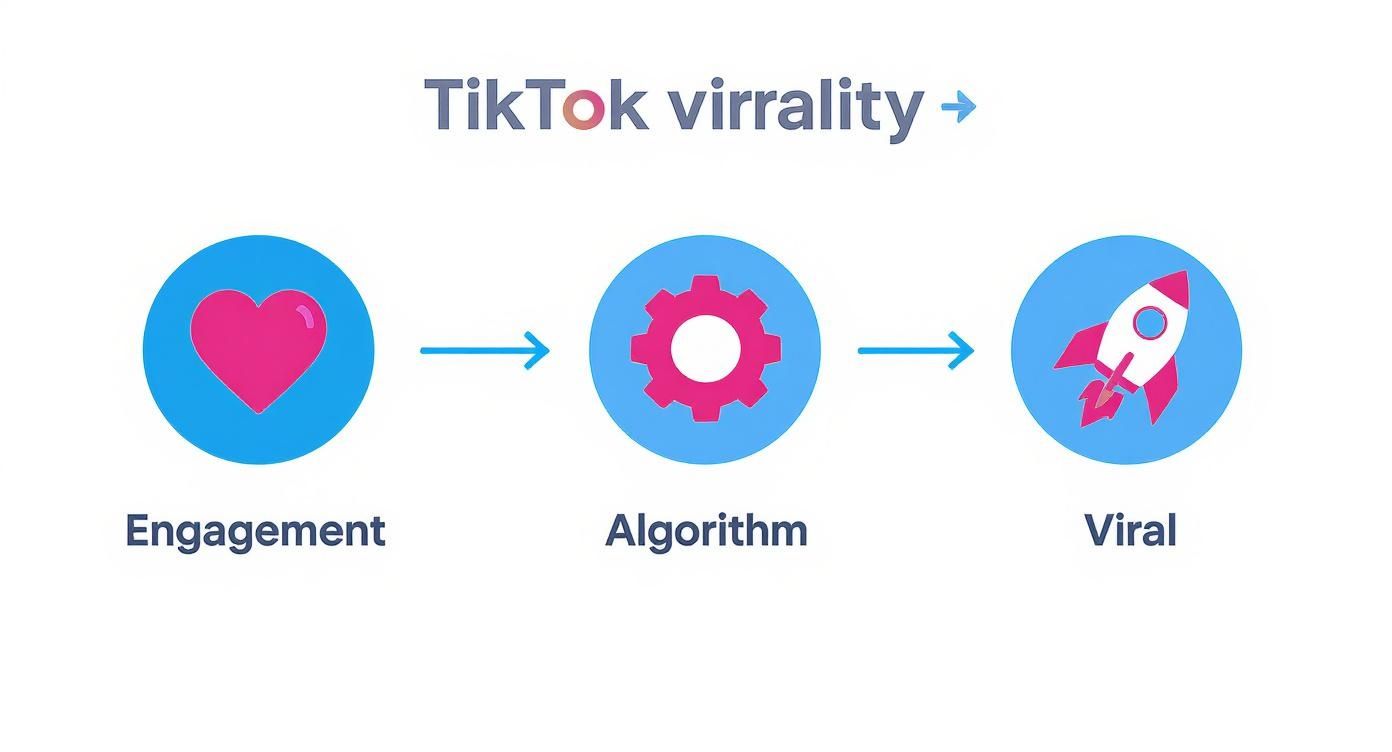
It’s not magic; it’s a simple chain reaction. Great engagement gets the algorithm's attention, and the algorithm gives you more reach. Your job during planning is to basically reverse-engineer this entire process.
Finding and Making Sense of New Trends
First thing's first: you have to become a student of the platform. You need to know what’s working right now, not what was big last month. TikTok trends have the shelf life of a banana, so your ability to spot them early and jump on them is everything.
Your For You Page (FYP) is your best friend here. Don't just mindlessly scroll. Start analyzing what you see. Are you noticing the same sound over and over? A particular format or filter? A recurring topic? When you see the same audio clip used in a dozen different ways, that's your signal—a trend is brewing.
For a more analytical approach, dive into the TikTok Creative Center. It’s a goldmine, and it’s free. It literally shows you which songs, hashtags, creators, and even videos are blowing up at this very moment. You can filter by your region and industry to find trends that actually make sense for your niche. The goal isn't just to copy, but to figure out why a trend is working and then put your own spin on it.
Nailing the Hook in the First 3 Seconds
You have 3 seconds. That’s it. If you can’t get someone to stop their scroll in that time, nothing else in your video matters. Your opening needs to be punchy, intriguing, and instantly signal that your video is worth watching.
A killer hook creates an "open loop"—it makes the viewer feel like they just have to stick around to see what happens.
Here are a few hook formulas I've seen work time and time again:
- The Problem/Solution: "Stop making this mistake with your resume..." This hits a pain point and promises an immediate fix.
- The Shock Factor: "You will not believe what my boss said to me..." This creates instant curiosity. Who wouldn't want to hear the rest of that story?
- The Listicle: "Here are three websites that feel illegal to know..." This sets a clear expectation and promises tangible, bite-sized value.
My two cents: The only job of your hook is to earn you another five seconds of watch time. Frame it as a promise of entertainment, a secret, or a solution.
Picking the Right Video Format
Okay, so you've got a trend and a killer hook. Now, how do you package it? The format is the structure of your video, and it needs to match both the trend you're using and your overall goal.
Some of the most reliable formats include:
- Talking Head with B-Roll: This is a classic. You talk to the camera, but as you speak, you overlay short, relevant clips (B-roll) that show what you're talking about. It keeps things visually interesting and stops people from getting bored.
- POV Skits: Point-of-view skits are incredibly relatable. You act out a scenario from a specific character's perspective, often using on-screen text for dialogue. They pull the viewer right into the story.
- Quick Tutorials: These are all about providing direct, actionable value. Think quick cuts, bold on-screen text, and a fast pace that guides the viewer through a specific process.
- Trend Adaptations: This is where you take a trending sound or effect and make it your own. The key is to add your unique personality or a niche-specific angle. Don't just do what everyone else is doing; add to the conversation.
Putting in the work upfront—finding a trend, writing a great hook, and picking the right format—is what sets your video up for success. It’s the foundation that dramatically increases your odds of going viral.
From Plan to Post: Creating Content That Clicks
You can have the best plan in the world, but going viral all comes down to execution. The TikTok algorithm is basically a massive engagement-seeking machine; its only job is to find and push content that keeps people glued to their screens. Your job is to make videos that feed that machine.
This means you have to think beyond just the topic of your video. You need to structure it in a way that actively encourages likes, comments, and—most importantly—shares and full watch-throughs. These are the loudest signals you can send to TikTok that your content is worth showing to more people.
Why Completion Rate and Shares Are Gold
Likes and comments are nice, but they're table stakes. The algorithm puts a much heavier emphasis on two other metrics: completion rate and shares.
A high completion rate is the holy grail. It tells TikTok that your video was so captivating people stuck around until the very end. It’s a direct measure of how well you held their attention.
Shares are the ultimate stamp of approval. When someone shares your video, they’re vouching for it with their own social cred. The algorithm sees this as a sign of incredibly valuable or relatable content, and it’ll reward you with a serious boost in reach. If you want to go viral, you have to make something people feel an almost instinctual need to share.
Aiming for the Right Engagement Numbers
So, what does "high engagement" actually look like? In 2025, the average engagement rate on TikTok is a whopping 2.5% per post—that's nearly five times what you'd see on a platform like Instagram. This means any video hitting a 5% engagement rate or higher is doing something right.
Shares are a massive part of this; once a video crosses 10,000 shares, it’s often considered to be in viral territory. You should also be aiming for a completion rate of at least 50%, especially since the platform average is only around 20% to 30%. This is why shorter videos, often under 15 seconds, tend to perform so well—they make it easy to hit that high completion mark. For a deeper dive, you can explore more about what these TikTok stats mean for creators.
My Two Cents: Don't just make content; make content that demands a response. End with a question. Present a controversial take that people can't resist debating in the comments. Create something so relatable their first thought is to hit the share button and text it to a friend with "This is SO us."
This simple shift in mindset changes your focus from just chasing views to earning the interactions that actually fuel the algorithm.
How to Actually Use Trending Audio and Effects
Hopping on a trending sound or effect is probably the fastest shortcut to getting discovered on TikTok. When a sound is popular, the algorithm is actively looking for new videos using it to serve up to people who've already shown interest. It's like catching a wave.
But you have to be smart about it.
- Adapt, Don't Just Copy: Find a trending sound in the TikTok Creative Center or on your For You Page, but don't just remake the video everyone else is making. Give it a unique spin that ties back to your niche. If a dance trend is blowing up, how could a real estate agent use the audio to highlight a home feature? That unexpected connection is what makes people stop scrolling.
- Match the Vibe: The audio you choose sets the entire mood. An upbeat, chaotic sound paired with a calm, educational video just feels off. Make sure the tempo and emotion of the audio actually complement what's happening on screen. It makes the whole thing feel more polished and intentional.
- Use Effects to Tell the Story: Effects aren't just goofy decorations; they're storytelling tools. Use the Green Screen to react to a news article, or build an entire skit around a popular filter. The effect should add to the video, not just be there for the sake of it.
By pairing a solid idea with the right trending audio, you're giving the algorithm a clear roadmap of who to show your video to. This dramatically increases your odds of landing on the right For You Pages and getting that viral push.
Optimizing Your Publishing Strategy
Your job isn't done the moment you hit "stop recording." Honestly, that's just the halfway point. The final steps—how you edit, caption, and publish—are what package your video for the algorithm and give it a real shot at taking off. I’ve seen so many brilliant videos die on the vine because of a lazy publishing strategy.
Think of it like this: the video is your product, but your publishing choices are the marketing. You have to make it easy to find, impossible to scroll past, and drop it at the exact moment your audience is glued to their phones. Nailing these details is a massive part of the puzzle.

Master In-App Editing for Maximum Watch Time
Before you even think about hashtags, your edit needs to be ruthlessly optimized for watch time. You don't need fancy software; TikTok's built-in tools are more than powerful enough if you know how to use them.
One of the simplest and most effective tools is text overlay. Use big, bold, easy-to-read text on screen to call out key moments or add extra context. This is a game-changer for viewers watching with the sound off (which, trust me, is a lot of them).
And please, always add closed captions. TikTok can auto-generate them in a second. Not only does this make your content accessible to a wider audience, but it gives people another way to follow along, dramatically increasing the chance they’ll stick around until the end.
Write Captions That Start a Fire
Your caption has one job: get people talking in the comments. The video’s hook grabs their attention for three seconds, but the caption is what convinces them to stay and engage. A caption that just describes the video is a massive missed opportunity.
Instead, ask a genuine, open-ended question. Or, take a slightly controversial stance that invites people to disagree. Even just sharing a super-relatable thought can be enough to make someone say, "me too!" and type out a reply.
Key Insight: A video with a thousand comments is far more likely to go viral than one with a thousand likes. Your caption is the single best tool you have for generating those comments.
Build the Perfect Hashtag Mix
Stop thinking about hashtags as a numbers game. Spamming every popular tag you can find is a surefire way to get lost in the noise. A strategic, blended approach is infinitely more effective. Your goal is to use a specific mix of hashtags that tells the algorithm exactly who to show your video to.
A balanced strategy always includes a mix of broad, niche, and trending tags. Using only massive tags like #fyp is like screaming into a hurricane—you’re competing against millions. But using only tiny, niche tags means you’re limiting your potential audience from the start.
To help you strike the right balance, here’s a look at how different hashtag types work and when to deploy them.
Hashtag Strategy Comparison for Maximum Reach
| Hashtag Type | Example | Purpose | When to Use |
|---|---|---|---|
| Broad | #digitalmarketing |
Reaches a large, general audience interested in your overall topic. | Use 1-2 per video to cast a wide net and signal the general category of your content. |
| Niche | #tiktokseotips |
Targets a specific, highly engaged community looking for content just like yours. | Use 2-3 per video to attract your ideal followers and connect with a dedicated subculture. |
| Trending | #marketingtrends2025 |
Taps into current conversations and events, piggybacking on existing search volume. | Use 1-2 when your video directly relates to a currently popular or timely discussion. |
| Branded | #ViralNewIdeas |
Helps build community and allows you to categorize your own content for your followers. | Use consistently on relevant posts to create a content library your audience can find easily. |
By combining these, you give your content the best of both worlds: the chance for broad discovery and the precision to reach a super-relevant audience that’s more likely to engage.
The Power of a Consistent Posting Cadence
The TikTok algorithm absolutely favors creators who show up consistently. Posting randomly sends mixed signals and makes it incredibly difficult to build any real momentum. You should be aiming to post at least once per day, especially when you're in a growth phase.
This consistency achieves two critical things:
- It keeps your audience engaged: You're training your followers to expect and look for your content, which keeps you top-of-mind.
- It gives you more data: Every single video is a data point. The more you post, the more you learn about what's working, which allows you to iterate and improve much faster.
Pinpoint Your Audience's Peak Activity
Posting every day is one thing, but posting at the right time is how you give your video an immediate boost. The goal is to publish your content right as the largest chunk of your followers are opening the app to scroll.
You can find this golden window right inside your TikTok Analytics.
- Head to your Profile and tap the three lines in the top-right corner.
- Select Creator Tools, then tap Analytics.
- Navigate to the Followers tab and scroll down until you see the "Follower activity" chart.
This graph shows you the exact hours and days your audience is most active. The sweet spot is to post 30-60 minutes before these peak times. This gives your video just enough time to start gaining traction so that when the wave of users comes online, the algorithm already sees your video as a winner worth pushing to a wider audience.
Analyzing Your Performance to Replicate Success
https://www.youtube.com/embed/bRug-2uCEak
Going viral once feels incredible. But the real goal? Building a system so you can do it again and again. This is exactly where most creators stumble—they get the win but have no clue why it happened. The single biggest shift you can make for long-term growth is learning to think like a data-driven creator.
Every single video you post, whether it gets 100 views or a million, is a direct message from your audience. Your job is to learn how to read it. TikTok's built-in analytics are your new best friend, turning vague ideas like "engagement" into hard numbers that tell you exactly what to do next.
Don't just glance at the view count and move on. You need to become a performance detective, digging through the data to find the clues that explain what worked and what flopped. This is how you stop guessing and start knowing.
Diving Into Your TikTok Analytics
First things first, you'll need a Creator or Business account to get to the good stuff. You can find your dashboard by going to your profile, tapping the three-line menu, and choosing Creator Tools, then Analytics. This is where the magic happens.
The dashboard has a few tabs, but for figuring out what to replicate, you’ll be living in the individual video performance section. When you open the analytics for a specific video, you’re hunting for patterns. The metrics I obsess over are:
- Average Watch Time: This is it. The holy grail for virality. It tells you, on average, how long people actually watched your video. A high average watch time, especially on a shorter video, screams to the algorithm that your content is compelling.
- Watched Full Video: This percentage shows how many people stuck around until the very end. If you're seeing numbers over 50%, you’ve officially made something sticky.
- Traffic Sources: This breakdown shows where your views came from. If a video is really taking off, you’ll see the For You Page dominating this chart. If most views are from your profile, it means the video never really broke out into the wild.
Translating Data Into Actionable Insights
Knowing the numbers is one thing. Using them to get better is what separates the pros from everyone else.
Let's imagine you post two videos. Video A gets a respectable 5,000 views, but Video B explodes with 250,000. Don't just pop the champagne for Video B; put it under a microscope.
Pull up their analytics side-by-side. I guarantee you'll find Video B had a significantly higher average watch time. Now, go back and watch both videos with a critical eye. What was different in the first three seconds of Video B? Was the hook stronger? Did you use a better trending sound? Was the visual more eye-catching?
The Creator's Mindset: Stop thinking of underperforming videos as failures. They're just hypotheses that were proven wrong. Your analytics give you the data to form a much stronger hypothesis for the next one.
This cycle of analyzing and iterating is how you build a content engine that actually works. It isn't about trying to make every video a viral hit. It’s about consistently raising your average view count by learning from your wins and ditching what doesn’t connect.
Understanding Who You're Talking To
Beyond individual video stats, the "Followers" tab in your analytics is a goldmine of information. It tells you the gender breakdown of your audience, where they live, and, most importantly, when they're most active on the app.
Say you create content for aspiring photographers. Your analytics show that 70% of your audience is male, primarily in the United States. That insight is pure gold. It should immediately shape your content—from the camera gear you reference to the locations you feature and even the time you post.
Analyzing your performance isn't something you do once a month. It’s a constant feedback loop. I check my analytics daily, always looking for outliers—both the hits and the misses—and asking "why?" That relentless curiosity, fueled by hard data, is the secret to moving beyond a one-hit wonder and building a presence that lasts.
The Burning Questions: Your TikTok Viral FAQ
Even with the best strategy, hitting that viral sweet spot can feel like a total mystery. Let's clear the air and tackle the questions I hear from creators all the time. Getting these fundamentals right means you can stop chasing myths and focus your energy on what actually works.
How Long Does It Take for a TikTok to Go Viral?
If a video is going to pop off, it happens fast. TikTok's algorithm makes its decision about your video's potential within the first few hours. It’s looking for a strong, immediate signal from viewers—likes, comments, shares, and, most importantly, high watch time.
Most viral hits see that massive spike within the first 24 to 72 hours. If your video is still sitting flat after a full day, it's almost certainly not going to take off later. My advice? Don't get hung up on it. Take what you can learn and move on to creating your next piece.
Should I Delete and Repost a Flopped TikTok?
This is probably the most common myth out there, and the answer is a hard no. Resist the urge to delete and repost. It's a waste of time and can actually hurt your account.
The algorithm can see this as spammy behavior, which is the last thing you want. A video that doesn't perform well isn't a failure; it's free market research.
My Take: I look at every underperforming video as a data point. It’s telling me something valuable about what my audience doesn't want. Use that feedback to make your next video smarter and stronger.
So, What Went Wrong With My Video?
Instead of hitting delete, play detective. Ask yourself these questions:
- Did the hook miss the mark? Were the first 3 seconds so compelling that someone had to stop scrolling? Or was it a slow start?
- Was the sound past its prime? You might have used a trending sound, but if you jumped on it too late, the wave has already passed. Timing is everything.
- Did you post at a bad time? Check your analytics. If you post when your audience is asleep, you miss that crucial window for initial engagement that feeds the algorithm.
- What was the point? Was the value proposition crystal clear? Every video needs to either entertain, educate, or inspire—if it's confusing, viewers will just swipe away.
Answering these honestly is way more productive for your long-term growth than just reposting and hoping for a different result.
Do I Need to Start a New Account to Go Viral?
Absolutely not. This is another popular misconception that just isn't true. The beauty of the TikTok algorithm is that it gives every single video a chance, judging it on its own merits.
Your account's age or follower count is largely irrelevant to the performance of a single video. I’ve seen brand-new accounts with zero followers pull in millions of views on their first post simply because the content was incredible. Focus your energy on making a killer video, not on creating a new profile.
Will Using #fyp Guarantee My Video Goes Viral?
Nope. Hashtags are organizational tools, not magic wands for virality. While you’ll see massive tags like #fyp, #foryou, and #viral on almost every popular video, they are an ocean of content.
Relying solely on those is like shouting into a hurricane—you're competing with millions of other videos uploaded every single hour. A smarter approach is to use a blended hashtag strategy that gives the algorithm clearer signals.
Here’s a simple formula that works:
- Broad Tags (1-2): Tell the algorithm your general category (e.g.,
#marketing). - Niche Tags (2-3): Target your specific community (e.g.,
#tiktokseotips). This is where you find your people. - Trending Tag (1): If it fits your video, hop on a relevant trend or challenge tag.
At the end of the day, a great video is what goes viral. Hashtags just help the right audience find it a little faster.
Ready to stop guessing and start creating content that works? Viral.new delivers AI-powered, trend-aligned video ideas directly to your inbox every morning. We analyze what’s working in your niche right now and turn it into ready-to-shoot concepts, so you can spend less time brainstorming and more time going viral. Get your daily dose of viral ideas.
