

Measuring your social media ROI really just comes down to one thing: proving that the money, time, and effort you pour into platforms like TikTok are actually worth it. It’s about drawing a straight line from your creative content to real business results, getting past vanity metrics like likes and views to see what’s actually making you money.
Your Framework for Measuring TikTok ROI

Let's cut right to it. Figuring out your return on investment from TikTok isn't just an exercise for big brands justifying ad spend. For creators and small businesses, it’s about proving your daily grind on content creation is actually moving the needle.
This is where you stop guessing and start knowing. While a video going viral feels amazing, those views don't automatically pay the bills. The real win is understanding exactly which of your TikToks are driving sales, pulling in email subscribers, or getting you new client inquiries.
The Fundamental ROI Formula
At its core, the math is pretty simple. The classic formula is (Profit from Social Media / Total Investment) x 100. So, if you spend $1,000 on a TikTok campaign and it brings in $5,000 in profit, your ROI is a very healthy 400%.
For TikTok creators, this means getting serious about using UTM links on every video to see which views actually convert into customers. While marketers still prioritize engagement (68%) and conversions (65%), the data is clear: short-form video delivers the highest ROI of any format at 41%.
If you want to really nail down the basics, getting a handle on how to measure marketing ROI in a broader sense will give you a rock-solid foundation. The principles there apply everywhere, including TikTok.
A huge mistake I see all the time is underestimating your "Total Investment." It’s not just about ad dollars. You have to account for your editing software, camera gear, any paid tools, and most importantly, your time. A true ROI calculation includes every single resource you put in.
The Four Pillars of Measuring TikTok ROI
To build a reliable measurement system, you need to focus on four key areas. Think of them as building blocks—each one supports the next, giving you a clear path from a video idea to a number in your bank account.
This table breaks down the essentials for a solid measurement strategy.
| Pillar | Description | Example for a Creator |
|---|---|---|
| Clear Goals | Start with your objective. Are you selling a product, generating leads for a service, or growing an email list? Your goal defines what you measure. | "I want to sell 50 units of my new digital course this month through my TikTok videos." |
| Accurate Tracking | This is the non-negotiable tech setup. Use tools like the TikTok Pixel, Google Analytics 4, and UTMs to trace a user's path from your video to a purchase. | Setting up a custom conversion event in GA4 that fires when someone lands on the course's "thank you for your purchase" page. |
| Honest Calculation | Use the right formulas and include all costs. Look beyond immediate revenue to metrics like Customer Lifetime Value (CLV) for a fuller picture. | Calculating total costs (e.g., $100 for a video editor + $50 in ads) against the $2,500 in course revenue to find the true ROI. |
| Smart Iteration | Your data is telling you a story. Listen to it. Figure out what content resonates and leads to sales, then double down on that strategy. | Noticing that "behind-the-scenes" videos drive 3x more course sign-ups than tutorial videos, and adjusting the content plan accordingly. |
By mastering these four pillars, you move from just creating content to building a predictable, profitable engine for your business on TikTok.
Picking Goals and KPIs That Actually Matter
Before you can even think about measuring social media ROI, you have to get crystal clear on what "return" means for your business. It’s so easy to fall into the trap of chasing vanity metrics—the follower counts and likes that make you feel good but don’t actually move the needle.
Success on TikTok isn't about big numbers on a screen; it’s about driving real, tangible results for your brand.
Your goals are the foundation for everything else. Are you a DTC brand trying to sell products? Your main goal is sales, plain and simple. Are you a coach? You're probably trying to book discovery calls or get people on your newsletter. Vague goals like "more engagement" won't cut it. Instead, aim for something concrete, like 50 product link clicks per video or 10 new email sign-ups from your bio link every week.
Getting this specific from the start is the only way to build a measurement plan that works.
Thinking in Funnel Stages
Not all goals are created equal. I find it helpful to frame them within the classic marketing funnel. Your TikTok content is likely hitting different parts of the customer journey, and your goals need to reflect that.
- Top-of-Funnel (Awareness): This is all about getting your brand in front of new eyeballs. The goal here is pure reach and brand recognition, not making an immediate sale.
- Mid-Funnel (Consideration): Now you're nurturing that initial interest. These goals focus on actions that show a deeper connection, like someone saving your video for later or tapping through to your profile.
- Bottom-of-Funnel (Conversion): This is where the magic happens—and the money is made. These goals are directly tied to revenue, like actual purchases, lead form submissions, or booking a demo.
A small business might have a primary goal of driving sales (bottom-funnel) but also a secondary goal of getting more brand mentions (top-of-funnel). Understanding this split helps you pick the right metrics for each objective without getting them mixed up.
Linking Your KPIs Directly to Your Goals
Once you've defined your goals, it's time to connect them to Key Performance Indicators (KPIs). A KPI is just a measurable value that tells you how effectively you're hitting your target. This is how you go from a broad idea to a hard data point you can track.
Think of it this way: if your goal is the destination, your KPIs are the mile markers on the highway, telling you if you’re actually making progress.
I see so many creators tracking metrics that have nothing to do with their actual business objectives. For most businesses, your follower count is way less important than your Bio Link Click-Through Rate (CTR). And metrics like 'Shares' and 'Average Watch Time' are much stronger signals of content quality and brand health than a simple 'Like'.
Here’s a simple way to think about connecting your goals to the right KPIs:
| Business Goal | Funnel Stage | Primary KPI | Why It Matters |
|---|---|---|---|
| Increase Brand Visibility | Awareness | Video Views & Reach | Measures how many unique people are seeing your content for the first time. |
| Build an Engaged Community | Consideration | Shares & Saves | Shows your content is valuable enough for people to pass along or revisit later. |
| Generate Leads for a Service | Conversion | Bio Link Clicks | Directly tracks how many people are taking that next step to sign up or learn more. |
| Drive Product Sales | Conversion | Conversion Rate | The ultimate metric showing what percentage of clicks actually turn into a sale. |
Remember, TikTok’s algorithm rewards content that keeps people on the platform. With an average engagement rate of 3.70%—dwarfing Instagram's 0.48%—it’s an incredible channel for grabbing attention. In fact, paid social media is now the second-highest ROI channel at 26%, right behind SEO. And with over 60% of global product discovery now happening on platforms like TikTok, tracking the right KPIs is how you prove your efforts are paying off.
Your KPIs should become a custom scorecard for your business. This is especially true if you’re using AI-driven prompts from a tool like Viral.new. You can start tracking whether a certain video hook style leads to a higher Average Watch Time, or if a specific call-to-action really boosts your Conversion Rate. This turns content creation from a guessing game into a repeatable growth engine.
Of course, knowing which metrics to track is only half the battle. You also need to understand what they mean, which is why it helps to learn how to calculate TikTok engagement rate to get a true picture of your content’s performance.
Building Your Analytics and Tracking Foundation
To actually measure your ROI, you need a solid data pipeline. I know, that sounds super technical and intimidating, but it’s really just about setting up a few key tools. These tools are the bridges between what happens on TikTok and what happens on your website.
Without them, you're flying blind.
Getting this right is the difference between guessing what works and knowing what works. You’ll finally be able to connect a specific viral video to a flood of new sales, moving beyond vanity metrics and into a world of data-driven decisions.
Putting the TikTok Pixel to Work
First up is the TikTok Pixel. It's a small snippet of code you add to your website. Think of it as a scout that watches what people do on your site after clicking a link from TikTok and then reports back to your Ads Manager.
Its main job is to track user behavior. For instance, if someone sees your video, clicks the link in your bio, and adds a product to their cart, the Pixel logs that action. This isn't just for curiosity; it's incredibly powerful for a few reasons:
- Conversion Tracking: It connects the dots, showing you which TikTok content is directly leading to purchases, sign-ups, or other valuable actions on your site.
- Ad Optimization: If you're running ads, the Pixel feeds data back to TikTok's algorithm, helping it find more people who are likely to become customers. It's like a cheat code for better ad performance.
- Audience Building: You can create custom audiences based on site visitors or specific actions (like "added to cart but didn't buy"), which is perfect for retargeting campaigns.
The good news? Most website platforms like Shopify or WordPress have simple integrations that make installing the Pixel a breeze. You often won't have to touch a single line of code.
Before we dive into the other tools, let's look at how they fit together. This quick overview will help you understand the role each one plays in your tracking setup.
Essential Tracking Tools for TikTok Creators
| Tool | Primary Function | Why It's Critical |
|---|---|---|
| TikTok Pixel | Tracks on-site actions from TikTok traffic | Directly attributes sales and leads to your TikTok content and ads. |
| UTM Parameters | Adds tracking tags to your links | Tells you exactly which TikTok link (bio, story, etc.) drove the traffic. |
| Google Analytics 4 | Central hub for all website data | Aggregates all your traffic sources and measures defined business goals (conversions). |
Each tool provides a different piece of the puzzle. The Pixel tells you what happened, UTMs tell you where it came from, and GA4 brings it all together to show you the full picture.
Demystifying UTM Parameters
While the Pixel gives you the big picture, UTM parameters are your secret weapon for getting incredibly specific. They are simple tags you tack onto the end of a URL to tell your analytics software exactly where a visitor came from.
This infographic shows how you might organize your KPIs based on different stages of the customer journey, from initial awareness to final sales.
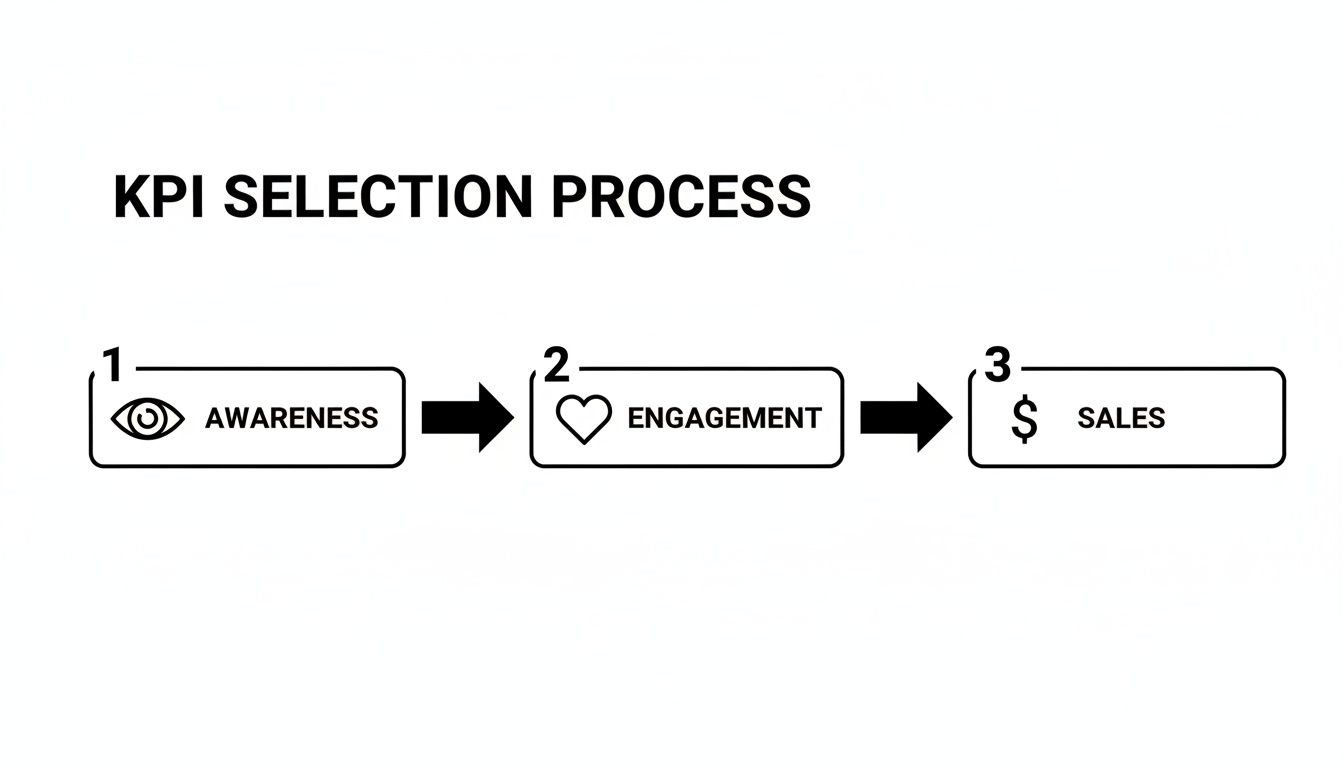
As you can see, moving from awareness to sales requires different metrics, and UTMs help you track that journey with precision.
Let's say you're promoting a new course in your TikTok bio. Instead of just dropping the plain link, you'd use one with UTMs. It would look something like this:
yourwebsite.com/course?utm_source=tiktok&utm_medium=social&utm_campaign=course-launch&utm_content=bio-link
Here’s a quick breakdown of what that all means:
- utm_source: Where did they come from? (tiktok)
- utm_medium: What kind of channel was it? (social)
- utm_campaign: What promotion are you running? (course-launch)
- utm_content: Which specific link did they click? (bio-link)
You can use Google’s free Campaign URL Builder to generate these in seconds. Now, when you pop into Google Analytics, you can see exactly how many people came from your TikTok bio link during that specific launch.
Configuring Google Analytics 4 for Conversions
Google Analytics 4 (GA4) is the command center where all this data comes together. It’s where you’ll see the traffic from your UTM links and the actions tracked by your TikTok Pixel. The single most important thing you can do here is set up conversion events.
A conversion event is simply an action on your website that you've defined as valuable. We're moving beyond just tracking page views and into tracking real business outcomes.
Don't get overwhelmed by all the options in GA4. Start with just one or two key conversions that directly relate to your primary business goal. If you sell a product, your first conversion should be 'purchase.' If you're a coach, it should be 'form_submission' for your contact form. Master that, then expand.
Here are a few essential conversion events every TikTok creator or small business should have set up in GA4:
purchase: The holy grail for e-commerce. This event should fire on your "thank you" page after someone buys something.add_to_cart: A huge indicator of purchase intent. Tracking this helps you see how many people are starting the checkout process but not finishing.generate_lead: This is your bread and butter if you're a service-based business. It tracks form submissions for things like contact forms or newsletter sign-ups.view_item: Tracks when someone looks at a specific product page. This helps you gauge interest in the items you're promoting on TikTok.
Once you have these configured, you can build reports in GA4 that definitively show, "I got 50 sales last month, and they came directly from the link in my TikTok bio." This level of clarity is a total game-changer. And remember, comparing this on-site data with your on-platform data is key, so it's always smart to know how to check TikTok analytics as well.
Calculating Your TikTok ROI Without the Headache

Alright, you've set your goals and your tracking is humming along. Now for the moment of truth: the math. Don't sweat it—you don't need a finance degree for this part. We're going to break down the essential formulas into simple, real-world terms that actually make sense.
Let's start with the classic formula you've probably seen before. It's the bedrock of ROI measurement for a reason: it gives you a clean, direct answer to whether your efforts are making money.
The Classic ROI Formula:
(Net Profit / Total Investment) x 100 = ROI %
Let’s put it into practice. Imagine you're a creator who spent $100 on TikTok ads to promote a new digital course. Those ads drove $500 in sales.
Here’s the calculation:
($500 - $100) / $100 * 100 = 400%
A 400% ROI looks amazing on paper, but that number is only as good as the data you plug into it. The most common pitfall is getting your "Total Investment" wrong.
What Really Goes Into Your Total Investment?
The biggest mistake I see creators make is thinking their investment is just their ad spend. That's not even close to the full picture. Your Total Investment is every single resource you pour into your TikTok strategy.
To get a true ROI, you have to account for everything:
- Software and Tools: Think video editing apps, scheduling platforms, or analytics subscriptions. It all adds up.
- Content Creation Costs: Did you hire a freelance editor? Buy stock footage or a trending sound? Those are direct costs.
- Ad Spend: This is the obvious one—the money you put directly into TikTok ads.
- The Value of Your Time: This is the hidden cost most people forget. If you spend 10 hours a week on TikTok and you value your time at $50/hour, that's a $500 weekly investment right there.
Thinking in terms of "Total Cost of Ownership" is a game-changer. It prevents a supposedly cheap strategy from secretly draining your resources. If you ignore these hidden costs, your ROI calculation becomes just another vanity metric.
The basic ROI formula is straightforward: if you spend $1K and make $5K in profit, you've got a 400% ROI. But that’s only if you can actually track it. For many, the real challenge is that over half of business leaders say poor tool integration is the biggest roadblock to seeing clear ROI. You need a setup where you can directly tie social activity to revenue, whether that's through direct sales or building an audience that will pay off later.
Beyond the Basic Formula
While the standard ROI calculation is a must-know, relying on it alone can give you tunnel vision. To get the full story of your TikTok performance, you need to understand precisely how to calculate marketing ROI with a few more nuanced metrics.
These formulas tell you so much more about your campaign's health.
Cost Per Acquisition (CPA)
How much does it really cost to get one new customer through the door? That’s what Cost Per Acquisition tells you. It's a critical number for judging the raw efficiency of your TikTok funnel.
The Formula:
Total Investment / Number of New Customers = CPA
Real-World Scenario: Let's say you spent a total of $500 on a campaign (including your time, tools, and ads). That campaign brought in 20 brand-new customers.
$500 / 20 = $25 CPA
Your CPA is $25. This number is your new benchmark. Now you can ask the important question: can my business afford to pay $25 for a customer? If your product sells for $30, that's a dangerously thin margin. But if your product is $200, a $25 CPA is a massive win.
Customer Lifetime Value (CLV)
This might be the single most important metric for understanding the long-term health of your business. Customer Lifetime Value (CLV) looks beyond the first purchase to predict how much profit a single customer will generate over their entire relationship with you.
A Simplified Formula:
(Average Purchase Value) x (Average Purchase Frequency) x (Average Customer Lifespan) = CLV
Real-World Scenario: A customer finds you on TikTok and buys your $50 monthly subscription box. They stick around for two years.
$50 (Avg. Value) x 12 (Purchases Per Year) x 2 (Years) = $1,200 CLV
All of a sudden, that $25 CPA looks incredible, doesn't it? This is how you prove that one viral TikTok isn't just a flash in the pan—it's an engine for sustainable, long-term revenue. This is the number that truly justifies your social media investment.
Turning Your Data into Smarter Content Decisions
Having your ROI numbers in hand is a huge win, but honestly, it's only half the battle. The real magic happens when you stop just reporting on the data and start letting it guide your creative process. Anyone can collect analytics; the hard part is turning those numbers into a strategic advantage that actually fuels better content.
This is where you build a powerful feedback loop. Your measurement starts to directly inform your creative decisions, transforming your content strategy from a high-stakes guessing game into a predictable growth engine.
Translating Analytics into Actionable Insights
Think of your tracking tools—like Google Analytics and your UTM parameters—as leaving a trail of breadcrumbs. Your job is to follow them to figure out what your audience truly wants and what actually compels them to act. The insights you uncover are often surprisingly simple but incredibly powerful.
For instance, after a month of tracking, you might look at your GA4 data and notice a pattern you can't ignore. Let's say your UTMs reveal that TikTok videos featuring a "day in the life" hook generate 80% of your bio link clicks, even though they only make up 20% of your content.
Boom. That single piece of data is your cue. It’s not just an interesting fact; it’s a direct instruction from your audience to double down on that format. It tells you that behind-the-scenes content resonates deeply and is your most effective tool for driving traffic off-platform.
Running Simple Experiments to Find Your Winners
You don't need a complex lab setup to figure out what works. Some of the most valuable insights I've ever seen come from running simple, controlled tests directly on a TikTok profile. It's all about pitting one idea against another to see which one performs better against your specific business goals.
Think of it as a friendly competition between your content ideas. The whole point is to isolate one variable and see how changing it impacts a key metric, like conversions or click-throughs.
The most effective social media strategies aren’t born from one viral moment. They are built through constant, small-scale experimentation. Testing eliminates assumptions and replaces them with hard evidence, which is the fastest way to improve your social media ROI.
Here are a few simple A/B tests you can run right now:
- The Pinned Video Test: Pin two different product-focused videos to the top of your profile. One could be a polished, direct product showcase, while the other is a more authentic, UGC-style video. Let them sit for a week, then check your analytics to see which one drove more clicks to your product page.
- The Call-to-Action (CTA) Test: For one week, end all your videos with a direct verbal CTA like, "Click the link in my bio to grab yours." The next week, switch to a more subtle text overlay CTA. Compare the bio link CTR for both weeks. Which approach was more effective?
- The Hook Variation Test: Create two nearly identical videos but change only the first three seconds—the hook. One might start with a question, while the other starts with a bold, controversial statement. Post them a day apart and measure which one achieves a higher average watch time.
These small tests compound over time, giving you a deep, practical understanding of what makes your specific audience tick.
Building Your Content Feedback Loop
The ultimate goal here is to create a cycle where performance data directly influences your next content batch. This moves you from being a reactive content creator to a proactive strategist who knows exactly which levers to pull. The process is straightforward but it requires discipline.
- Analyze Performance Weekly: Set aside time each week to review your key metrics. Look at your TikTok analytics for on-platform data (watch time, shares) and your website analytics for off-platform data (conversions, link clicks).
- Identify Top and Bottom Performers: Don't just look at averages. Pinpoint the one or two videos that drove the most ROI and the one or two that performed the worst. What do they have in common?
- Formulate a Hypothesis: Based on your analysis, create a simple "if-then" statement. For example, "If I create more videos showing the product in a real-life setting, then I will get more link clicks."
- Test and Repeat: Put your hypothesis to the test with your next batch of content. Then, start the cycle all over again.
This iterative process ensures your content strategy is always evolving and improving based on real-world results. For a deeper understanding of audience sentiment, you might also be interested in learning about the role of TikTok social listening, which can add a qualitative layer to your quantitative data.
Common Questions About TikTok ROI
Even with a solid framework, trying to pin down ROI on a platform as wild and fast-paced as TikTok can throw some curveballs. Let's dig into the most common hang-ups I see creators and small businesses run into when they start trying to connect their content to actual business results.
These are the real, in-the-weeds questions that pop up once you move past the theory. Getting these answers right can completely change how you see your data.
How Do I Measure ROI If I Don't Sell Products Directly?
This is a huge one, especially for consultants, coaches, and anyone in a service-based industry. When you aren't selling a physical product with a price tag, your ROI is all about tracking valuable actions that lead to revenue down the road. Think booking discovery calls or getting a qualified lead to fill out a contact form.
The key is to assign a monetary value to a lead. For instance, if you know from experience that one in every ten discovery calls turns into a $1,000 client, then you can say each lead is worth $100 to your business.
Once you have that number, you can use your tracking tools—like UTMs and GA4—to count how many of those form submissions or booked calls came directly from your TikTok efforts. From there, the ROI calculation is simple: the total value of the leads you generated versus what you spent creating the content.
How Long Should I Wait Before Measuring ROI?
The lifecycle of a TikTok video is notoriously unpredictable. A video might sit dormant for days and then suddenly catch fire a week later. Because of this, jumping the gun on your ROI calculation will almost certainly give you a skewed picture.
For a quick vibe check, I like to look at the data after the first 72 hours. This usually gives a good initial read on a video's immediate engagement and impact.
But for a true ROI assessment that includes actual sales, you need a longer leash. I always recommend using a 30-day attribution window. This means you give credit to TikTok for any sale that happens within 30 days of someone clicking your link. This longer timeframe is crucial because it accounts for people who save your video and come back to it later, giving you a much more honest look at your content's true influence.
A negative ROI isn't a failure; it's a data point. It's your audience telling you exactly what they don't want, which is just as valuable as them telling you what they do. Use it as a clear signal to pivot your strategy.
What Should I Fix First If My ROI Is Negative?
Seeing red on your ROI report stings, but it’s actually an incredible learning opportunity. Don't throw out your entire strategy. Instead, think like a detective and work your way through the funnel to find the weak link.
I always check these three areas, in this specific order:
- Your Content Strategy: Is your hook actually stopping the scroll? Is your call-to-action (CTA) impossible to misunderstand? Dive into your TikTok analytics. A big drop-off in average watch time within the first three seconds is a dead giveaway that your hook isn't working.
- Your Audience Targeting: The video might be a masterpiece, but if it's being served to the wrong people, it will never convert. Are you using hashtags and sounds that genuinely attract your ideal customer, or are you just hopping on whatever trend is popular?
- Your Landing Page Experience: If people are clicking through from TikTok but not converting on your site, the problem probably isn't your TikTok. It's what happens after the click. Is your page loading at a snail's pace? Is the checkout process clunky? Does it look terrible on a phone? A bad post-click experience will kill your conversions every time.
By troubleshooting step-by-step, you can make precise, targeted fixes instead of just guessing and starting over from scratch.
Ready to stop guessing and start creating TikToks that are aligned with real trends? Viral.new delivers fresh, AI-powered video ideas to your inbox every morning, tailored to what's actually working in your niche. Get your first batch of viral ideas today.
