

Adopting a TikTok video finder approach is about making a critical shift: moving from mindless scrolling to intentional, strategic discovery. It’s a mindset that helps you unearth the videos that will actually inform your content strategy, sharpen your competitor analysis, and put you ahead of the curve on trends. This isn't about getting lucky once; it's about building a system for sustainable growth.
Why Finding the Right TikTok Videos Is a Game Changer
Staring into the endless scroll of your "For You" page can feel like drinking from a firehose. The amount of content is just staggering. Think about this: every single minute, users upload around 16,000 videos to the platform. That flood of content creates a hyper-competitive space where just making "good" videos isn't nearly enough to get noticed.
To really succeed, you have to stop acting like a consumer and start thinking like a curator. Treating video discovery as a core business activity—not just a distraction—is the key. It's the engine that powers smart content ideation, giving you a direct line to what your audience is actually watching, saving, and sharing right now.
From Passive Viewing to Active Discovery
There's a huge difference between the two. Passive scrolling just feeds you what the algorithm thinks you want to see based on your history. Active discovery, on the other hand, is when you deliberately hunt for content that aligns with your specific goals.
Going on the offensive with your search helps you:
- Spot trends before they peak: Get a jump on emerging sounds, video formats, and challenges while they're still fresh.
- Analyze your competition: See what's landing for others in your niche and, more importantly, find the gaps they've missed.
- Tune into audience pain points: Hear the exact questions and problems your target audience is talking about in their own words.
- Spark new ideas: Break out of a creative rut by seeing how others are tackling topics similar to yours.
I’ve personally seen brands blow up from finding a single trending audio just a few days before it went mainstream. A small e-commerce shop I followed used an up-and-coming sound for a simple product video, and it pulled in more views in 48 hours than their last ten videos combined.
The goal isn't just finding popular videos; it's about finding the right videos. The right video acts as a blueprint, showing you exactly what resonates with your audience at this very moment and giving you a clear path to creating content that genuinely connects.
This strategic approach is what separates creators who build a lasting presence from those who are just a flash in the pan. Realizing the powerful benefits of using TikTok for your brand is the first step, but mastering video discovery is the foundation of any winning strategy. It turns the platform from a time-wasting app into a powerful engine for growth. This guide will show you exactly how to build that engine.
Mastering TikTok’s Built-In Discovery Tools
You don’t need a complicated software suite to become a great TikTok video finder. Honestly, the best tool is probably already in your pocket. TikTok’s native app has a surprising amount of firepower for content research, but only if you know where to look and how to use it with a little strategy.
Your "For You" Page (FYP) isn't just for mindless scrolling; it's a living, breathing focus group. The trick is to train the algorithm to work for you as a personal trend spotter. Start by intentionally engaging with content in your niche. Follow key creators, like every single relevant video, and save sounds that catch your attention. Before you know it, your FYP will morph into a highly curated feed of pure inspiration.
Digging Deeper with Advanced Search
When you're ready to move beyond the FYP, the standard search bar is your next best friend. But don't just stop at a generic keyword. You have to think like your target customer would.
For example, if you're a baker, searching for "baking tips" is too broad. Instead, search for a specific problem your audience is trying to solve, like "how to frost a cake smoothly." This immediately shows you the content already hitting the mark with people who actually need what you offer.
Once you’ve searched, tap the little filter icon in the top-right corner. This is where the real magic happens. You can slice and dice the results by:
- Date Posted: I always filter by "Past week" or "Past month" to see what’s working now, not what went viral six months ago.
- Most Liked: This is a quick and dirty way to identify the undisputed top-performing videos for a keyword, giving you a clear benchmark for success.
- Relevant: This is TikTok’s default, but I find that toggling between all the filters helps uncover different pockets of content you might have otherwise missed.
Using these filters lets you cut straight through the noise. It’s like having a direct line to what hooks, formats, and sounds are driving real engagement for your competitors and other creators in your space. That kind of insight is invaluable when you're planning your next move.
The TikTok algorithm is ruthless. It heavily favors videos that hook viewers in the first 2 seconds—that’s where over 70% of retention is decided. It also loves proven formats like transformation videos, which can pull in 2x higher watch time. You can dig into more of these stats over at browseract.com.
Uncovering Trends in the Creative Center
For a more analytical approach, TikTok’s own Creative Center is a severely underutilized goldmine. It's a free resource you can access from any web browser, and it’s packed with analytics on what’s actually trending. You can explore rising hashtags, breakout songs, and popular videos, all filterable by region and industry.
I highly recommend checking the "Trend Discovery" section. It shows you simple charts of a sound or hashtag’s popularity over time. This is key for jumping on trends that are still on the way up, not the ones that have already peaked and are on their way out.
When you use all these built-in tools together, you create a powerful, self-contained workflow for finding and validating your content ideas without ever leaving the TikTok ecosystem.
Reading the Tea Leaves: How to Spot a Viral Video in the Making
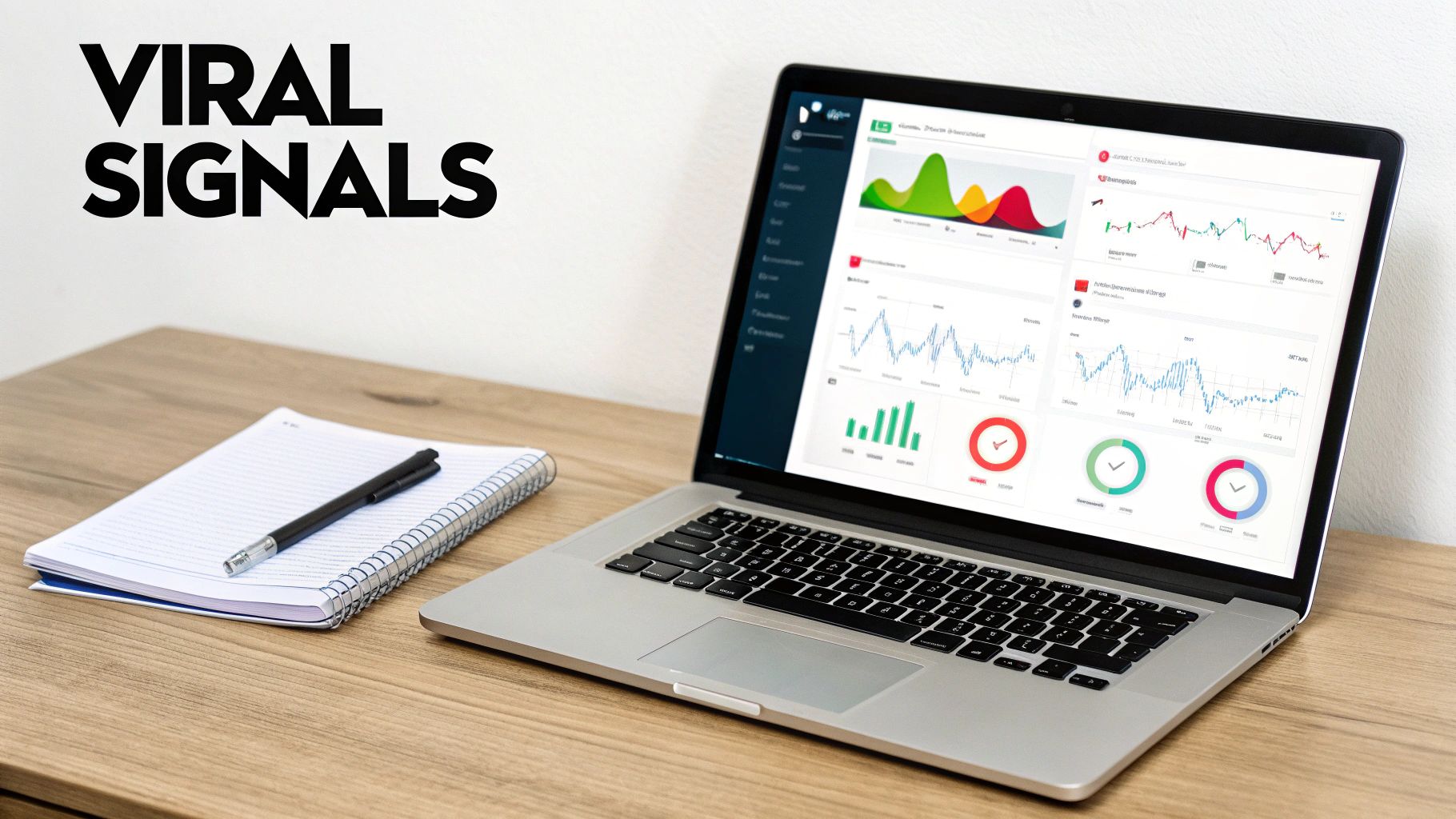
Finding a video that’s already trending is one thing. The real magic, though, is learning to spot a video’s viral potential before it explodes. This is where you shift from just watching TikTok to actively analyzing it. You start to see the hidden signals that tell you which clips are about to take off.
The TikTok algorithm is obsessed with engagement velocity—how fast a video racks up likes, comments, and shares right after it's posted. A video that’s only a day or two old with a sudden surge in shares is a much stronger signal than an older clip with millions of views that have flatlined. You're looking for acceleration, not just big numbers.
The Metrics That Really Matter
Forget raw view counts for a second. The ratios between different metrics tell you so much more about how an audience is really reacting to a video.
A key one is the like-to-view ratio. On average, a video gets a like for about 4% of its views. But the ones poised for takeoff? They often hit a 5-10% like-to-view ratio, showing that people aren't just watching—they're genuinely enjoying it. These videos almost always have an incredible hook, too, keeping viewers watching for over 70% of the duration. That completion rate is a massive green light for the algorithm.
Another powerful indicator is the comment section. A high number of comments shows the content is sparking a real conversation, not just passive scrolling.
Don't just count the comments; you have to actually read them. Are people asking follow-up questions? Are they tagging their friends? Or are they just adding to the joke? That kind of active, positive engagement is gold.
To help you get into the habit of checking these signals, I've put together a quick reference table. Use this checklist whenever you find a video you think might have some legs.
Viral Potential Signal Checklist
| Signal Category | What to Look For | Why It Matters |
|---|---|---|
| Engagement Ratios | Like-to-view ratio above 5%; High comment-to-like ratio. | Shows the audience is actively enjoying and discussing the content, not just passively watching. |
| Velocity & Timing | A recent video (1-3 days old) with a sudden spike in shares or saves. | Indicates momentum. The algorithm favors fresh content that's gaining traction right now. |
| Watch Time | An estimated completion rate over 70%. Look for comments like "watched this 5 times." | High watch time is one of the strongest signals to the algorithm that the content is valuable. |
| Audience Actions | High number of Saves or Shares. | Saves signal high-value, evergreen content. Shares show the video is relatable and transferable. |
Looking at these signals consistently will train your eye to spot opportunities that others miss. It's the difference between chasing trends and starting them.
Breaking Down the Creative DNA
Numbers only tell half the story. To truly understand why something is working, you have to dissect the creative elements. This is how you figure out what you can borrow and adapt for your own content.
When you find a video that’s hitting all the right metric signals, run it through this quick creative audit:
- The First 3 Seconds: What's the hook? Is it a bold statement on screen? A weird visual that makes you do a double-take? A question that you just have to know the answer to?
- The Sound: Is it a brand-new sound that’s just starting to get traction, or a popular one being used in a clever new way? Always check how many other videos are using the same audio.
- The Story Arc: Is there a clear beginning, middle, and end? Think about classic narrative structures like a problem-and-solution, a surprising transformation, or a satisfying "before and after" reveal.
Let’s take a #BookTok video as an example. If you see one with an unusually high save rate, you know people find the book recommendation so valuable they want to come back to it later. Or think about a simple DIY video with a ton of shares—that tells you the idea is easy enough for others to try themselves.
By combining the data with the creative breakdown, you start to see the full picture of what truly makes a TikTok video go viral. You’re no longer just guessing; you’re decoding the formula.
Using Third-Party Tools for Deeper Insights
While TikTok’s native app is fantastic for a daily dose of inspiration, third-party platforms are the secret weapon for anyone serious about building a data-driven strategy. Think of them as your analytics command center, giving you a depth of insight the app just wasn't built to provide. These tools take your discovery process to the next level, turning a manual scroll-session into a targeted intelligence-gathering mission.
This is how you graduate from just seeing what's popular to truly understanding why. A solid TikTok video finder tool can track a sound's growth velocity, flagging which audio clips are picking up steam long before they hit the mainstream. That kind of foresight is invaluable for timing your content perfectly.
For example, I regularly use these platforms to get a complete picture of a competitor's content strategy over the last 90 days. I can pinpoint which of their videos popped off, which hashtags actually drove traffic, and what formats they're leaning into. That’s the kind of competitive intelligence you’ll never get from just scrolling your feed.
From Searching to Automated Discovery
The real power of these tools lies in their ability to monitor trends, hashtags, and competitors at scale. Instead of crossing your fingers and hoping the algorithm serves you something relevant, you can set up specific dashboards and alerts that deliver the most important intel right to you.
This systematic approach is a massive time-saver and takes the guesswork out of the equation. You can stop wondering if you’ve missed the boat on a trend and start making decisions backed by hard data. It completely flips your process from being reactive to proactive.
The best content strategies are built on a mix of qualitative and quantitative data. Your "For You" Page gives you the qualitative gut feeling, while third-party tools provide the quantitative proof to back it up.
What These External Tools Do Best
Most of these platforms are built to excel in a few key areas, giving any serious creator or brand a huge advantage.
- Advanced Trend Analysis: They don't just show you what's popular now; they provide historical data to map out the entire lifecycle of a trend, from emerging sounds and effects to viral challenges.
- Competitor Monitoring: You can keep tabs on specific accounts to see their performance metrics, top-performing content, and overall strategy. It’s like getting a peek at their playbook.
- Hashtag Performance Tracking: Go way beyond just seeing which hashtags are big. These tools can show you the average views and engagement for posts using a specific tag, helping you pick the right ones for maximum reach.
- Deeper Audience Insights: Some platforms even offer demographic and psychographic data about the audience engaging with certain topics or creators, helping you understand who you're really talking to.
Folding these tools into your workflow creates a powerful system for continuous discovery. If you want to dive in, a great starting point is learning more about how a dedicated TikTok trend tracker can automate a huge chunk of this research for you. Honestly, they’ve become an essential part of any modern creator's toolkit.
Turning Your Findings Into Actionable Content Ideas
Finding a video that’s taking off is just the first step. The real magic happens when you figure out how to translate that spark into something that feels genuine to your brand. So many people get this wrong—they just copy, they don't adapt. The goal here is to borrow the skeleton, not the soul.
Think of it like this: you're a chef who just discovered a new, wildly popular recipe. You wouldn't just serve the exact same dish, right? You'd take the core technique (the viral video's format) but use your own fresh, unique ingredients (your perspective, your niche, your product) to create something distinctly yours. This is how you bridge the gap between just watching trends and actually creating them.
Deconstruct the Viral Blueprint
Every video that pops on TikTok has a blueprint, and it's usually built on four key components. If you can learn to spot them, you'll understand why a video connected with so many people. It’s a simple framework that takes the guesswork out of the creative process.
Let's break down what to look for:
- The Hook: What grabs you in the first two seconds? Is it a controversial question flashed on screen? A visually jarring opening shot? A bold, unbelievable claim? This is what stops the scroll.
- The Format: What's the underlying structure? Is it a classic "day in the life," a "before and after" reveal, a point-of-view (POV) story, or a simple product demo?
- The Sound: What audio is driving the video? Is it a trending pop song, a funny snippet of dialogue, or an original sound that’s just starting to catch on? The audio is the engine that sets the mood and pace.
- The Emotional Trigger: How does the video make you feel? Is it hilarious, deeply satisfying, surprising, relatable, or maybe even a little inspiring? This invisible force is what compels people to share and comment.
Once you’ve identified these four pillars, you can start swapping out the original elements with your own.
Adapt, Don’t Duplicate
This is where your unique voice shines. You take that deconstructed blueprint and rebuild it for your audience.
Let’s say you stumble upon a viral "day in the life" video from a software engineer in Silicon Valley. The format is clear. The hook might be something like, "Here's what a $200k/year tech job really looks like." The sound is a chill, lo-fi beat that makes it feel aspirational.
Now, imagine you’re a landscape gardener. You can lift that entire structure.
Your version would look like this:
- Hook: "Here's what a day of transforming messy backyards really looks like."
- Format: The same quick cuts and "day in the life" style.
- Sound: Use the exact same calming, lo-fi track to create a satisfying, transformative vibe.
- Emotional Trigger: You're still tapping into that "satisfying" or "aspirational" feeling, but you’ve made it relevant for a completely different audience.
You’ve kept the proven framework but created something totally new and authentic to your world.
Chasing huge, mainstream trends is smart, but don't sleep on the power of niche communities. Their trends might be smaller, but the audiences are often way more engaged. For instance, #BookTok has racked up over 200 billion views, and data shows that collaborative videos can pull in 31% more engagement on average. You can dig into more of these TikTok video statistics on browseract.com.
This method is a repeatable system that works for any industry. You can repurpose a trending sound from a comedy sketch for a satisfying product unboxing. You can adapt a "top 3 mistakes" format from a financial advisor to talk about fitness.
Tools like Viral.new are even starting to automate this. Instead of you having to manually break down every trend, the platform analyzes what's working and gives you ready-to-shoot video prompts tailored to your brand. It can turn hours of research into a simple, actionable plan you can use every day.
Building Your Weekly Trend-Spotting Workflow
To really succeed on TikTok, you need a system. Relying on random scrolling for inspiration is a surefire way to burn out. A structured weekly workflow, on the other hand, transforms trend-spotting from a time-sucking chore into a strategic advantage.
The goal isn't to spend more time on the app, but to make your time more effective. A simple, repeatable rhythm keeps your content pipeline full and ensures you're consistently tapping into what's relevant right now.
A Simple, Repeatable Trend Workflow
Here's a straightforward schedule you can adapt to fit your own needs. The key is consistency.
- Monday: Check your curated For You Page and scan any third-party trend alerts you've set up. Look for emerging sounds and video formats that are just starting to gain traction.
- Tuesday: Pick one high-potential trend from your list and break it down. Figure out what makes it work. Then, brainstorm 3-5 unique ways you can apply it to your specific niche.
- Wednesday: Block out time to batch-film your content for the week. With your ideas already mapped out, you can get it all done in one focused session.
This isn't just about getting views; it's about turning engagement into real results. Consider this: in the U.S. alone, users spend an average of 52 minutes on TikTok every day. Half of all social shoppers on the platform make a purchase every month. In fact, TikTok Shop brought in $5.7 billion from 11.9 million new buyers. You can dig deeper into these numbers over at browseract.com.
This simple flow chart really nails down the deconstruction process.
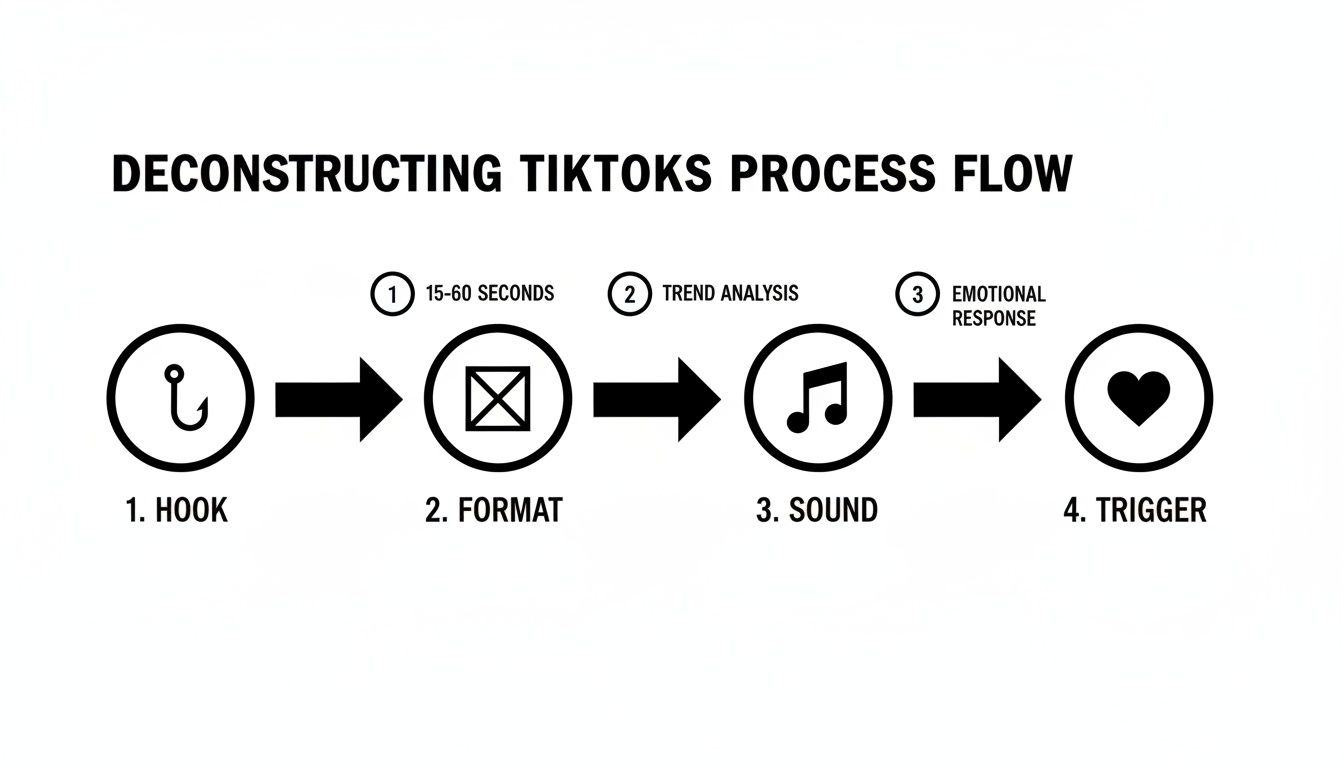
The big takeaway here is that every single viral video can be reverse-engineered. They all share four fundamental building blocks: the hook, the format, the sound, and the emotional trigger.
By focusing on this repeatable workflow, you spend less time searching and more time creating. The most time-consuming part—finding and deconstructing trends—can be automated, giving you back precious hours to focus on what truly matters: building your brand.
Answering Your Top Questions
Even with the best tools and a solid plan, a few practical questions always pop up. Let's tackle some of the common things I hear from creators who are trying to lock down their next great video idea.
How Often Should I Be Hunting for New TikTok Trends?
TikTok trends have a notoriously short shelf life, so you have to stay on top of them. I've found a two-part rhythm works best.
Try a quick, 15-minute daily scan of your FYP and your go-to trend-spotting tools. This is all about staying nimble and catching those fast-moving sounds or challenges before they fizzle out.
Then, block out about an hour once a week for a more serious deep dive. This is your time to analyze everything you've flagged and thoughtfully map out your content calendar.
Will I Get in Trouble for Using Someone Else's Idea?
This is a big one. There's a difference between being inspired by a trend and straight-up copying someone's work. The good news is that TikTok's culture is built on a shared language of sounds, formats, and challenges. Hopping on a trend is exactly what you're supposed to do.
The key is adaptation, not duplication.
You want to take the core idea and put your own spin on it. Filter it through your unique niche, your voice, and your personality. Your goal is to contribute to the trend, not just repeat what someone else already did. And it goes without saying: never, ever re-upload another creator's video without their explicit permission.
Your best bet is to make the trend so uniquely yours that no one could mistake it. The format might be borrowed, but the humor, the insight, or the value you bring should be 100% original. This keeps you in the clear while still letting you ride a wave of viral momentum.
Should I Stick with TikTok’s Native Search or Use a Third-Party Tool?
Honestly? You need both. They serve two very different, but equally critical, functions. Any creator serious about finding winning TikTok video ideas should have a workflow that includes both.
Think of it this way:
- Native Search & Your FYP: This is for gut-feel, real-time discovery. It’s a direct line into what the algorithm is pushing right now. Perfect for daily inspiration and getting a feel for the platform's current vibe.
- Third-Party Tools: This is where you get your data. These tools are crucial for tracking a trend's growth over time, seeing what your competitors are up to, and spotting opportunities before they've hit their peak. This is for your weekly strategy sessions.
Stop guessing what will go viral. Viral.new delivers fresh, niche-specific TikTok ideas to your inbox daily, turning trends into ready-to-shoot video prompts. Start your free trial at https://viral.new and never run out of content ideas again.
