
Social listening is your secret weapon for growing customer advocacy. It's the difference between shouting into the void and actually being part of the conversation. By tuning into what people are saying, you can find your happiest customers, engage with them meaningfully, and give them a reason to shout your praises from the rooftops. This isn't about manipulation; it's about building real relationships and turning positive experiences into authentic, trusted endorsements that actually drive growth.
From Data Points to Brand Champions
Too many businesses treat social media like a one-way street—a place to blast out marketing messages. They get caught up chasing vanity metrics like likes and followers, completely missing the goldmine of unstructured conversations happening every single day. The real magic of listening is that it forces you to shift from broadcasting to understanding. You stop just counting mentions and start digging into the why behind what people are posting.
At its core, social listening means actively tracking mentions of your brand, your competitors, and the keywords that matter to your industry. It’s not just about keeping an eye on your @mentions. It's about finding those untagged conversations and getting a feel for the real-world context of how people talk about you.
Turning Feedback into Fuel
Every single post—good or bad—is a chance to do something great. A glowing review is a bright, flashing sign that you've got a potential advocate just waiting for a high-five. And a complaint? That’s an opportunity to show you care and deliver some truly exceptional service.
In fact, research shows that simply answering a complaint on social media can boost customer advocacy by as much as 25%. When you jump on issues quickly and with real empathy, you can often turn a frustrated customer into one of your most passionate supporters. You can dig deeper into how responsiveness builds loyalty with these insightful social listening statistics.
This entire process gives you a direct line to what your customers need, what they think of your product, and even what content they want to see. When you listen, you learn to speak their language.
The goal isn’t just to respond; it’s to show you’re listening. When customers feel heard, they feel valued. That feeling of value is the bedrock of genuine advocacy.
To help you connect the dots, here’s a quick look at how specific listening actions can directly lead to powerful advocacy outcomes.
How Listening Directly Fuels Advocacy
| Social Listening Action | Advocacy Outcome |
|---|---|
| Finding untagged positive mentions | Discovering and engaging with "hidden" happy customers who become potential champions. |
| Responding quickly to complaints | Turning a negative experience into a positive one, often creating a loyal, vocal supporter. |
| Monitoring competitor conversations | Identifying your unique strengths from the customer's POV and finding opportunities to shine. |
| Tracking industry keywords & trends | Creating timely, relevant content that resonates and gets shared by your community. |
| Sharing User-Generated Content (UGC) | Making customers feel seen and valued, encouraging others to share their own experiences. |
By building these practices into your strategy, you're not just reacting—you're proactively building a community of trust and credibility that no amount of advertising can buy. This guide will give you the framework to make that happen.
Building a Listening Framework to Find Advocates
If you want to find your future brand advocates, you first need a system built to actually hear them. This means going way beyond just tracking mentions of your brand handle. A solid listening framework is your radar, constantly scanning for the signals that point to your biggest fans.
Think of it like casting a net. A basic setup only catches fish that jump right into the boat—the people who directly tag you. What you really want is a smarter, wider net that captures everything else. That means setting up your listening queries to include more than just your brand name.
- Common misspellings and abbreviations of your brand and products. You'd be surprised how often this happens.
- Branded hashtags from your campaigns or community discussions.
- Industry keywords related to the problems your product solves. This helps you find people looking for a solution like yours.
- Competitor brand names to see conversations where customers are comparing you, or even better, choosing you over them.
Selecting the Right Channels and Tools
Don't try to listen everywhere at once; you'll just drown in noise. Zero in on the platforms where your audience is most active and honest. For a direct-to-consumer brand, that might be TikTok and Instagram, where unboxing videos and candid reviews thrive. If you're a SaaS company, you'll likely get more mileage out of monitoring specific subreddits, LinkedIn, and Twitter threads where people are hunting for technical advice.
Picking the right social listening tool is a make-or-break decision. You need a platform with features that genuinely support your advocacy goals. For me, powerful sentiment analysis is non-negotiable. It’s the fastest way to sift through thousands of mentions and instantly separate the happy cheerleaders from the frustrated customers who need help.
This whole process is actually pretty straightforward when you break it down: listen for the right signals, understand the context behind them, and then give those happy customers a megaphone.
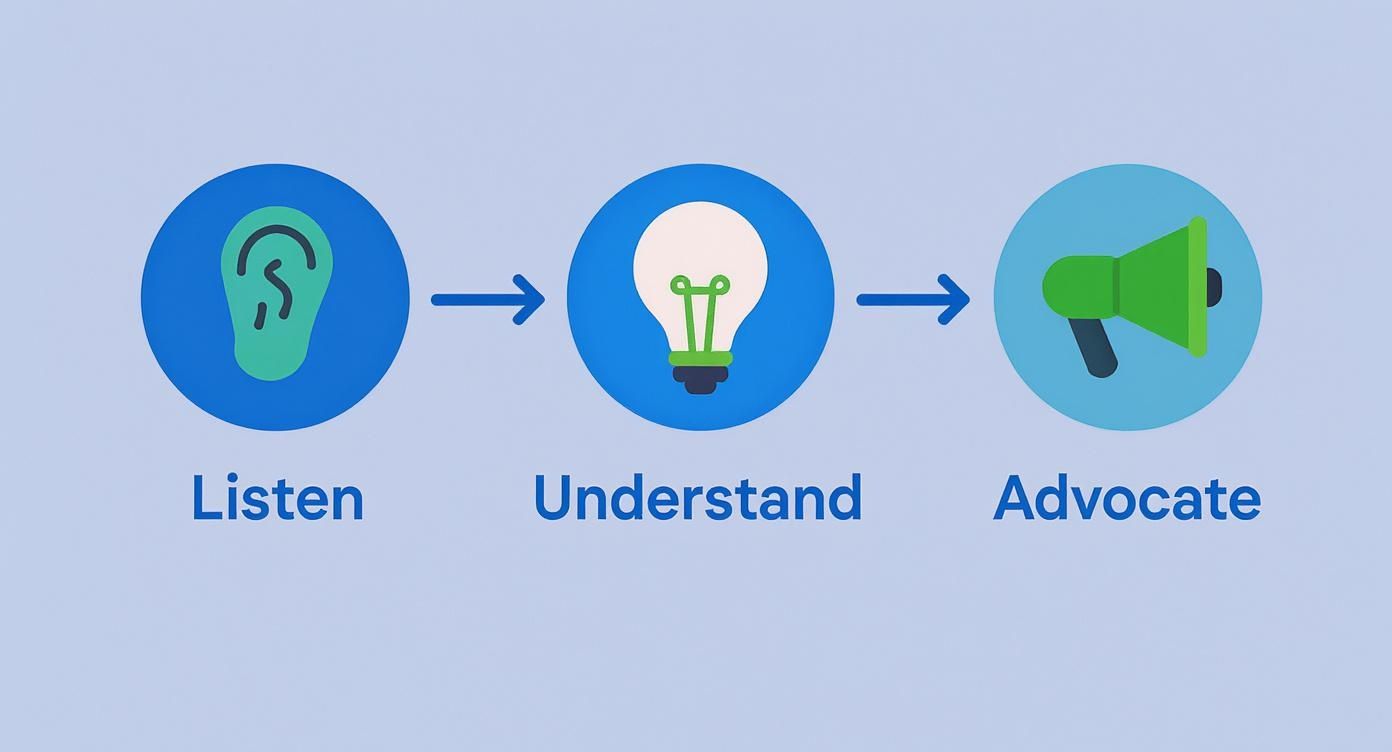
The key thing to remember is that advocacy isn't random. It’s the natural result of a deliberate process of listening and understanding.
The best brands use sentiment analysis to flag both glowing praise and sharp criticism. This lets them jump on opportunities to celebrate with happy customers and, just as importantly, step in to help unhappy ones, sometimes turning a bad experience into a story of incredible customer service. By learning from these conversations, they're constantly optimizing their customer journeys with social insights and building real brand loyalty.
Crafting Sophisticated Queries
Once you've chosen your tool, like a Talkwalker or a Brandwatch, the quality of your insights comes down to the quality of your queries. It's time to move past basic keyword tracking and get comfortable with Boolean logic.
For instance, a food and beverage brand could set up a query that looks something like this: ("our brand name" OR #ourbrandhashtag) AND ("love this" OR "obsessed" OR "game changer") NOT ("competitor brand name").
This simple string of logic filters out the irrelevant noise and pinpoints highly positive, untagged mentions—which are often the most authentic and powerful signals you can find.
Your goal isn't just to collect mentions; it's to surface conversations that signal high emotional investment. These conversations are the starting point for building real, lasting relationships with your most passionate customers.
How to Identify Your Future Brand Champions
Okay, so you've got your social listening dashboards up and running, and the positive mentions are starting to roll in. It's easy to get caught up in the excitement of every nice comment, but the real magic lies in spotting the people who are on the verge of becoming true brand champions.
The trick is learning to tell the difference between a casual compliment and a signal of genuine, invested passion.
A future advocate isn't just someone who says they like your new product. They're the person who, completely unprompted, posts a TikTok tutorial showing everyone else how to use it. They’re the one who jumps into a heated Reddit thread to defend you, armed with their own positive experience. These actions reveal an emotional investment that a simple "like" just can't match.
Spotting High-Potential Advocacy Signals
Your listening tool is going to throw a lot of data at you. Your job is to filter out the noise and find the signals that really matter. You're looking for specific behaviors that show someone is more than just a happy customer—these are the green flags of authentic advocacy.
Keep an eye out for these patterns:
- Unsolicited Positive Reviews: I'm talking about the detailed, thoughtful reviews that pop up on places you don't own, like personal blogs, forums, or deep in a subreddit. This is pure, trusted social proof.
- Proactive Helpfulness: Notice users who answer other people's questions about your products on X (formerly Twitter) or in Facebook groups. They're essentially acting as free, passionate customer support. That's a huge tell.
- Brand Defense: Pay very close attention when someone steps up to correct misinformation or defend your brand against criticism. This shows they feel a personal connection and a sense of shared identity with you.
- Consistent Engagement: A one-off positive comment is great, but it's the person who consistently shares your posts, tags their friends, and joins the conversation who has long-term potential.
True advocates don't just consume your content; they add to the conversation around it. Their actions are voluntary, passionate, and driven by a genuine belief in your brand. That's the difference between a fan and an ally.
Segmenting and Prioritizing Your Advocates
Not all advocates are created equal, and that's perfectly okay. Recognizing their different strengths is the key to engaging them effectively. Someone who's a power user in a niche forum providing in-depth technical answers has a different kind of value than a lifestyle creator on Instagram with a massive-but-broad audience.
You need both, but you can't approach them the same way.
To make this manageable, create a simple tier system for the potential champions you find. This helps you stop guessing and start building strategic relationships that feel right for everyone involved.
| Advocate Tier | Key Characteristics | Engagement Goal |
|---|---|---|
| Casual Supporter | Likes and shares content occasionally; leaves positive comments. | Acknowledge and thank them to encourage repeat engagement. |
| Vocal Fan | Creates original content (UGC), actively recommends the brand, answers peer questions. | Feature their content, offer exclusive access, build a personal connection. |
| Super Advocate | Defends the brand, has significant niche influence, consistently drives conversation. | Treat them like a VIP partner; involve them in feedback and co-creation. |
By sorting your advocates this way, you move away from a generic, one-size-fits-all strategy. Instead, you're investing your time and energy where it will have the biggest impact, nurturing the relationships that will become the most powerful and authentic voice for your brand.
Engaging Advocates Without Being Transactional
Okay, so you've used social listening to find the people who genuinely love your brand. This is the moment of truth. How you approach them next can either build a powerful, long-term relationship or make them feel like just another cog in your marketing machine.
The biggest mistake I see brands make is shifting immediately into a transactional mindset. They see an advocate and think, "How can I get more out of them?" That's the wrong approach entirely. You need to think relationally.
The best currency you have isn't money; it's empowerment. It’s about making these fans feel seen, heard, and deeply appreciated. A generic, automated "Thanks for the share!" is worse than saying nothing at all. People can spot a low-effort, copy-paste reply instantly, especially on platforms like TikTok where authenticity is everything. Your goal is to create a moment of genuine connection that makes them feel good about their decision to support you.
Moving Beyond Generic Replies
Let’s get practical. Authentic interaction means throwing out the script. When you see a positive post, don't just hit the like button and move on.
Leave a real, specific comment that proves you paid attention. If someone created a clever video showing off your product, comment on their creativity or ask a question about their technique. This simple, personal touch shows there’s a real human behind the brand logo, and it makes all the difference.
Here are a few high-impact ways to do this that don't cost a thing:
- Surprise and Delight: Slide into their DMs with a simple, unexpected thank you. No ask. No pitch. Just pure, unadulterated appreciation for their support.
- Amplify Their Voice: This is huge. Ask for permission to feature their post, video, or photo on your official channels (with full credit, of course). It’s a massive validator for them and gives you incredible user-generated content (UGC).
- Offer Exclusive Access: Got a new feature or product in the works? Give your top advocates a sneak peek. This makes them feel like trusted insiders and deepens their connection to your brand's journey.
Don't underestimate the power of these small interactions. A Brand24 analysis found that 44% of people believe brand conversations—like direct replies and DMs—are more important than what a brand says in its paid ads. These touchpoints build real trust and show you actually value the two-way conversation, which is the core of how social media listening increases customer advocacy.
Advocate Engagement Tactics Comparison
Choosing the right way to engage depends on your goal and the advocate's platform of choice. Some tactics are great for quick validation, while others are designed to build deeper, collaborative relationships. This table breaks down a few common approaches.
| Tactic | Best For | Platform Example | Advocacy Impact |
|---|---|---|---|
| Personalized Comments | Quick, genuine acknowledgment and validation | Instagram, TikTok | High (Shows you're listening and value their content) |
| UGC Amplification | Showcasing advocate content and building social proof | Twitter, Instagram Stories | Very High (Provides exposure and makes them feel like a star) |
| Exclusive Access | Rewarding top-tier advocates and fostering loyalty | Private Slack, Discord, Email | Very High (Creates a feeling of being a valued insider) |
| Co-Creation Projects | Deepening relationships and generating unique content | TikTok (Stitch/Duet), YouTube | Highest (Turns advocates into true partners and collaborators) |
Ultimately, a mix of these tactics will create a well-rounded program. The key is to match the engagement to the advocate's level of enthusiasm and contribution.
Co-Creation and Community Building
Ready to take it to the next level? Invite your advocates directly into your creative process. Co-creation is the ultimate form of engagement because it transforms passive fans into active collaborators.
For example, if you run a social media tool like Viral.new, you could invite a power user who's killing it on TikTok to co-host an Instagram Live about content strategy. They get exposure to your audience, and you get an authentic expert to share valuable insights.
Another fantastic approach is to make their stories part of your brand’s story. Stitch a fan's glowing TikTok review with a "thank you" video from your team. Compile a highlight reel of your favorite user testimonials. This puts your advocates in the spotlight, making them the heroes of your brand narrative.
The most effective advocacy programs are built on a foundation of mutual respect and shared value. When you empower your advocates to share their voice, you're not just gaining a promoter; you're building a stronger, more resilient brand community.
Measuring the Real Impact of Your Advocacy Program
Engaging with your brand advocates is great, but let's be honest: if you can't prove it's helping the business, it's just a vanity project. To show the real value, you have to move past basic metrics like likes and follows and dig into the data that connects social listening directly to growth.
The first move is to stop treating all brand mentions as equal. Go into your listening tool and create specific segments that separate chatter from your identified advocates from the general noise. This one simple step gives you a game-changing metric: advocate share of voice. You can finally see what percentage of the positive conversation is being driven by your actual champions. It's the clearest sign of whether your engagement efforts are paying off.
Tracking What Truly Matters
To get a clear picture of your program's ROI, you need to zero in on metrics that link back to core business goals. These are the numbers that show the tangible value your advocates are delivering every day.
Here are a few metrics I always keep a close eye on:
- Reach of User-Generated Content (UGC): When an advocate posts, how far does it travel? Tallying up the total reach of their content shows you the raw earned media value you’re getting for free.
- Referral Traffic: Get smart with trackable links. Whether you're sharing links directly with advocates or they’re linking out on their own, using UTM parameters is non-negotiable. It’s the only way to know precisely how much traffic is coming from their efforts.
- Sentiment Shift: Keep a running tally on your brand's overall sentiment. As you nurture your advocate community, you should see a clear, measurable lift in positive mentions compared to negative ones.
Your measurement dashboard isn't just a place to dump charts. It needs to tell a story. That story is about how turning happy customers into vocal fans directly strengthens your brand and boosts your bottom line.
Creating a Feedback Loop
The data you gather is useless if it just sits in a report. You have to use it to inform your strategy, creating a continuous feedback loop.
For instance, if you see that UGC from advocates on TikTok is sending a ton of referral traffic your way, that’s your green light. Double down. You could launch a campaign encouraging more TikTok content or start featuring the best advocate videos on your own channels.
This is the secret sauce. This is how social media listening can increase customer advocacy for the long haul. By measuring what works, you can fine-tune your strategy, pour your resources into the right places, and consistently prove the incredible value of building real relationships with your biggest fans.
Common Questions About Social Listening for Advocacy
Jumping into social listening to find brand advocates can feel like a big undertaking, and it’s natural for questions to pop up. Let's walk through some of the most common ones I hear from teams who are just getting started. Getting these answers straight is the key to building a program that actually works and doesn't burn out your team.
What’s the Real Difference Between Social Listening and Social Monitoring?
This is probably the most frequent question, and it's a good one. It's easy to get them mixed up, but the distinction is crucial.
Think of social monitoring as the day-to-day, reactive stuff. It's about catching individual mentions and responding directly. It’s your community manager answering a support question on X or your social team thanking someone for a nice comment. It's essential for keeping the lights on.
Social listening, on the other hand, is proactive and strategic. You're zooming out to analyze the entire conversation happening around your brand, your industry, and your competitors. It's less about the individual trees and more about understanding the whole forest—spotting trends, gauging sentiment, and finding those golden opportunities you would have otherwise missed.
Monitoring is about keeping the ship steady day-to-day. Listening is what helps you chart the course for where you’re headed next.
How Do I Start an Advocacy Program if I Have No Budget?
Good news: you don't need a massive budget or a pricey enterprise-level tool to get the ball rolling. In the beginning, consistency is far more valuable than complexity.
Start by getting your hands dirty with some manual searches. Head over to the platforms where your people actually hang out—think TikTok, specific subreddits, or X (formerly Twitter)—and search for your brand name, product names, or even common problems your product solves.
You can also set up free tools like Google Alerts to get an email whenever you're mentioned on a blog or forum. The initial goal is simple: find just a handful of people already saying good things and strike up a real conversation. A genuine thank-you note or a simple reshare of their content costs nothing but can be the first step in building a truly powerful relationship.
What if a Potential Advocate Posts Something Negative?
It can feel like a punch to the gut when someone you see as a potential advocate shares negative feedback. But take a deep breath, because this is actually a pivotal moment. How you respond can either cement a loyal fan for life or lose them forever.
The best move is to address their concern publicly and quickly. Acknowledge their frustration, show some empathy, and take ownership of the issue right there in the comments.
Then, immediately try to move the conversation to a private channel like DMs to sort out the specifics and fix their problem.
This is a golden opportunity. Addressing negative feedback with empathy and resolving it effectively often turns a critic into your most vocal supporter. You’ve proven you listen and care, transforming their story from a problem into a testament to your excellent support.
When you nail this, their story changes completely. Research shows customers are 2.4 times more likely to stick with a company when their problems are solved quickly. You're not just fixing a bug; you're building serious, long-term loyalty.
Ready to stop guessing what will go viral? With Viral.new, you get AI-powered TikTok ideas based on current trends delivered to your inbox daily. Spend less time brainstorming and more time creating content that connects. Discover your next hit video at https://viral.new.
