
Slapping #fyp or #viral onto your video caption and calling it a day isn't going to cut it. A killer TikTok hashtag strategy is all about the mix—blending high-traffic tags with super-specific niche and community ones. This is how you tell the algorithm exactly who needs to see your content. It’s the difference between shouting into the void and speaking directly to your target audience.
Why Your Hashtag Strategy Needs a Rethink
Let’s get real for a second. If your "strategy" is just tossing a few popular tags on a video and hoping it sticks, you don't have a strategy at all. So many creators treat hashtags like an afterthought, a random dash of keywords they hope will magically catch the algorithm's eye. This is a one-way ticket to inconsistent views and frustratingly slow growth because it completely misses the point of what hashtags actually do.
Hashtags aren't just decorative labels; they're powerful sorting mechanisms. They give the TikTok algorithm critical context to figure out:
- What your video is about: The most fundamental job—categorizing your content. Is it a recipe, a comedy sketch, a DIY tutorial?
- Who your video is for: This is crucial. It helps connect your content with users who have already watched, liked, or engaged with similar topics.
- Which communities to show it to: Tags like #BookTok or #CleanTok drop your video right into the laps of active, highly engaged niche communities hungry for that specific content.
Moving From Guesswork to Growth
I see this mistake all the time: people just copy and paste the hashtags from a video that went viral. But think about it—if you run a local coffee shop, a trending dance challenge hashtag is useless unless you're actually doing the dance in your shop. Using irrelevant tags just confuses the algorithm and can actually torpedo your video's initial push.
The goal here is to stop being reactive—chasing whatever trend is hot today—and start being proactive. You want to intentionally choose hashtags that line up perfectly with your content, your brand, and the audience you want to attract. This is how you build real, sustainable growth, not just pray for a one-off viral hit.
This guide will change how you look at hashtag trends on TikTok. You'll stop seeing them as a lottery ticket and start seeing them as a language you can learn to speak fluently. We’re going to break down how to spot the trends that actually matter for your niche, figure out the intent behind them, and weave them into your content from the very start.
Once you get a handle on how these signals work, you can build a much more reliable path to reaching the right people every single time. And when you're ready to really go deep on the numbers, you can explore our guide on TikTok hashtag analytics to get even sharper with your choices.
Getting Ahead of the Curve: How to Spot Hashtag Trends Before They Explode
The real magic on TikTok happens when you catch a trend on its way up, not after it has already peaked. If a hashtag is everywhere, you're probably late to the party. Spotting trends early is about shifting your mindset from a passive scroller to a strategic analyst, giving your content a massive head start.
Think of your 'For You' Page (FYP) as a personalized trend forecast. Sure, it's for entertainment, but it's also a direct reflection of what's gaining traction right now. When you notice the same sounds, video styles, or specific phrases popping up repeatedly in one session, pay attention. Those are the early signs of an emerging trend.
Look at the Data with TikTok's Own Tools
For a more concrete approach, it’s best to go straight to the source. The TikTok Creative Center is a goldmine of information, and it's completely free. It shows you exactly what’s trending in real-time, backed by actual data.
You can filter everything by region and industry to see which hashtags, sounds, and even creators are picking up steam over the last 7, 30, or 120 days. This is how you confirm if those patterns you're seeing on your FYP have real momentum or are just a fluke.
Pro Tip: Don't just fixate on the hashtags with billions of views. Keep an eye on the "breakout" tags—the ones showing a sudden, sharp spike in growth. That's your sweet spot for jumping on a trend before it gets crowded.
Moving from just guessing at hashtags to building a real strategy is what separates stagnant accounts from those that see real growth.
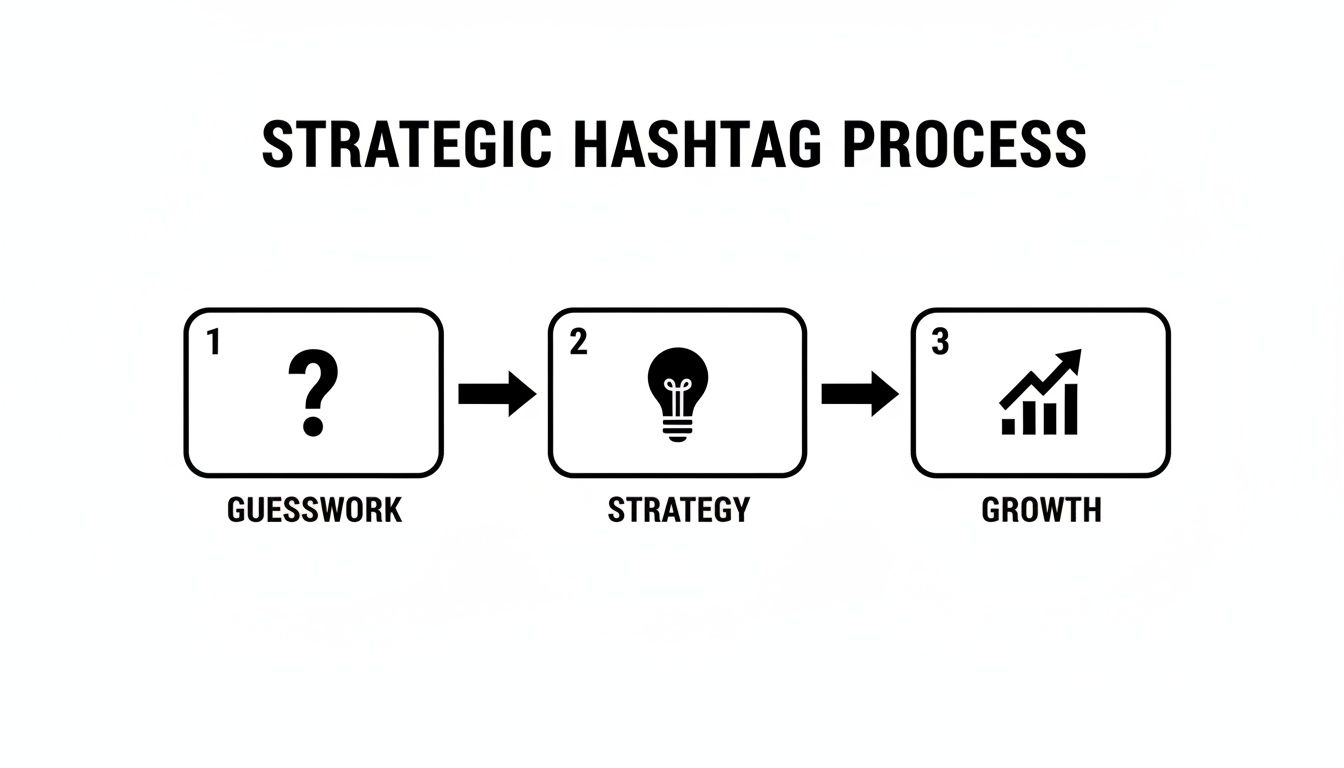
This process makes it clear: strategic, data-informed decisions are the only way to get measurable results. You have to leave the guesswork behind.
Study What the Pros Are Doing
Another trick I use is to see what the top creators in my niche are up to. Don't just watch their videos that went viral; look at their newer or less popular ones, too. What are they experimenting with? Big creators are often the first to try new formats or hashtags, and their experiments can be a sneak peek of what's about to blow up.
Finally, let the search bar guide you. When you type in a core topic like "home organization," TikTok will autocomplete with related searches. These suggestions often point to clusters of related, up-and-coming hashtags that people are actively looking for. It’s a direct window into what your audience wants to see.
The undisputed king of all hashtags is #FYP, your main ticket to the For You Page, which has an incredible 55.4 trillion views. To put that in perspective, the next closest is #ForYou with 31.7 trillion views, and #Viral comes in at 21.7 trillion. The reach of #FYP is almost double its nearest competitor.
To make the most of these trends, you need a balanced approach. Using a mix of different hashtag types helps you reach a broad audience while still attracting your ideal followers.
Hashtag Categories for a Balanced Strategy
| Hashtag Type | Description | Example | Strategic Goal |
|---|---|---|---|
| Broad/Trending | High-volume, general tags related to a current trend. | #trendingsong, #viralvideo | Maximize immediate reach and visibility. |
| Niche-Specific | Tags that directly relate to your industry or content. | #smallbusinessowner, #potterytiktok | Attract a highly relevant, engaged audience. |
| Community-Based | Tags that connect you to a specific subculture on TikTok. | #BookTok, #CleanTok | Build community and foster a loyal following. |
| Branded | A unique tag for your brand or a specific campaign. | #YourBrandChallenge | Drive user-generated content and track campaign performance. |
Combining these categories gives your content the best chance to be discovered by both a wide audience and the specific people who will become loyal fans.
Ultimately, knowing how to spot trends is just one piece of the puzzle. You also have to build content that can ride that wave, which is how you can consistently boost TikTok views and go viral.
By mixing these methods, you'll develop a solid system for catching trends early. For a deeper dive, check out our complete guide on TikTok trend discovery.
Deciding Which Trends Align with Your Brand
Look, jumping on every single trend that blows up on TikTok feels like a smart move. It’s tempting. But chasing every viral dance or audio can seriously mess with your brand message and leave your audience scratching their heads. The real skill is shifting from just participating in hashtag trends on TikTok to strategically picking the ones that actually make sense for who you are.
It all starts with figuring out the intent behind the trend. Why are people making these videos? Is it just for a laugh, like a new comedy skit format? Is it to teach something, like the whole #LearnOnTikTok movement? Or is it about building community, like #smallbusinesstok? Once you understand the "why," you can decide if you can genuinely add to the conversation without looking like you're trying too hard.
The Brand Alignment Checklist
Before you even think about hitting that record button, you need a quick gut check. This isn't about being a buzzkill; it's about protecting the brand you've worked hard to build. A badly chosen trend feels forced and out of touch, which honestly is way worse than just sitting one out.
So, ask yourself these questions every single time:
- Does this actually sound like us? If your brand voice is normally serious and professional, a goofy prank trend is going to feel weird and jarring.
- Will our audience even get it? If a trend is built around a super niche reference that your target customer has never heard of, your video is going to completely miss the mark.
- Can we bring something new to the table? Don't just copy the trend. Can you put your own unique spin on it that showcases your industry knowledge or unique perspective?
Think about it this way: a financial advisor probably shouldn't be doing the latest viral dance challenge. It just doesn't fit. But they could absolutely crush a #MoneyTok trend by making a video on "3 Investing Myths Everyone Falls For." It uses a trending tag but reinforces their expertise and delivers real value. That’s the sweet spot.
Saying "No" is a Legitimate Strategy
Learning when to pass on a trend is just as crucial as knowing when to dive in. Trust me, trying to keep up with every viral moment is a one-way ticket to burnout and a feed that looks totally chaotic. Your goal isn't just to rack up views; it's to attract the right followers—the people who will stick around and become part of your community.
Every video you post is another brick in your brand's foundation. Does it make the whole thing stronger, or does it weaken it? A trend that doesn’t align with your core message is like using a crumbling brick. It might fill a gap for a moment, but it’ll compromise the whole structure down the line.
When you're selective, the trends you do participate in hit so much harder. They feel authentic and purposeful, which is the secret sauce for building trust and real engagement on TikTok. It’s all about the quality of your participation, not the quantity.
Weaving Hashtags into Your Content Strategy

The best TikToks are built around trends, not just decorated with them. Once you've found a hashtag that fits your niche, don't just tack it onto the end of your video description. Instead, think of it as the creative brief for your entire video—from the opening hook all the way to your call-to-action.
This means asking yourself, "What's the story here?" For instance, if #SmallBusinessSaturday is trending, a simple video of your product with the tag won't cut it. A much better approach is to tell the story behind your business. Show a day-in-the-life, introduce your team, or highlight what makes your brand genuinely unique. This way, your content feels native to the trend and part of the larger conversation, not just an ad trying to jump on the bandwagon.
Building Your Strategic Hashtag Stack
To really get your content seen, you need a balanced mix of hashtags. I like to call this a "hashtag stack," and the idea is to target different layers of the TikTok audience all at once. A solid stack isn't just a random collection of tags; it's a strategic blend.
Here’s how to think about building your own:
- Broad Reach Tags: These are the giants like
#fypor#viral. They cast the widest net possible, giving your video a shot at landing in front of a massive, general audience. - Niche-Specific Tags: These get granular, describing your content's topic with precision. Think
#HandmadeGiftsor#PotteryTips. This is how you connect with people actively searching for what you do. - Community Tags: These tap into established subcultures on the platform, like
#SmallBusinessTokor#BookTok. Using them signals that you're an active participant in that community. - Branded Tags: This is your signature hashtag, something like
#YourBrandChallenge. It helps build a library of your content and encourages your followers to create their own videos featuring your brand.
Let's say you're an artist launching a new print collection. A powerful hashtag stack might look like this: #fyp (broad), #ArtForSale (niche), #ArtistOfTikTok (community), and #NewPrintDropBy[ArtistName] (branded). Each one has a specific job, from attracting casual scrollers to engaging your most loyal fans. If you're struggling to brainstorm, a good TikTok Hashtag Generator can help you find the right mix.
A common mistake I see is creators relying only on massive, broad hashtags. While the potential reach is tempting, the competition is just insane. Your most engaged audience—the people who actually follow, comment, and buy—are often found through niche and community tags.
The power of hashtag trends on TikTok goes way beyond just getting views. Look at the music industry, where trends literally create global hits. An incredible 84% of songs that hit Billboard’s Global 200 first gained traction on TikTok. That’s a stunning example of how hashtags can take something from total obscurity to a chart-topping phenomenon.
Getting this blend right ensures your content isn't just shouting into the void. It’s a smart, targeted approach that puts your videos in front of the right people at the right time. For more ideas, you can always check out our guide to popular trending hashtags to see what top creators are doing right now.
Common Hashtag Mistakes That Hurt Your Reach

If your views have completely flatlined, take a hard look at your hashtag strategy. It's often the silent killer of great content. I've seen countless creators—even seasoned ones—fall into the same traps that confuse the algorithm and stop their videos from ever finding the right audience. Getting this right is absolutely crucial for any real growth.
One of the biggest mistakes is leaning entirely on mega-hashtags. Slapping #fyp or #viral onto your video and calling it a day is like trying to whisper in a football stadium. You're just one voice among millions, and unless you're already a huge creator, your content is going to get buried instantly.
The Problem with Irrelevant Tags
Another common pitfall is "hashtag hijacking"—using a popular but totally unrelated tag just to grab some eyeballs. For instance, putting #beautytok on your video about stock market trends sends a massive mixed signal to TikTok's algorithm.
Remember, TikTok’s entire job is to serve people content they'll actually watch. When your finance video gets pushed to a beauty enthusiast who immediately scrolls past, the algorithm flags it. It thinks your content is boring or misplaced, and it stops showing it to anyone.
This approach completely backfires. You end up trading a few fleeting, low-quality views for long-term reach. The algorithm rewards content that satisfies the audience it's shown to; irrelevant tags shatter that connection.
Fixing Your Strategy with Smart Adjustments
The good news is that these are all easy fixes. It's not about finding some secret hack, but about shifting your thinking from pure volume to precision and relevance. A balanced mix is what truly works.
Here are a few quick adjustments you can make to your very next video:
- Stop Hashtag Stuffing: More is not better. Overloading your caption with dozens of tags just looks spammy. Aim for a tight, focused set of 3-6 hashtags that perfectly describe your video and who it’s for.
- Pair Broad with Niche: You don't have to ditch #fyp completely. The trick is to pair it with specific, niche tags. A baker, for example, could use a powerful combo like
#fyp,#bakingrecipe, and#sourdoughtips. This targets a huge audience while also zeroing in on a passionate, engaged community. - Watch Out for Banned Tags: Certain hashtags are shadowbanned because they're linked to spam or inappropriate content. Using one can get your video suppressed without you even knowing. A quick Google search will pull up lists of known tags to steer clear of.
- Ditch the Engagement Bait: Tags like
#like4likeor#followmeare relics of the past. They don't work on TikTok, they attract bots and low-quality engagement, and they make your content look desperate.
By avoiding these rookie mistakes, you start feeding the algorithm crystal-clear signals about your content. That precision is what lands your videos on the For You Pages of people who will actually watch, engage, and follow, leading to real, sustainable growth.
Got Questions? Let's Talk TikTok Hashtags
Alright, so you've got the basics down, but when you're in the trenches, the little details matter most. Let's tackle some of the nagging questions that pop up when you're about to hit that "post" button. Getting these right can be the difference between a video that flies and one that flops.
So, How Many Hashtags Should I Actually Use?
This is easily the number one question I get. It's tempting to cram as many as you can into the caption, hoping one sticks, but that's a mistake.
The sweet spot is usually a tight, focused group of 3 to 6 hashtags. Think quality over quantity. Overloading your caption with a wall of tags just looks spammy, and worse, it can muddy the waters for the algorithm, leaving it confused about who your video is actually for.
Your best move is to create a balanced mix. I like to think of it as a small crew, with each hashtag having a specific role. For instance, if you're posting a video on making sourdough bread, your lineup could look something like this:
#fyp(For broad reach)#bakingrecipe(Targets a specific niche interest)#sourdoughforbeginners(Connects with a highly targeted community)
This strategy hits multiple audience segments at once, from the casual scroller to the dedicated beginner baker.
Whoops, Can I Edit My Hashtags After I Post?
Here's a hard and fast rule you need to remember: no, you cannot edit or add hashtags to a TikTok caption once it's live. The second you publish, those hashtags are set in stone.
This is why double-checking your work is so crucial. If you spot a glaring typo or realize you forgot a critical tag, your only real option is to delete the video and start over by re-uploading it with the right caption.
A word of caution: don't get into the habit of deleting and reposting. Doing it once in a while is fine for a major error, but repeatedly doing so can mess with your account's momentum. It's far better to just build the habit of proofreading your caption before you post.
Is It Okay to Reuse the Same Hashtags on Every Video?
I see this all the time, and it feels like an efficient shortcut, but it's one you should avoid. Copying and pasting the exact same block of hashtags on every video is a missed opportunity.
Tailor your hashtags to the specific content of each video.
Sure, you might have one or two core "brand" hashtags that show up often, but the full set should always be customized. Every video you create has a unique hook or angle, and your hashtags need to reflect that to give the algorithm clear, accurate signals about what's inside.
Sticking to the same old list can actually cap your reach because TikTok might see it as repetitive or lazy. By switching up your tags, you show the platform you're creating a variety of content for different people, which helps you break into new pockets of your audience.
Stop guessing what's trending and start creating with confidence. Viral.new delivers AI-powered, niche-specific video ideas to your inbox daily, so you always know what to film next. Get your personalized TikTok ideas today.
